229
Marc Newson
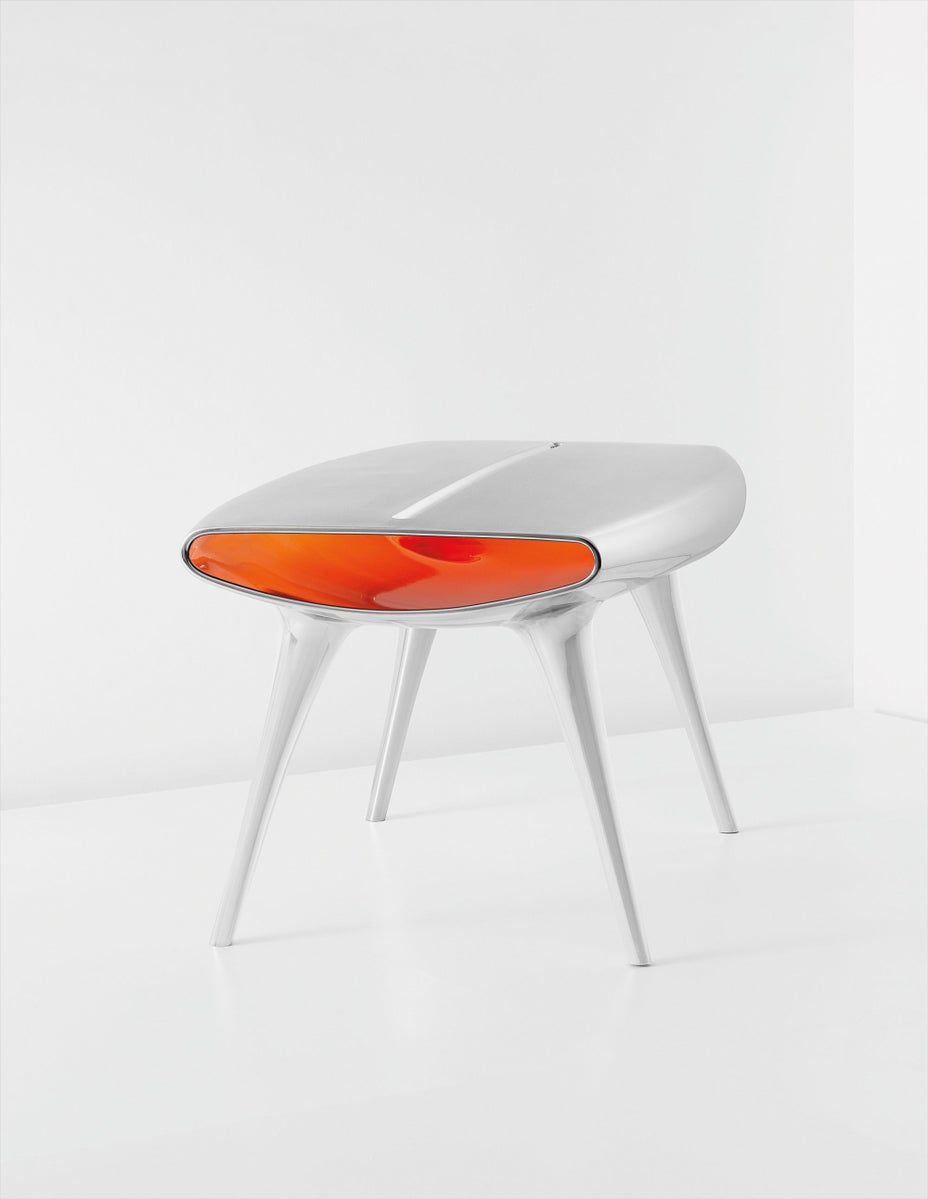
'Event Horizon Table'
Estimate
£100,000–150,000Ω︎
Sold For
£110,500
1992
Polished aluminium, painted aluminium.
81 x 180 x 96 cm (31 7/8 x 70 7/8 x 37 3/4 in)
Produced by POD Edition, UK. Number 6 from the edition of 10 plus 3 artist’s proofs, plus 1 yellow version (3 orange versions within the edition). Tabletop impressed with manufacturer’s logo and dated ‘MARC NEWSON POD EDITION EVENT HORIZON 1992’ and underside with ‘MARC NEWSON POD EDITION’, ‘POD’, ‘6 / 10’ and artist’s mark.
Full-Cataloguing
The 'Event Horizon Table' will be included as reference: MN - 13EHTR-1992; in the forthcoming catalogue raisonné of limited edition works by Marc Newson, being prepared by Didier Krzentowski, Gallery kreo, Paris.
With the Event Horizon Table, Newson was finally able to achieve what he had sought with the LC1 and the Lockheed Lounge: to work with aluminium as if it were a soft, bendable material, stretching it and warping it seamlessly. As a silversmith, he knew how to do this on a small scale, but had not been able to realise such a feat on the scale of a chair or table. Around 1990, he had a eureka moment: skilled coachbuilders could work with aluminium in such a way! He was able to make significant progress with tradespeople in Sydney, but had a major struggle with the top of the table: when the edges of the panel were curved, the tabletop inevitably became warped. The initial study was abandoned in two halves while Newson went to Japan. When he moved to Paris in 1991, Newson came across a chaudronnerie (boilerworks) outside the city where the tradesmen were skilled in producing airplane panels and were capable of greater precision than typical coachbuilders. They produced the first two studies, which were very close to what Newson was looking for. Perfection was not reached until he discovered an Aston Martin restoration firm near London, where the coachbuilders were highly skilled at welding, wheeling, and forming, and worked almost exclusively in aluminium. He showed them one of the studies and described which improvements he sought; by introducing a small but undetectable degree of positive curvature in the tabletop panel, they were able to give it the strength it needed to withstand the curvature introduced at the edges. A groove was also placed along the top, lending an unexpected bit of character to the table (reminiscent of the stringer on a surfboard) and adding enough reinforcement to keep the surface from flexing. Made of 16-gauge (about 1.6 mm) aluminium, the table is very lightweight; Newson wanted the aluminium to be as thin as possible while still having inherent strength. The edges of the aluminium at the ends of the table are rolled inward for reinforcement, adding a decidedly aerodynamic element. Viewed from the end, the opening looks like the grille of an old car or the air intake of a jet engine. Painting the inner surface to give it a perfectly lacquered finish was another challenge, requiring the talent of highly specialized auto painting experts. In a nod to the car-racing industry, Newson chose Ferrari red, Bugatti blue, and British racing green as the colour choices (though upon request, he ended up making the table in a variety of colours, including black, red, yellow, orange, and lime green). When one looks inside the table, with its glossy, continuous surface and legs like black holes disappearing into nothingness, one has the sense of losing all depth perception. Newson’s intention was to create an optical illusion, a continuous skin-like form whose interior volume appears to be larger than its exterior volume. The Event Horizon is very much an evolution of the Black Hole Table (its title is the scientific term for the boundary of a black hole), but like Newson’s other aluminium pieces made during the same period, the Event Horizon’s interior, rather than exterior, is the focal point of the piece.
Alison Castle, Marc Newson Works, London, 2012
With the Event Horizon Table, Newson was finally able to achieve what he had sought with the LC1 and the Lockheed Lounge: to work with aluminium as if it were a soft, bendable material, stretching it and warping it seamlessly. As a silversmith, he knew how to do this on a small scale, but had not been able to realise such a feat on the scale of a chair or table. Around 1990, he had a eureka moment: skilled coachbuilders could work with aluminium in such a way! He was able to make significant progress with tradespeople in Sydney, but had a major struggle with the top of the table: when the edges of the panel were curved, the tabletop inevitably became warped. The initial study was abandoned in two halves while Newson went to Japan. When he moved to Paris in 1991, Newson came across a chaudronnerie (boilerworks) outside the city where the tradesmen were skilled in producing airplane panels and were capable of greater precision than typical coachbuilders. They produced the first two studies, which were very close to what Newson was looking for. Perfection was not reached until he discovered an Aston Martin restoration firm near London, where the coachbuilders were highly skilled at welding, wheeling, and forming, and worked almost exclusively in aluminium. He showed them one of the studies and described which improvements he sought; by introducing a small but undetectable degree of positive curvature in the tabletop panel, they were able to give it the strength it needed to withstand the curvature introduced at the edges. A groove was also placed along the top, lending an unexpected bit of character to the table (reminiscent of the stringer on a surfboard) and adding enough reinforcement to keep the surface from flexing. Made of 16-gauge (about 1.6 mm) aluminium, the table is very lightweight; Newson wanted the aluminium to be as thin as possible while still having inherent strength. The edges of the aluminium at the ends of the table are rolled inward for reinforcement, adding a decidedly aerodynamic element. Viewed from the end, the opening looks like the grille of an old car or the air intake of a jet engine. Painting the inner surface to give it a perfectly lacquered finish was another challenge, requiring the talent of highly specialized auto painting experts. In a nod to the car-racing industry, Newson chose Ferrari red, Bugatti blue, and British racing green as the colour choices (though upon request, he ended up making the table in a variety of colours, including black, red, yellow, orange, and lime green). When one looks inside the table, with its glossy, continuous surface and legs like black holes disappearing into nothingness, one has the sense of losing all depth perception. Newson’s intention was to create an optical illusion, a continuous skin-like form whose interior volume appears to be larger than its exterior volume. The Event Horizon is very much an evolution of the Black Hole Table (its title is the scientific term for the boundary of a black hole), but like Newson’s other aluminium pieces made during the same period, the Event Horizon’s interior, rather than exterior, is the focal point of the piece.
Alison Castle, Marc Newson Works, London, 2012