4
Margaret Bourke-White
Flood Refugees, Louisville, Kentucky
Estimate
$150,000–250,000
Sold For
$400,000
1937
Gelatin silver print.
9 5/8 x 13 1/8 in. (24.4 x 33.3 cm)
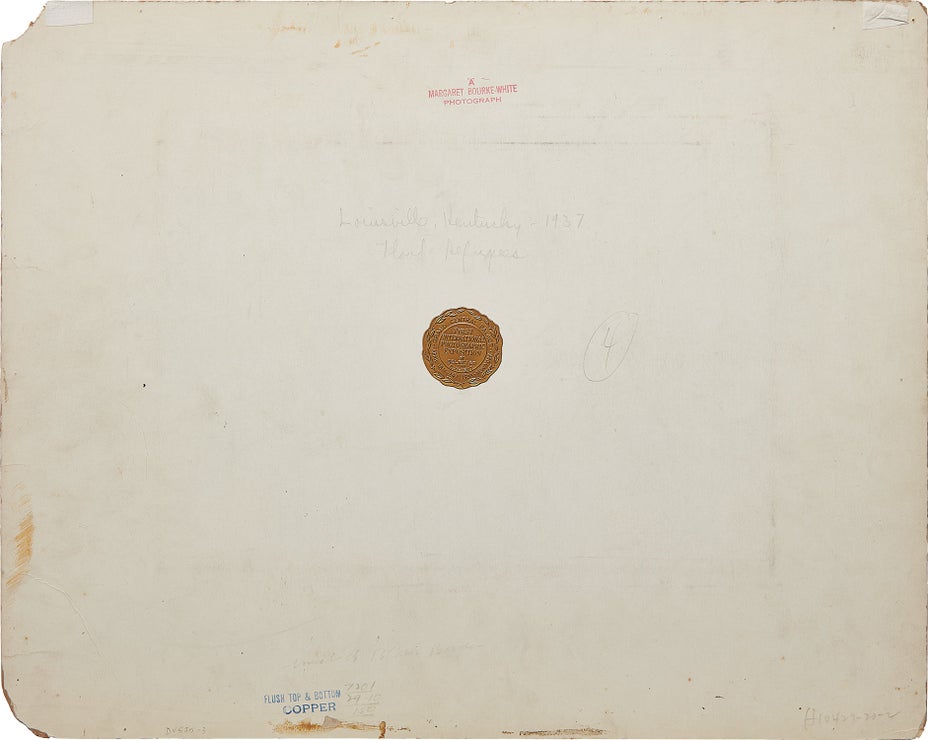
Credited and titled in a calligraphic hand in ink on the mount; credit stamp and titled in an unidentified hand in pencil and a gold foil 1938 Grand Central Exposition label on the reverse of the mount.
Full-Cataloguing
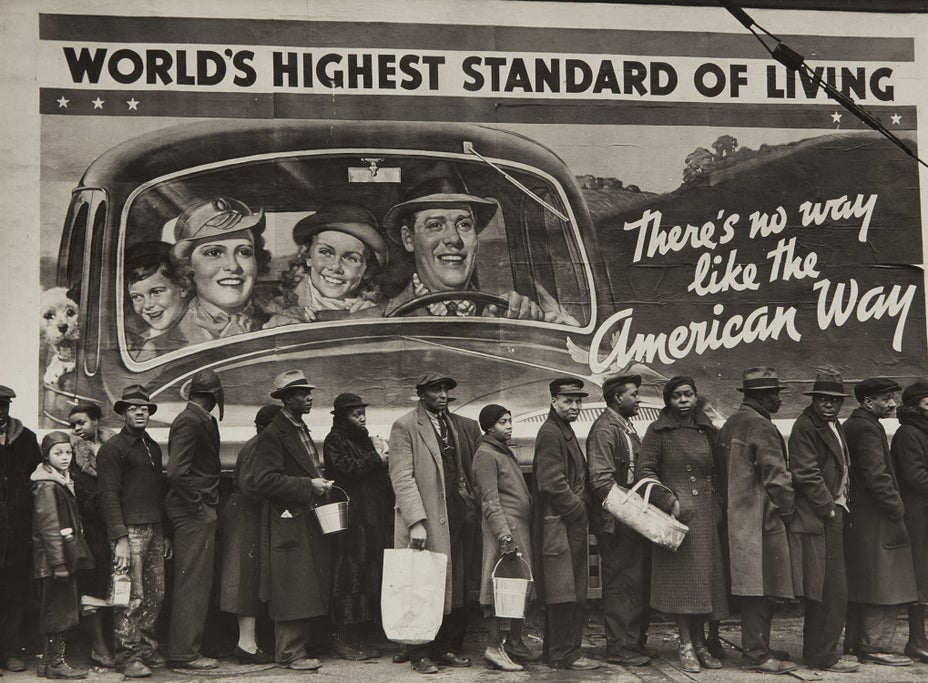
Flood Refugees, Louisville, Kentucky, dramatizes the humanitarian crisis created by the flooding of the Ohio River in 1937, which killed nearly 900 people and displaced thousands more in Louisville, hitting that city’s African-American quarter especially hard. At the time, the Louisville flood was considered one of the three most disastrous floods in American history.
Margaret Bourke-White was dispatched by LIFE magazine in January to cover the story, and she arrived on the last flight into Louisville before the airport closed. Hitching rides on rowboats and a raft, she made her way into the city and photographed throughout the flood zones. The photograph offered here is the best of that series, capturing the harsh juxtapositions of American life at the time in a single frame. It was first published in LIFE in February 1937. The irony of the billboard’s message was lost on no one: as LIFE’s caption wryly observed, 'It was going to take a lot of money to restore the American standard of living in the cities and towns of the Ohio Valley.'
This photograph’s exhibition label attests to its early print date. It was shown in 1938 in the First International Photographic Exposition, held at the Grand Central Palace in New York City. Organized by photographer and LIFE photo editor Willard Morgan, the exhibition included a large selection of images by Bourke-White and a host of Farm Security Administration photographers, including Dorothea Lange, Walker Evans, Russell Lee, and others. While Flood Refugees, Louisville, Kentucky, is one of the most famous of Bourke-White’s images for LIFE, few early prints, especially those with a documented exhibition history, are extant. It is believed that in recent years only one other early print has appeared at auction, in 2014.
Bourke-White had covered the Dust Bowl for Fortune magazine in 1934, and the conditions she saw then opened her eyes to the devastating effects manmade and natural disasters could have on working people. Remembering the Louisville experience in her 1967 autobiography, she wrote, ‘To me this mammoth flood was another bitter chapter in the bleak drama of waste of our American earth, which I had watched unfolding and had tried to record since the drought. The juxtaposition of blowing soil and rainfall, of eroded farmlands and inundated cities, made an ominous continuing pattern’ (Portrait of Myself, p. 150).
Margaret Bourke-White was dispatched by LIFE magazine in January to cover the story, and she arrived on the last flight into Louisville before the airport closed. Hitching rides on rowboats and a raft, she made her way into the city and photographed throughout the flood zones. The photograph offered here is the best of that series, capturing the harsh juxtapositions of American life at the time in a single frame. It was first published in LIFE in February 1937. The irony of the billboard’s message was lost on no one: as LIFE’s caption wryly observed, 'It was going to take a lot of money to restore the American standard of living in the cities and towns of the Ohio Valley.'
This photograph’s exhibition label attests to its early print date. It was shown in 1938 in the First International Photographic Exposition, held at the Grand Central Palace in New York City. Organized by photographer and LIFE photo editor Willard Morgan, the exhibition included a large selection of images by Bourke-White and a host of Farm Security Administration photographers, including Dorothea Lange, Walker Evans, Russell Lee, and others. While Flood Refugees, Louisville, Kentucky, is one of the most famous of Bourke-White’s images for LIFE, few early prints, especially those with a documented exhibition history, are extant. It is believed that in recent years only one other early print has appeared at auction, in 2014.
Bourke-White had covered the Dust Bowl for Fortune magazine in 1934, and the conditions she saw then opened her eyes to the devastating effects manmade and natural disasters could have on working people. Remembering the Louisville experience in her 1967 autobiography, she wrote, ‘To me this mammoth flood was another bitter chapter in the bleak drama of waste of our American earth, which I had watched unfolding and had tried to record since the drought. The juxtaposition of blowing soil and rainfall, of eroded farmlands and inundated cities, made an ominous continuing pattern’ (Portrait of Myself, p. 150).