40
Marina Abramović
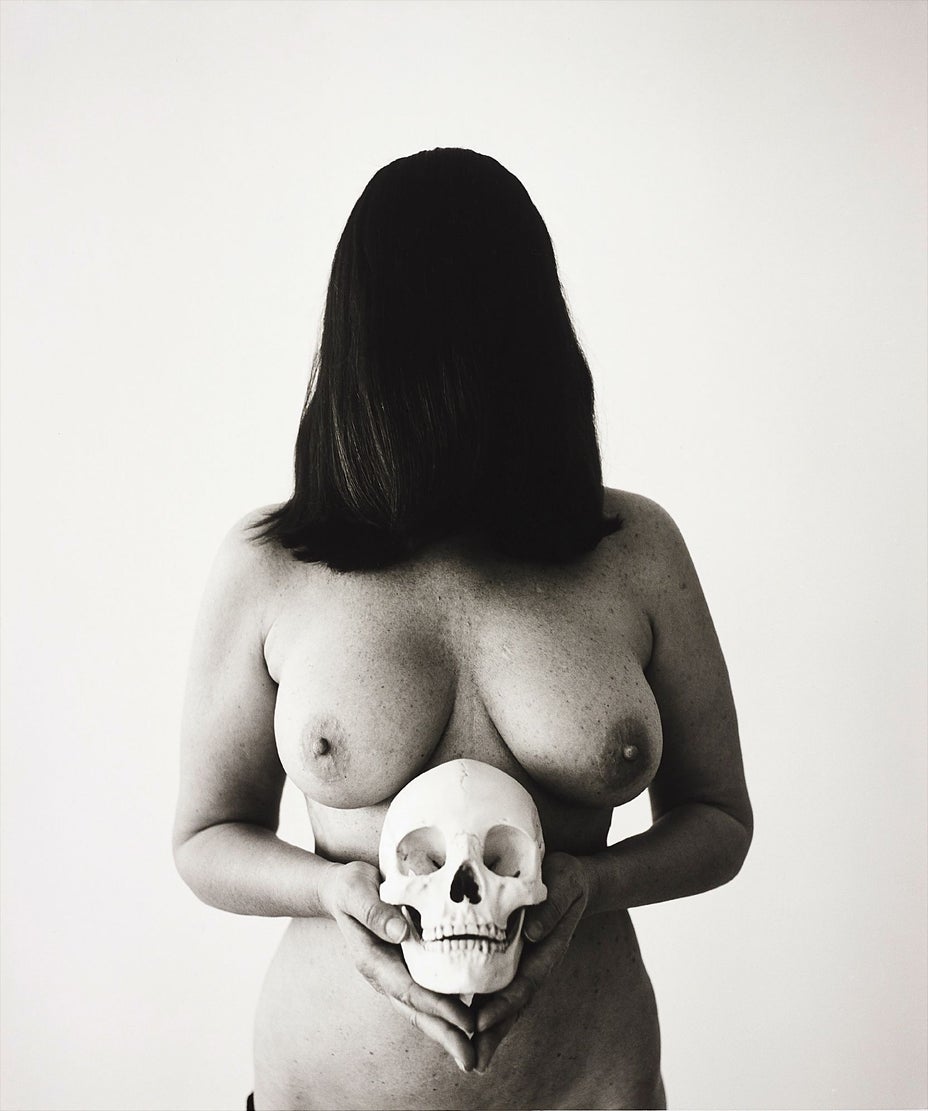
Self Portrait with Skull
Frame: 80.4 x 69 cm (31 5/8 x 27 1/8 in.)
This work is a one-off work outside the sold-out edition of 3 + 2 AP and is the same size as prints from the edition.
Full-Cataloguing
Marina Abramović
Pushing boundaries and challenging her own fear as well as that of the viewer, much of Marina Abramović’s work deals with the limitations of the body. In recent years, she has focused more on mortality. ‘When you get to my age,’ she says, ‘you know you have to confront death. I want to die without anger, without fear and consciously, and these three things are not easy.’
In the present work, she brings death to the forefront in her use of the skull. This work is related to a performance piece, Nude with Skeleton (2002). Lying on the floor with a skeleton draped over her, she breathes life into it, forcing the viewer to confront that inevitable end. ‘Being so close to your skeleton,’ she explains, ‘breathing through and looking at, confronting it – it’s the way to deal with the fear.’ In Self Portrait with Skull, 2004, Abramović stands naked, facing the camera directly; her hair is brushed over her face and she holds a skull at her stomach. Concealing her own face, the skull is what the viewer confronts. This pose is repeated the following year in her video installation Balkan Erotic Epic, which examined the connection between eroticism and spirituality in Serbian folklore.
In 1997, Abramović was awarded the Golden Lion at the Venice Biennale for the video installation and performance Balkan Baroque and her major 2010 retrospective, The Artist is Present, at the Museum of Modern Art, New York, garnered over 750,000 visitors. Her work resides in many institutional collections, including Solomon R. Guggenheim Museum, New York; Tate Modern, London; and Centre Georges Pompidou, Paris.
Marina Abramović
Serbian | 1946Marina Abramovic is celebrated as a pioneering practitioner of performance art, best known for her works that explore the physical limitations of the body, as well as the body’s potential as a vehicle to spiritual metamorphosis. Born in Belgrade, Abramovic studied at the Academy of Fine Arts in Belgrade and in Zagreb, Croatia. She was among the first generation of performance artists of the 1970s, a group that often resorted to using their own bodies as an artistic medium. Her works often explore extremes of sensation, and, frequently, the audience is invited to participate in the intense, and often exhausting, painful performances. She later regularly collaborated with German artist Ulay on other performative works, exploring the capacities of the body, as well as constructions of gender and social systems in their pieces.
She also began traveling around the world to perform, exploring the body and nature as a means of achieving spiritual transformation, in locations ranging from the Gobi Desert to the Tibetan mountains, and the Great Wall of China. Abramovic’s presentations of her work include sound, video, photography, language, and sculpture, in addition to using her body as the central medium for her work. She has exhibited her work at the Venice Biennale, where she won a Golden Lion award in 1997, and at Documenta in Kassel, the Whitney Biennial, and the Solomon R. Guggenheim Museum in New York, Art Basel in Switzerland, and the Kumamoto Museum of Contemporary Art in Japan, among many other venues.
She currently lives and works in Amsterdam and New York.