Property from a Distinguished New York Collection
2Ο︎
Marisol
Couple No. 1
Estimate
$400,000–600,000
Sold For
$461,000
wood, painted wood, fabric, electric motor and mixed media
71 x 34 x 26 7/16 in. (180.3 x 86.4 x 67.2 cm)
Full-Cataloguing
"Originally using my face was like a search for the self. I don't have to do that anymore because I know I'll never find it." Marisol
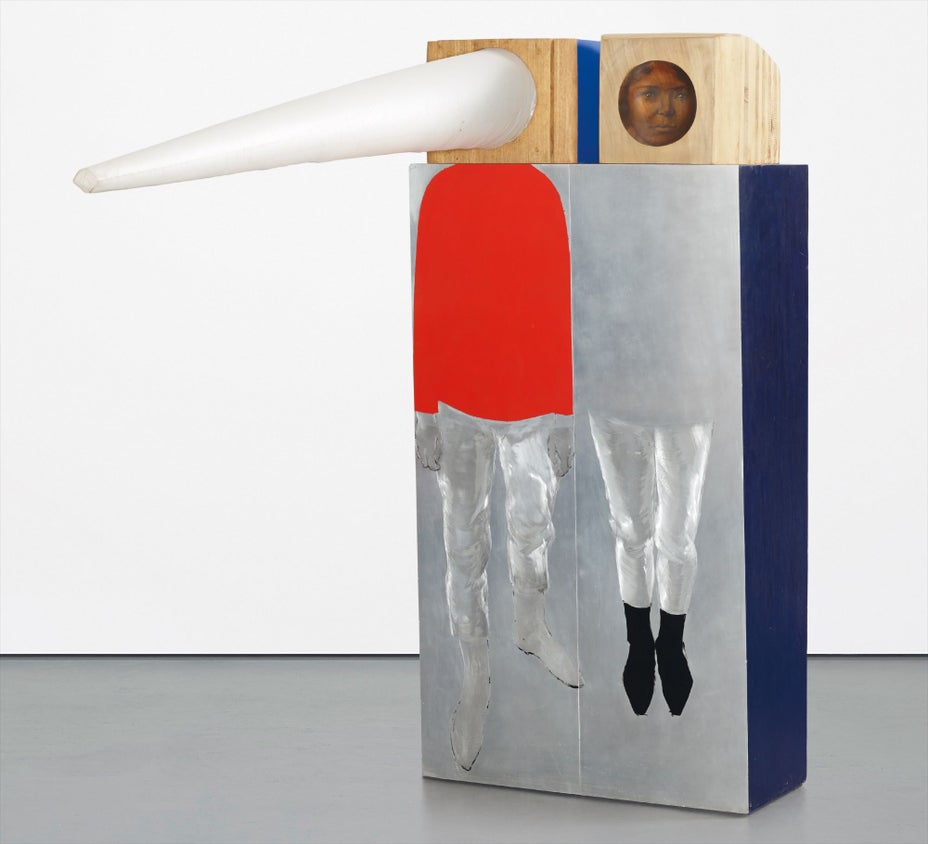
Marisol’s exhibition at Sidney Janis gallery in New York opened in April 1966 to a crowd of over three thousand viewers; the present lot Couple No. 1, 1965-66 greeted audiences immediately upon entering the space. Curator Marina Pacini commented that “visitors stood in line to get in. Marisol surprised and enthralled with works such as Couple No. 1 with its fabric noise jutting out six feet into space thanks to a fan blowing air into it.” Couple No. 1, is comprised of two illustrated figures contained within one wooden column. The left figure, dressed in a bright crimson sweater, matching white pants, white gloves and white boots juts his right foot out towards us, as though he is about to walk right out of the wooden containment and approach us. The figure on the right appears spectral, as though only existing through a pair of floating, white, panted legs with black socks. The masculine figure’s head contains a fan, which when plugged in, blows a continuous stream of air into the white, fabric cone. When activated the white material dramatically extends outwards, centering him with an elongated “nose.” While his red sweater, turned out stance and protruding nose characterize him with an undeniably strong, masculine presence, his counterpart seems to drift, barely visible, her face shrouded within the physical bounds of the wooden block. A delicately rendered face rests within the strict confines of the wood head, in direct contrast to the face of her companion. “Her face, a lifelike rendering in pencil on a concave plate of polished mahogany, betrays vulnerability, and in her expressive dark eyes, extreme sadness. She's obviously trying to put up a good front even as she verges on tears…. it brings to mind the recent study, widely commented on in the media, concluding that women suffer physically when they refrain from expressing themselves in disagreements with their domestic partners.” (C. Diehl, “Eye of the Heart Marisol," Art in America, March 2008, pp. 158-161)
Marisol’s interest in the experience of the human condition has always elevated her practice to a social investigation. Described as a humanist, “a person with a strong concern for human welfare, values, and dignity,” Marisol’s figural sculptures touch on the sensitivity of racial, cultural and economic diversity. Grace Glueck poignantly described this project in her 1965 New York Times article, “The Marisol legend is nourished by her chic, bones-and hollows face (elegantly Spanish with a dash of gypsy)…her mysterious reserve and faraway, whispery voice, toneless as a sleepwalker’s….Marisol’s real fame rests on a dazzling ability to distill art from the clichés of American life.” (G. Gluek, “It’s Not Pop, It’s Not Op --- It’s Marisol”)
Marisol’s exhibition at Sidney Janis gallery in New York opened in April 1966 to a crowd of over three thousand viewers; the present lot Couple No. 1, 1965-66 greeted audiences immediately upon entering the space. Curator Marina Pacini commented that “visitors stood in line to get in. Marisol surprised and enthralled with works such as Couple No. 1 with its fabric noise jutting out six feet into space thanks to a fan blowing air into it.” Couple No. 1, is comprised of two illustrated figures contained within one wooden column. The left figure, dressed in a bright crimson sweater, matching white pants, white gloves and white boots juts his right foot out towards us, as though he is about to walk right out of the wooden containment and approach us. The figure on the right appears spectral, as though only existing through a pair of floating, white, panted legs with black socks. The masculine figure’s head contains a fan, which when plugged in, blows a continuous stream of air into the white, fabric cone. When activated the white material dramatically extends outwards, centering him with an elongated “nose.” While his red sweater, turned out stance and protruding nose characterize him with an undeniably strong, masculine presence, his counterpart seems to drift, barely visible, her face shrouded within the physical bounds of the wooden block. A delicately rendered face rests within the strict confines of the wood head, in direct contrast to the face of her companion. “Her face, a lifelike rendering in pencil on a concave plate of polished mahogany, betrays vulnerability, and in her expressive dark eyes, extreme sadness. She's obviously trying to put up a good front even as she verges on tears…. it brings to mind the recent study, widely commented on in the media, concluding that women suffer physically when they refrain from expressing themselves in disagreements with their domestic partners.” (C. Diehl, “Eye of the Heart Marisol," Art in America, March 2008, pp. 158-161)
Marisol’s interest in the experience of the human condition has always elevated her practice to a social investigation. Described as a humanist, “a person with a strong concern for human welfare, values, and dignity,” Marisol’s figural sculptures touch on the sensitivity of racial, cultural and economic diversity. Grace Glueck poignantly described this project in her 1965 New York Times article, “The Marisol legend is nourished by her chic, bones-and hollows face (elegantly Spanish with a dash of gypsy)…her mysterious reserve and faraway, whispery voice, toneless as a sleepwalker’s….Marisol’s real fame rests on a dazzling ability to distill art from the clichés of American life.” (G. Gluek, “It’s Not Pop, It’s Not Op --- It’s Marisol”)