Property of a French Collector
109
Martin Szekely
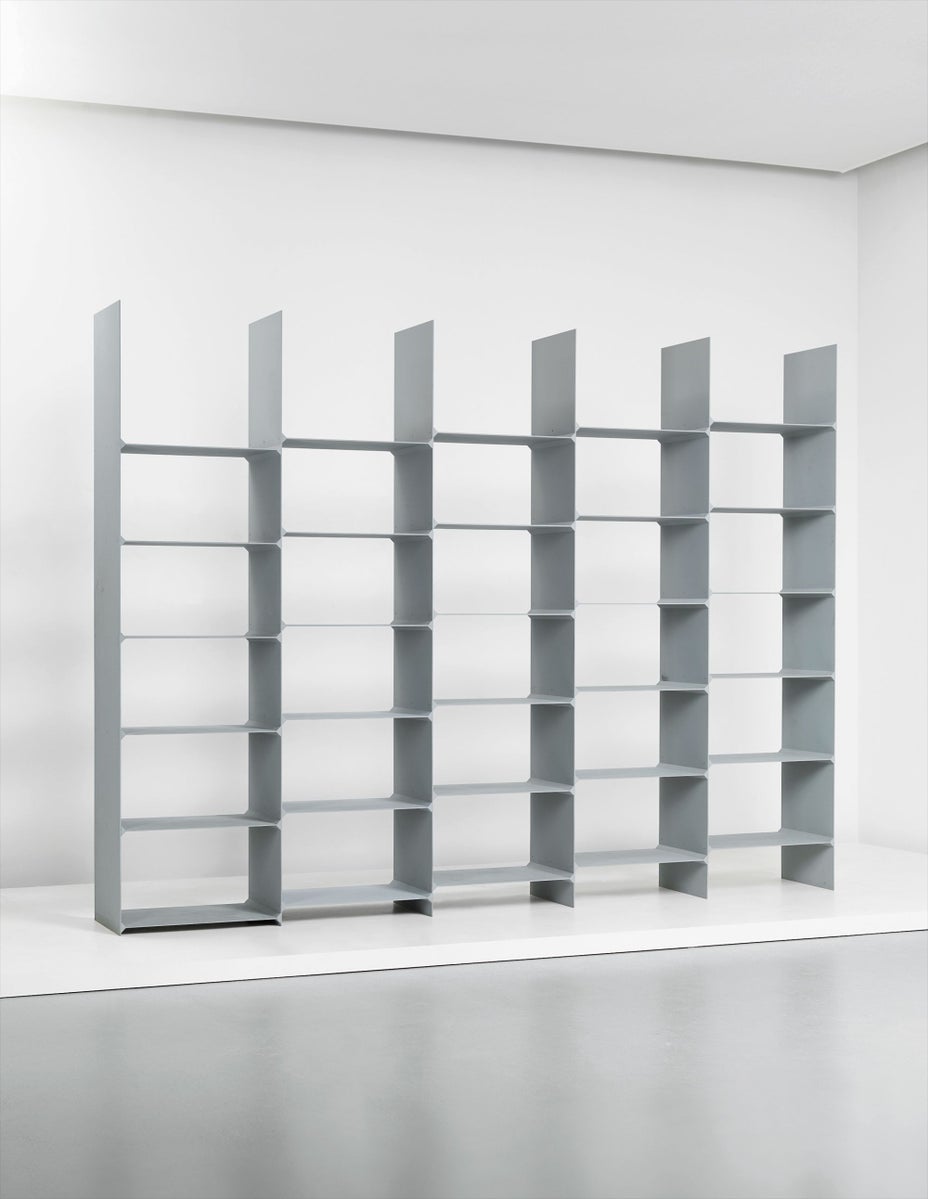
"T5" bookshelf, from the “Des Étagères” collection, in "bleu-clair"
Estimate
$50,000–70,000
Sold For
$60,000
2004
Nextel-coated aluminum.
101 7/8 x 135 1/2 x 18 1/8 in. (258.8 x 344.2 x 46 cm)
Editioned by Galerie kreo, Paris and produced by Tolerie Fine de Précision, France. Number 3 from the edition of 8 plus two artist's proofs and two prototypes. Metal plaque incised with m Szekely, "étagè T5" 2004, N0 3/8, Édition galerie kreo.
Full-Cataloguing
An industrial designer living and working out of Paris, Martin Szekely is widely known for his designs for Hermès, Dom Perignon, and Perrier. The diversity of his design capabilities is evident in his portfolio, with projects ranging from an electric pylon for the French utility company EDF to a leather satchel for Belgian clothier Delvaux.
The present lot was designed in 2004 as part of the des étagères series. The concept of a borderline informs the work both physically and formally. The design was conceived as an engineering challenge that would test the limits of minimal use of material. In Ne plus dessiner, the publication related to Szekely’s 2012 exhibition at the Centre Georges Pompidou in Paris of the same name, the rationale and success of the construction is explained: “Keeping a structure upright means thinking about bracing-the use of triangulation to cancel out vertical and horizontal forces. Des étagères uses a simple small triangle, its base placed along the vertical strut and its summit lying along the underside of the shelf. The combined force of all the small triangular pieces stabilizes the whole structure whatever is placed on it. ” Says Szekely, “The shelves have their own rules, dictated by the functional specificity of the way it is put together rather than by subjective aesthetic decisions.”
The present lot was designed in 2004 as part of the des étagères series. The concept of a borderline informs the work both physically and formally. The design was conceived as an engineering challenge that would test the limits of minimal use of material. In Ne plus dessiner, the publication related to Szekely’s 2012 exhibition at the Centre Georges Pompidou in Paris of the same name, the rationale and success of the construction is explained: “Keeping a structure upright means thinking about bracing-the use of triangulation to cancel out vertical and horizontal forces. Des étagères uses a simple small triangle, its base placed along the vertical strut and its summit lying along the underside of the shelf. The combined force of all the small triangular pieces stabilizes the whole structure whatever is placed on it. ” Says Szekely, “The shelves have their own rules, dictated by the functional specificity of the way it is put together rather than by subjective aesthetic decisions.”