13
M.C. Escher
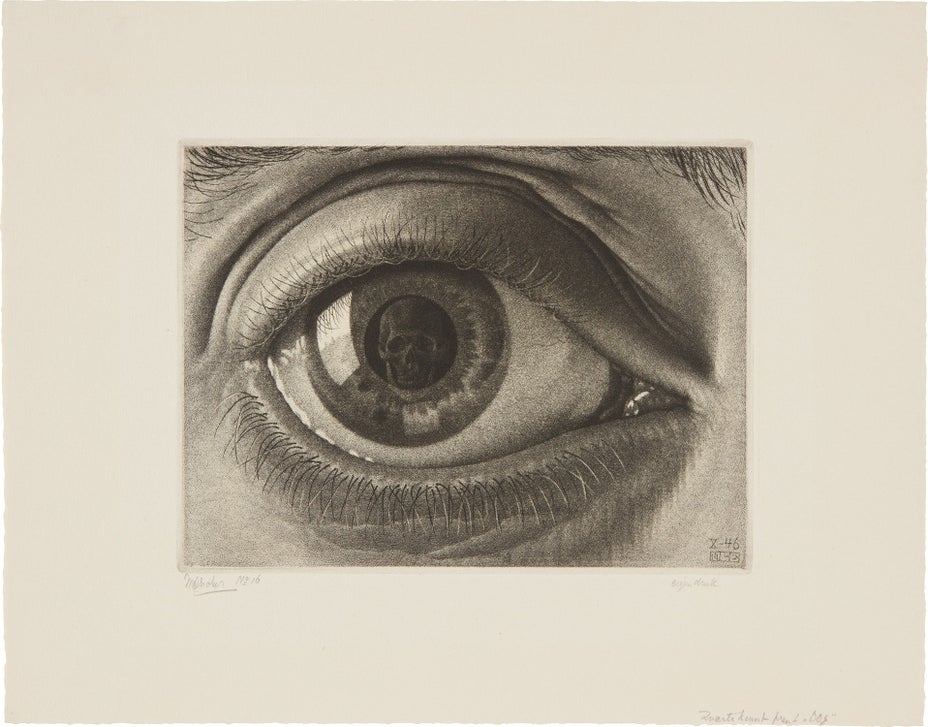
Eye
Estimate
$40,000–60,000
Sold For
$72,500
1946
Mezzotint, on Van Gelder Zonen laid paper, with full margins.
Image 5 3/4 x 7 11/16 in. (14.6 x 19.5 cm)
Plate 6 x 7 15/16 in. (15.2 x 20.2 cm)
Sheet 10 x 12 5/8 in. (25.4 x 32.1 cm)
Plate 6 x 7 15/16 in. (15.2 x 20.2 cm)
Sheet 10 x 12 5/8 in. (25.4 x 32.1 cm)
Signed, annotated 'eigen druk' (hand printed), numbered 'No 16' in pencil, also annotated 'zwarte kunst prent "Oog"' (black art print 'eye') lower right sheet edge, framed.
Full-Cataloguing
“… a last example of globular reflection: an eye, which is of course my own, copied as faithfully as possible in a concave shaving glass. It was necessary and logical to portray somebody in a pupil, an observer, reflected in the convex mirror of the eye. I chose the features of Good Man Bones, with whom we are all confronted whether we like it or not.” – Escher, Exploring the Infinite
In 1946 Escher became interested in mezzotint, a technique that fascinated him because of the possibility of obtaining extremely subtle graduation of light and dark. Though new to Escher, the process of mezzotint was developed in 17th century Germany and named mezzo-tinto, or “half-tone.” English artists and printmakers then found it to be a perfect medium to express their obsession with portraiture. Lasting well into the 1820's the mezzotint spread to the United States where it found footing among graphic artists. The mezzotint is a burnishing process that uniquely captures subtle gradient tonality and works from dark to light. A highly laborious process, Escher produced only eight mezzotints during his career, a feat given the fact that so few artists embrace the demanding technique today. He referred to mezzotint as 'black art,' and these prints are, undoubatly, among his most alluring. "White and black, day and night," said Escher, "the graphic artist lives on these."
I could fill an entire second life with working on my prints.
In 1946 Escher became interested in mezzotint, a technique that fascinated him because of the possibility of obtaining extremely subtle graduation of light and dark. Though new to Escher, the process of mezzotint was developed in 17th century Germany and named mezzo-tinto, or “half-tone.” English artists and printmakers then found it to be a perfect medium to express their obsession with portraiture. Lasting well into the 1820's the mezzotint spread to the United States where it found footing among graphic artists. The mezzotint is a burnishing process that uniquely captures subtle gradient tonality and works from dark to light. A highly laborious process, Escher produced only eight mezzotints during his career, a feat given the fact that so few artists embrace the demanding technique today. He referred to mezzotint as 'black art,' and these prints are, undoubatly, among his most alluring. "White and black, day and night," said Escher, "the graphic artist lives on these."
I could fill an entire second life with working on my prints.