Ultimate
38
Murray Fredericks
Salt 400
Estimate
£12,000–18,000‡︎
Sold For
£25,000
2014
Archival pigment print.
110 x 200 cm (43 1/4 x 78 3/4 in.) Overall 111.3 x 201.3 cm (43 7/8 x 79 1/4 in.)
Signed, titled, dated and numbered 1/1 in pencil on an artist's label affixed to the reverse of the flush-mount.
This work is number 1 from the edition of 1 and is unique in this size.
This work is number 1 from the edition of 1 and is unique in this size.
Full-Cataloguing
‘I wanted to find a landscape devoid of features … somewhere I could point my camera into pure space’
Murray Fredericks
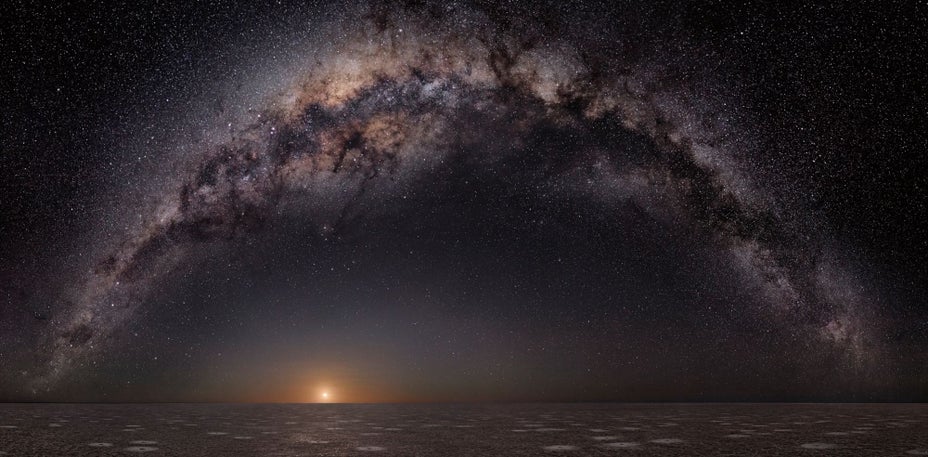
In Murray Fredericks’ panoramic tour de force Salt 400, we encounter an almost other-worldly space. We see the salt pan in the foreground, the moonset on the low horizon and the Milky Way arching across the night sky. Salt 400 is the culmination of his long-term series Salt, begun in 2003 and photographed on location on the giant salt pan of Lake Eyre in the deserts of Central Australia.
In order to capture this near impossible composition with his camera, Fredericks spent weeks on Lake Eyre testing different lightings, primarily driven by the moon phase and the varying times of moonrises and moonsets. He also tested various sensors and lenses, arriving at a combination that enabled him to photograph the night sky with a short shutter speed of only a few seconds. This technical feat prevented star trails, which are caused by Earth’s rotation. The resulting image, shot on a calibrated panoramic head, is comprised of over 30 single images that are seamlessly stitched together. The fatness of the low horizon – a reference point in every Salt image – was achieved by converting the original three-dimensional projection into a two-dimensional image.
For Fredericks, this series is not a document of a specific place but of the emotions he experienced while spending long stretches of time in solitude in a remote and desolate environment, which he describes as “freedom, release and surrender.” His aim is to trigger an emotional response in the viewer and he succeeds.
Fredericks’ works are exhibited internationally and are held in various collections, including the National Gallery of Victoria, Melbourne; and the Sir Elton John Collection, Atlanta/London. His first documentary film Salt won 12 major international awards, played over 50 festivals and was screened on ABC and PBS in the US.
Murray Fredericks
In Murray Fredericks’ panoramic tour de force Salt 400, we encounter an almost other-worldly space. We see the salt pan in the foreground, the moonset on the low horizon and the Milky Way arching across the night sky. Salt 400 is the culmination of his long-term series Salt, begun in 2003 and photographed on location on the giant salt pan of Lake Eyre in the deserts of Central Australia.
In order to capture this near impossible composition with his camera, Fredericks spent weeks on Lake Eyre testing different lightings, primarily driven by the moon phase and the varying times of moonrises and moonsets. He also tested various sensors and lenses, arriving at a combination that enabled him to photograph the night sky with a short shutter speed of only a few seconds. This technical feat prevented star trails, which are caused by Earth’s rotation. The resulting image, shot on a calibrated panoramic head, is comprised of over 30 single images that are seamlessly stitched together. The fatness of the low horizon – a reference point in every Salt image – was achieved by converting the original three-dimensional projection into a two-dimensional image.
For Fredericks, this series is not a document of a specific place but of the emotions he experienced while spending long stretches of time in solitude in a remote and desolate environment, which he describes as “freedom, release and surrender.” His aim is to trigger an emotional response in the viewer and he succeeds.
Fredericks’ works are exhibited internationally and are held in various collections, including the National Gallery of Victoria, Melbourne; and the Sir Elton John Collection, Atlanta/London. His first documentary film Salt won 12 major international awards, played over 50 festivals and was screened on ABC and PBS in the US.