Property of an Important Southeast Asian Collector
10
Natee Utarit
The Dawn of Day (Illustration of the Crisis Series)
Estimate
HK$500,000–700,000
€56,100–78,500
$64,100–89,700
Sold For
HK$1,437,500
signed, titled and dated 'Natee Utarit 10 "The Dawn of Day" Illustration of the Crisis Series' on the reverse
oil on linen
170 x 140 cm. (66 7/8 x 55 1/8 in.)
Executed in 2010, this work is accompanied with a certificate of authenticity issued by the Art Seasons Gallery.
Full-Cataloguing
“There is no irony. There are no optical illusions. Everything is meant to tell a story in the same direct manner that characterized paintings for centuries.” Natee Utarit, 2013
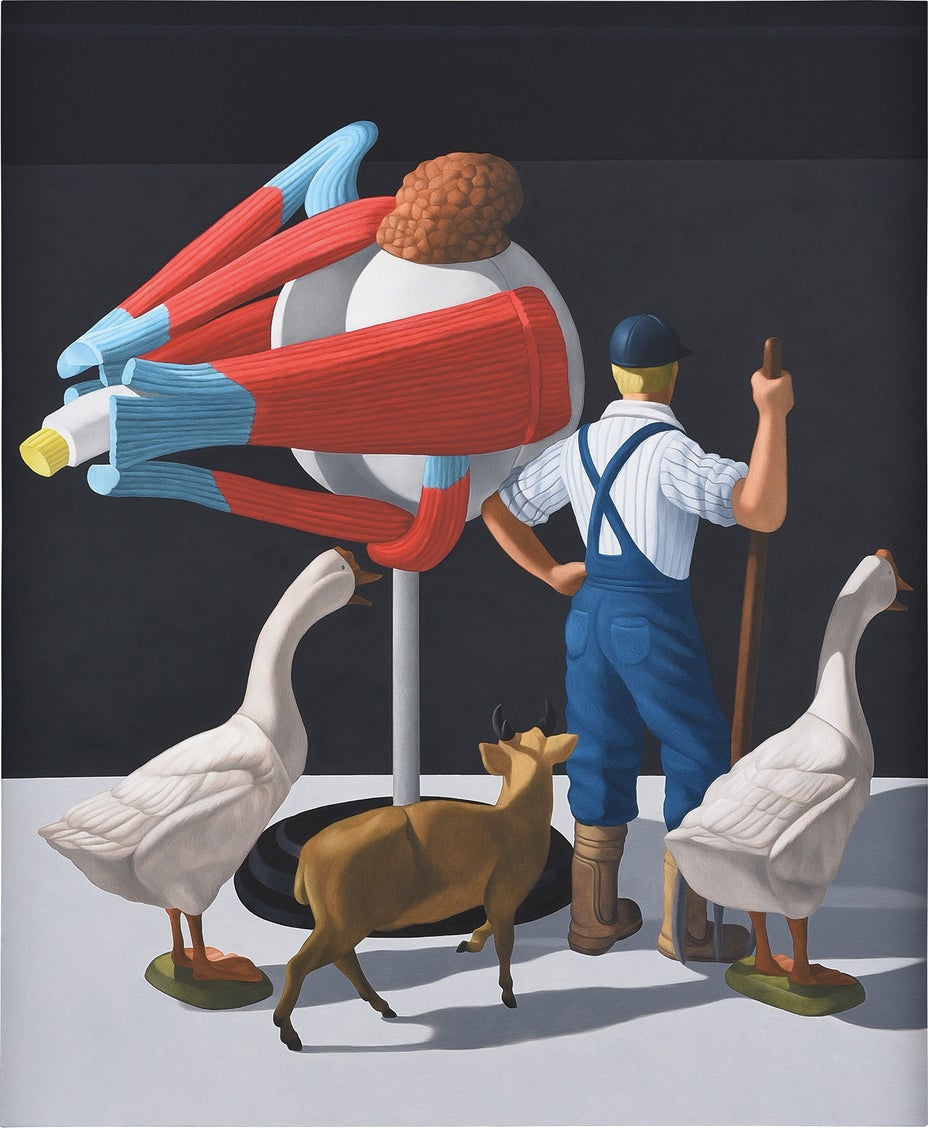
Beneath the ordered compositions and painterly aesthetic of Natee Utarit’s canvases resides a latent anxiety that expresses the complexities and contradictions in the experience of modern life. In The Dawn of Day, Utarit’s accomplished painterly style and use of traditional compositional framing most closely associated with classical still life painting lulls the viewer into a false sense of familiarity. What appears to be a scene of a worker surrounded by a group of animals is disrupted by the inclusion of a scientific model of an eyeball which draws our attention to the unnatural scale of the elements in the painting, and the eventual discovery that all of the objects in the painting are artificial – revealed most clearly by the plastic base supporting the two geese. Foregrounding the artifice of his subjects, Utarit complicates earlier philosophies of painting that were concerned with creating accurate representations of reality within the picture plane, and critically redeploys the techniques from that early period of Western art history. The realistic rendering of his lifeless subjects results in an uncanny stillness and Utarit reveals his critical perspective through a complex blurring of reality and artifice.
Utarit’s subjects are painted from the calculated arrangement of his collection of figurines and found objects, carefully positioned in real life before being translated onto his canvas. The Dawn of Day sees his strange menagerie turned away from the viewer, effectively rejecting a traditional reading of meaning into the picture. In doing so, Utarit leaves to viewers the challenge of interpretation. With their backs turned, Utarit shows through the long shadows cast by the figurines that they are also turned away from the light source ironically suggested by the title of the work. Looking away from the light into what we can only assume to be the darkness, the positioning of the disparate figurines begins to reveal deeper meaning. Led by a figure holding an authoritative posture, two geese turn in the same direction and serve as a critical metaphor for blind groupthink. Despite the presence of the great eye beside them, they all mistakenly look away from the source of the light. Utarit offers us a bitter consolation in the inclusion of a deer which turns its head attentively in a different direction, however it too inevitably fails to turn away completely. Their positioning, filling the entirety of the large picture plane suggests a purposeful existence on the cusp of some great discovery which Utarit effectively reveals as futile and misguided.
The Dawn of Day is a significant work from Utarit’s Illustration of the Crisis series that sought to capture the individual and collective turmoil in Thailand over the increasing escalation of events in the political landscape beginning in the mid-2000s. While reflecting the specificity of his context, Utarit’s work succeeds in tapping into a universal feeling of ennui as a consequence of the modern condition.
Beneath the ordered compositions and painterly aesthetic of Natee Utarit’s canvases resides a latent anxiety that expresses the complexities and contradictions in the experience of modern life. In The Dawn of Day, Utarit’s accomplished painterly style and use of traditional compositional framing most closely associated with classical still life painting lulls the viewer into a false sense of familiarity. What appears to be a scene of a worker surrounded by a group of animals is disrupted by the inclusion of a scientific model of an eyeball which draws our attention to the unnatural scale of the elements in the painting, and the eventual discovery that all of the objects in the painting are artificial – revealed most clearly by the plastic base supporting the two geese. Foregrounding the artifice of his subjects, Utarit complicates earlier philosophies of painting that were concerned with creating accurate representations of reality within the picture plane, and critically redeploys the techniques from that early period of Western art history. The realistic rendering of his lifeless subjects results in an uncanny stillness and Utarit reveals his critical perspective through a complex blurring of reality and artifice.
Utarit’s subjects are painted from the calculated arrangement of his collection of figurines and found objects, carefully positioned in real life before being translated onto his canvas. The Dawn of Day sees his strange menagerie turned away from the viewer, effectively rejecting a traditional reading of meaning into the picture. In doing so, Utarit leaves to viewers the challenge of interpretation. With their backs turned, Utarit shows through the long shadows cast by the figurines that they are also turned away from the light source ironically suggested by the title of the work. Looking away from the light into what we can only assume to be the darkness, the positioning of the disparate figurines begins to reveal deeper meaning. Led by a figure holding an authoritative posture, two geese turn in the same direction and serve as a critical metaphor for blind groupthink. Despite the presence of the great eye beside them, they all mistakenly look away from the source of the light. Utarit offers us a bitter consolation in the inclusion of a deer which turns its head attentively in a different direction, however it too inevitably fails to turn away completely. Their positioning, filling the entirety of the large picture plane suggests a purposeful existence on the cusp of some great discovery which Utarit effectively reveals as futile and misguided.
The Dawn of Day is a significant work from Utarit’s Illustration of the Crisis series that sought to capture the individual and collective turmoil in Thailand over the increasing escalation of events in the political landscape beginning in the mid-2000s. While reflecting the specificity of his context, Utarit’s work succeeds in tapping into a universal feeling of ennui as a consequence of the modern condition.