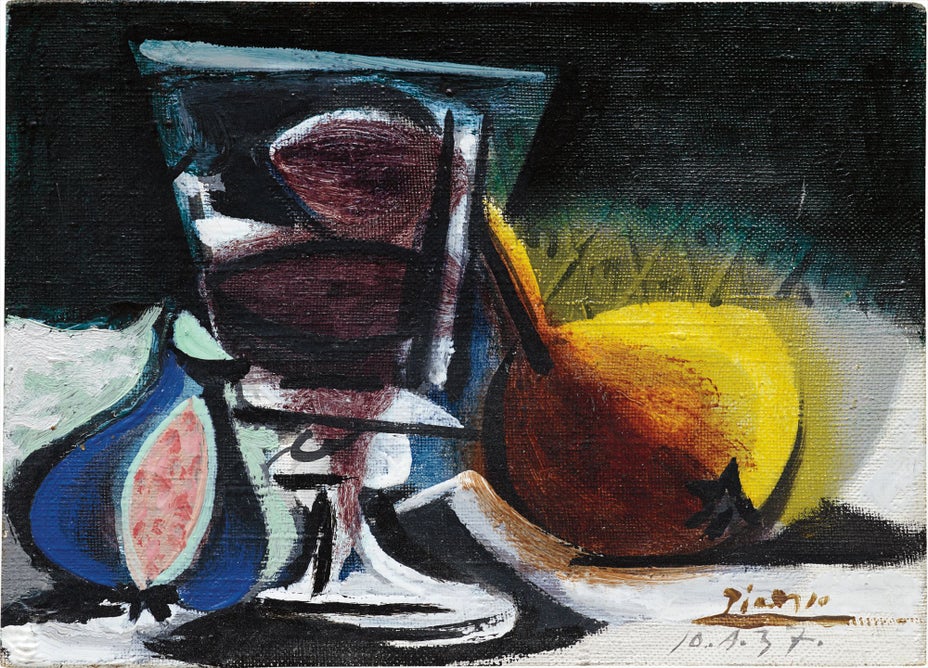

Property of a Gentleman, Boston
23
Pablo Picasso
Nature morte
- Estimate
- $900,000 - 1,200,000
$965,000
Lot Details
oil on canvas
6 1/4 x 8 3/4 in. (15.9 x 22.2 cm)
Signed and dated "Picasso 10.4.37." lower right.
Specialist
Full-Cataloguing
Catalogue Essay
In the context of Pablo Picasso’s long career, the year 1937 marked one of the most significant landmark moments in his artistic production. It was during this year that the artist completed arguably his most ambitious work, the canonical Guernica. With the tumultuous political unrest of the Spanish Civil War and early traces foreshadowing a looming war more widely in Europe creating tension on the continent, it is unsurprising that Picasso’s works were united by a dark palette during the following years. Nature morte, painted in 1937 marries one of Picasso’s most frequent themes, the still life, with his stylistic tendencies of this period. A domineering dark tone casts the background in shadow while the objects in the foreground are thickly outlined in an equally overpowering black. In comparison to Picasso’s earlier still-life compositions such as Nature morte au compotier (Still Life with Compote and Glass) 1914-15, the approach is far more heavy-handed. However, this confidence in applying strong strokes suggests freer movement of the paintbrush and for this reason, Nature morte appears far more spontaneous than his previous almost mathematically arranged pieces.
From the outset of Picasso’s career a distinct nod towards Paul Cezanne’s oeuvre is brought to the fore. However, Cezanne’s vital role as the pivotal forerunner to Cubism is reasserted throughout the movement’s trajectory. Painted far later in his career, Nature morte illustrates this notion profoundly. Compositional, tonal and stylistic similarities are made all the more clear when one compares this work with Still Life with Fruit and a Ginger Pot, 1895. The shallow composition emphasized by the simple monochrome background in both gives rise to the heavily contoured still-life displayed before the viewer.
Although Picasso approached abstraction in various capacities throughout his life, he never fully dislocated himself entirely from the figurative or relinquished the object completely. This late composition appears to return to a more complete and harmonious method of depiction as the simply laid out wine glass and fruit on a tablecloth press against the picture’s surface, all equally positioned beside each other. Even their comparable scale is accurate despite the overall flatness created by Picasso’s simplification. Compared to the highly wrought still lifes from the 1910s that were defined by their angularity, fragmentation and geometrical dissection, this composition reverts back to a simpler aesthetic and remains characteristic of Picasso’s creative endeavors.
From the outset of Picasso’s career a distinct nod towards Paul Cezanne’s oeuvre is brought to the fore. However, Cezanne’s vital role as the pivotal forerunner to Cubism is reasserted throughout the movement’s trajectory. Painted far later in his career, Nature morte illustrates this notion profoundly. Compositional, tonal and stylistic similarities are made all the more clear when one compares this work with Still Life with Fruit and a Ginger Pot, 1895. The shallow composition emphasized by the simple monochrome background in both gives rise to the heavily contoured still-life displayed before the viewer.
Although Picasso approached abstraction in various capacities throughout his life, he never fully dislocated himself entirely from the figurative or relinquished the object completely. This late composition appears to return to a more complete and harmonious method of depiction as the simply laid out wine glass and fruit on a tablecloth press against the picture’s surface, all equally positioned beside each other. Even their comparable scale is accurate despite the overall flatness created by Picasso’s simplification. Compared to the highly wrought still lifes from the 1910s that were defined by their angularity, fragmentation and geometrical dissection, this composition reverts back to a simpler aesthetic and remains characteristic of Picasso’s creative endeavors.
Provenance
Literature
Pablo Picasso
Spanish | B. 1881 D. 1973One of the most dominant and influential artists of the 20th century, Pablo Picasso was a master of endless reinvention. While significantly contributing to the movements of Surrealism, Neoclassicism and Expressionism, he is best known for pioneering the groundbreaking movement of Cubism alongside fellow artist Georges Braque in the 1910s. In his practice, he drew on African and Iberian visual culture as well as the developments in the fast-changing world around him.Throughout his long and prolific career, the Spanish-born artist consistently pushed the boundaries of art to new extremes. Picasso's oeuvre is famously characterized by a radical diversity of styles, ranging from his early forays in Cubism to his Classical Period and his later more gestural expressionist work, and a diverse array of media including printmaking, drawing, ceramics and sculpture as well as theater sets and costumes designs.
Browse Artist