851Σ︎
Patek Philippe
Ref. 5059J
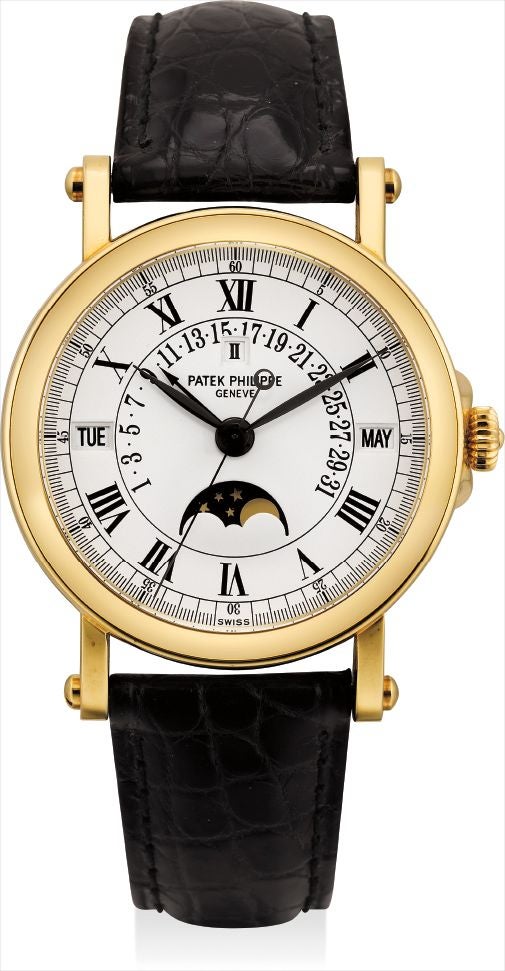
A very fine and rare gold perpetual calendar wristwatch with sweep center seconds, retrograde date, moon phases, officier-style case, certificate and box
Full-Cataloguing
As descendant of reference 5050, it features the same movement, which is one of the most historically important for the evolution of Patek Philippe. In fact, it combines an automatic module with sweep centre seconds, and builds up upon that with a retrograde date indicator. Before the advent of cal. 315 S-QR Aut., no Patek Philippe perpetual calendar featured both automatic winding and sweep centre seconds, but only one of the two, such as the automatic ref. 3448 and more recently 3940, or the sweep centre seconds ref. 2497.
The dial layout is inherited from the most complicated wristwatch serially made by the House until the advent of the Sky&Moon Tourbillon: ref. 5016, which features retrograde date but is neither automatic, nor features centre seconds. Compared to ref. 5016, however, ref. 5059 introduced a different, very nostalgic graphic approach which makes it a masterpiece of readability, featuring radial Roman numerals and a sectorial style, bringing the beholder back to timepieces from the early 20th century.
Case-wise, the simple calatrava-style of reference 5050 is abandoned in favor of a more prominent and elaborated officier-style case, defined by screw lugs and hinged case back (in this model protecting a second glazed back). Beyond increasing the wrist presence of the piece, the case is deeply rooted in Patek Philippe DNA, albeit its use is quite sparse. It is not a coincidence that it often appears in celebratory series (for example the 150th anniversary ref. 3960), and it is even today used on some of the most classical and important models (such as ref. 5959).
All this considered, one has to appreciate this model as a very refined, complicated and probably not yet fully appreciated example of Patek Philippe watchmaking at its best.
Patek Philippe
Swiss | 1839Since its founding in 1839, this famous Geneva-based firm has been surprising its clientele with superbly crafted timepieces fitted with watchmaking's most prestigious complications. Traditional and conservative designs are found across Patek Philippe's watches made throughout their history — the utmost in understated elegance.
Well-known for the Graves Supercomplication — a highly complicated pocket watch that was the world’s most complicated watch for 50 years — this family-owned brand has earned a reputation of excellence around the world. Patek's complicated vintage watches hold the highest number of world records for results achieved at auction compared with any other brand. For collectors, key models include the reference 1518, the world's first serially produced perpetual calendar chronograph, and its successor, the reference 2499. Other famous models include perpetual calendars such as the ref. 1526, ref. 3448 and 3450, chronographs such as the reference 130, 530 and 1463, as well as reference 1436 and 1563 split seconds chronographs. Patek is also well-known for their classically styled, time-only "Calatrava" dress watches, and the "Nautilus," an iconic luxury sports watch first introduced in 1976 as the reference 3700 that is still in production today.