


US import tariffs: Non-US origin lots in this sale (including watches and timepieces with Swiss-made or non-US made movements) will be subject to special tariffs upon import to the USA, currently ranging from 10% to 39% on the total invoice price (hammer price plus buyer’s premium). Buyers are responsible for paying any applicable tariffs, duties, taxes and charges when importing their purchased lots. Due to the evolving nature of international trade regulations, we recommend clients consult with their local customs office or advisor for up-to-date information on the applicable tariffs.
18
Patek Philippe
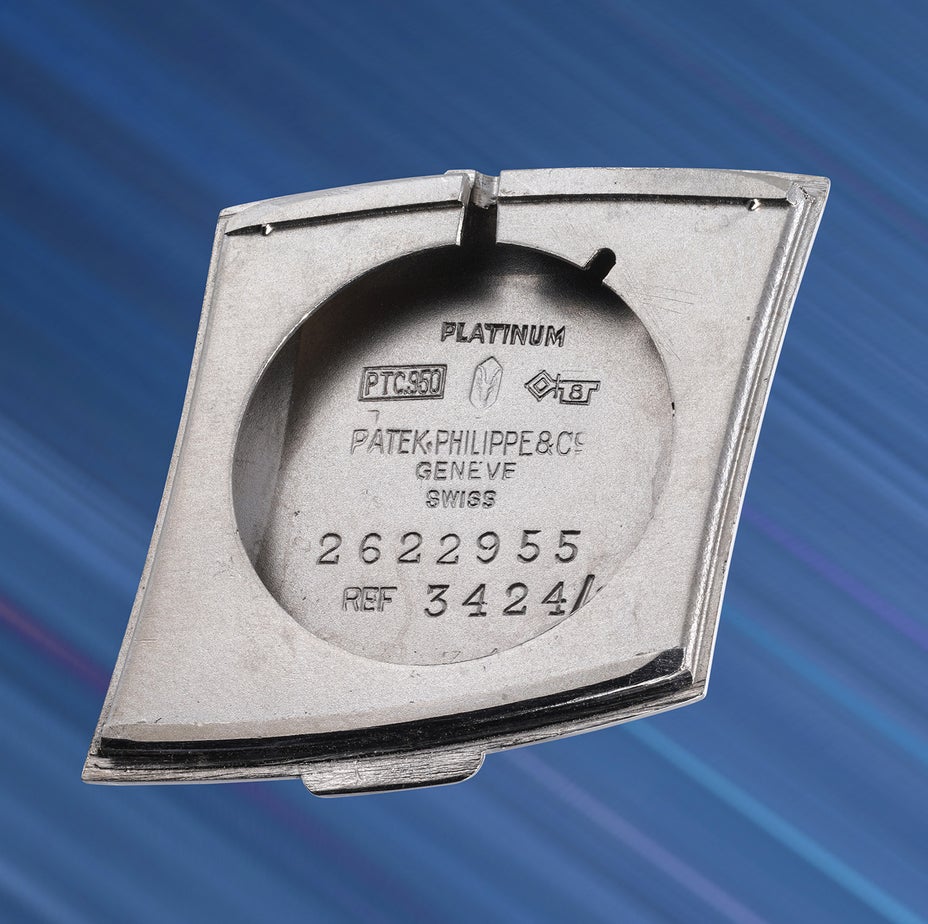
Ref. 3424/1
"Gilbert Albert"
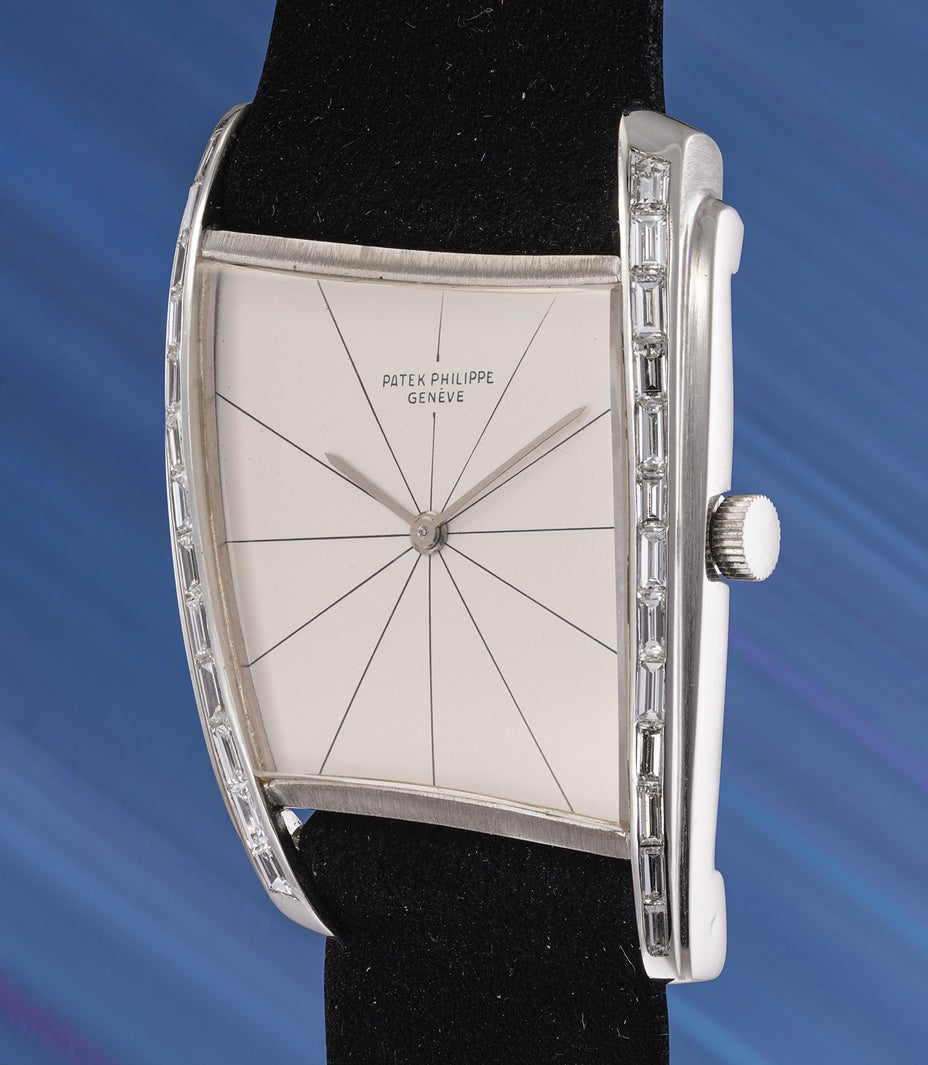
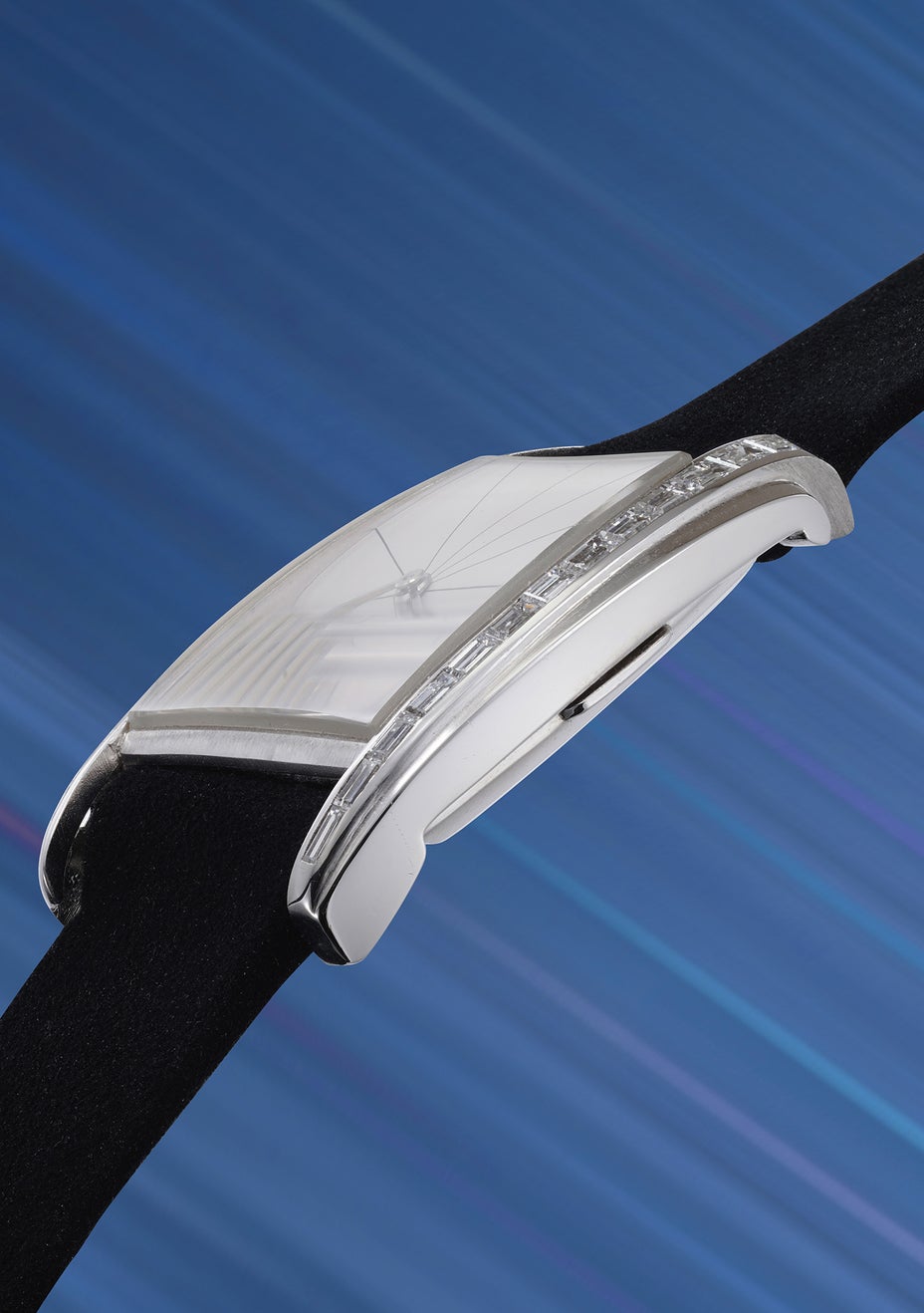
An exquisite, very elegant, fresh-to-the-market and extremely rare platinum and diamond-set asymmetric wristwatch designed by Gilbert Albert
- Estimate
- CHF100,000 - 200,000€108,000 - 216,000$126,000 - 251,000
CHF812,800
Lot Details
- Manufacturer
- Patek Philippe
- Year
- 1961
- Reference No
- 3424/1
- Movement No
- 857'432
- Case No
- 2'622'955
- Model Name
- "Gilbert Albert"
- Material
- Platinum
- Calibre
- Manual, cal. 8'''85, 18 jewels
- Bracelet/Strap
- Patek Philippe suede strap
- Clasp/Buckle
- Patek Philippe platinum pin buckle
- Dimensions
- 40mm Length and 27mm Width
- Signed
- Case, dial, movement and clasp signed
- Accessories
- Accompanied by Patek Philippe Extract form the Archives confirming production of the present watch in 1961 with 26 diamonds for approx 1.99 ct. and its subsequent sale on November 21, 1984
Specialist
Full-Cataloguing
Catalogue Essay
Gilbert Albert is beloved for his novel and daring designs that completely departed from the quotidian during the 1950s and 1960s. In 1955, Patek Philippe teamed up with the designer to produce a series of unusual wristwatches. The talented artist took inspiration from modern artists such as Brancusi and Mondrian, and his daring and unconventional case designs are considered as cutting-edge today as they were 60 years ago.
Fresh to the auction market, the present watch belongs to the famous “Asymétrie” collection of asymmetrical timepieces. While some of Albert’s modern designs never went beyond the prototype stage due to the uncertainty of their commercial success, Henri Stern, then chairman of Patek Philippe, was seduced by the present case design and approved its manufacture. Thus, reference 3424 was in fact produced, albeit in extremely limited numbers. The case maker chosen for this very unusual creation was Geneva-based Markowski (identified by the number 8 in a Key).
The watch here on offer, however, is not a simple 3424, but the much more exclusive /1 version denoting the sublime baguette diamond setting. Gem-set pieces commanded - back then as it is now - a remarkable increase in retail price (especially in the case of baguette-cut stones, such as in this instance), and the market was not yet very receptive of this trend. The situation is exemplified by the fact that the present watch was made in 1961 and sold more than two decades later, in 1984. One can then understand how restricted production of these pieces was. As a matter of fact, while 10 examples of reference 3424 in platinum are known, the present watch one of only four examples of the hyper-exclusive /1 gem-set version.
Fresh to the auction market, the present watch belongs to the famous “Asymétrie” collection of asymmetrical timepieces. While some of Albert’s modern designs never went beyond the prototype stage due to the uncertainty of their commercial success, Henri Stern, then chairman of Patek Philippe, was seduced by the present case design and approved its manufacture. Thus, reference 3424 was in fact produced, albeit in extremely limited numbers. The case maker chosen for this very unusual creation was Geneva-based Markowski (identified by the number 8 in a Key).
The watch here on offer, however, is not a simple 3424, but the much more exclusive /1 version denoting the sublime baguette diamond setting. Gem-set pieces commanded - back then as it is now - a remarkable increase in retail price (especially in the case of baguette-cut stones, such as in this instance), and the market was not yet very receptive of this trend. The situation is exemplified by the fact that the present watch was made in 1961 and sold more than two decades later, in 1984. One can then understand how restricted production of these pieces was. As a matter of fact, while 10 examples of reference 3424 in platinum are known, the present watch one of only four examples of the hyper-exclusive /1 gem-set version.
Patek Philippe
Swiss | 1839Since its founding in 1839, this famous Geneva-based firm has been surprising its clientele with superbly crafted timepieces fitted with watchmaking's most prestigious complications. Traditional and conservative designs are found across Patek Philippe's watches made throughout their history — the utmost in understated elegance.Well-known for the Graves Supercomplication — a highly complicated pocket watch that was the world’s most complicated watch for 50 years — this family-owned brand has earned a reputation of excellence around the world. Patek's complicated vintage watches hold the highest number of world records for results achieved at auction compared with any other brand. For collectors, key models include the reference 1518, the world's first serially produced perpetual calendar chronograph, and its successor, the reference 2499. Other famous models include perpetual calendars such as the ref. 1526, ref. 3448 and 3450, chronographs such as the reference 130, 530 and 1463, as well as reference 1436 and 1563 split seconds chronographs. Patek is also well-known for their classically styled, time-only "Calatrava" dress watches, and the "Nautilus," an iconic luxury sports watch first introduced in 1976 as the reference 3700 that is still in production today.
Browse Maker