185
Richard Diebenkorn
No. 7 (Ocean Park, Variation 7)
Estimate
$200,000–300,000
Sold For
$245,000
gouache, wax crayon on paper
25 x 18 in. (63.5 x 45.7 cm)
Initialed and dated "RD 71" lower left; further titled "variation #7" on the reverse.
Full-Cataloguing
The Ocean Park series, one of the most masterful and fascinating bodies of work in American art, were conceived after Richard Diebenkorn relocated to Southern California from the Bay Area in 1967. This series was important in that, not only it was the largest body of work he produced; it also offered new insights into the artist’s working process, stylistic evolution and artistic explorations. Diebenkorn worked and reworked his paintings and drawings, scraping and repainting again and again, stepping away from the work, assessing an area or a whole, returning and building up layers and abstract geometric relationships and lines as well as atmospheric fields and planes.
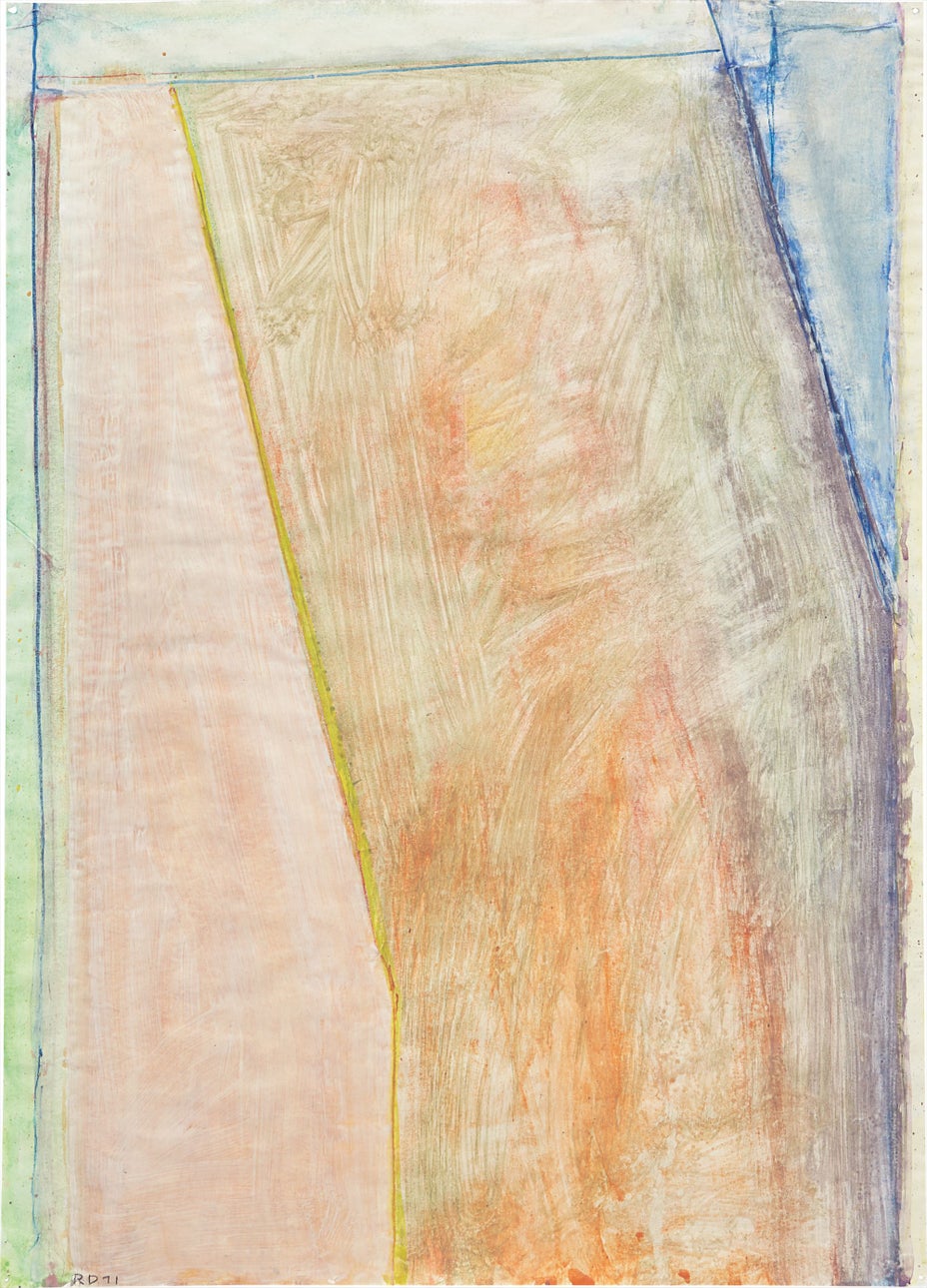
The present lot entitled No. 7 (Ocean Park, Variation 7), 1971 is an exceptional example of Diebenkorn’s earliest Ocean Park drawings. Spare and graphic, it presents a gestural exploration of color, light, form and shape. The various geometric panels featuring the cool and warm pastel shades of green, pink, yellow, grey and blue converge into a single composition with many planes divided by architectonic geometric lines of color. A thin rectangular band of pastel green is juxtaposed to a triangular panel of pinkish beige while a panel of earthy yellow merges into a smaller field of light grey. Although composed of numerous geometric shapes in various colors, the entire image dissolves into a satisfying whole and gains momentum through a mass of lines, subsequent structures and structural relationships. A combination of intention, intuition, and “improvisation,” the numerous strokes of gouache and pastel demonstrate emotions of anger, frustration, despair and relief, and contribute to a variety of textures. Instead of being a study for the paintings, this image is an exploration of “rightness” – an attempt to set up problems, to welcome mistakes, to encourage objectives, and to self-doubt only to result in a well-balanced composition.
The present lot entitled No. 7 (Ocean Park, Variation 7), 1971 is an exceptional example of Diebenkorn’s earliest Ocean Park drawings. Spare and graphic, it presents a gestural exploration of color, light, form and shape. The various geometric panels featuring the cool and warm pastel shades of green, pink, yellow, grey and blue converge into a single composition with many planes divided by architectonic geometric lines of color. A thin rectangular band of pastel green is juxtaposed to a triangular panel of pinkish beige while a panel of earthy yellow merges into a smaller field of light grey. Although composed of numerous geometric shapes in various colors, the entire image dissolves into a satisfying whole and gains momentum through a mass of lines, subsequent structures and structural relationships. A combination of intention, intuition, and “improvisation,” the numerous strokes of gouache and pastel demonstrate emotions of anger, frustration, despair and relief, and contribute to a variety of textures. Instead of being a study for the paintings, this image is an exploration of “rightness” – an attempt to set up problems, to welcome mistakes, to encourage objectives, and to self-doubt only to result in a well-balanced composition.