53Ο︎◆︎
Richard Prince
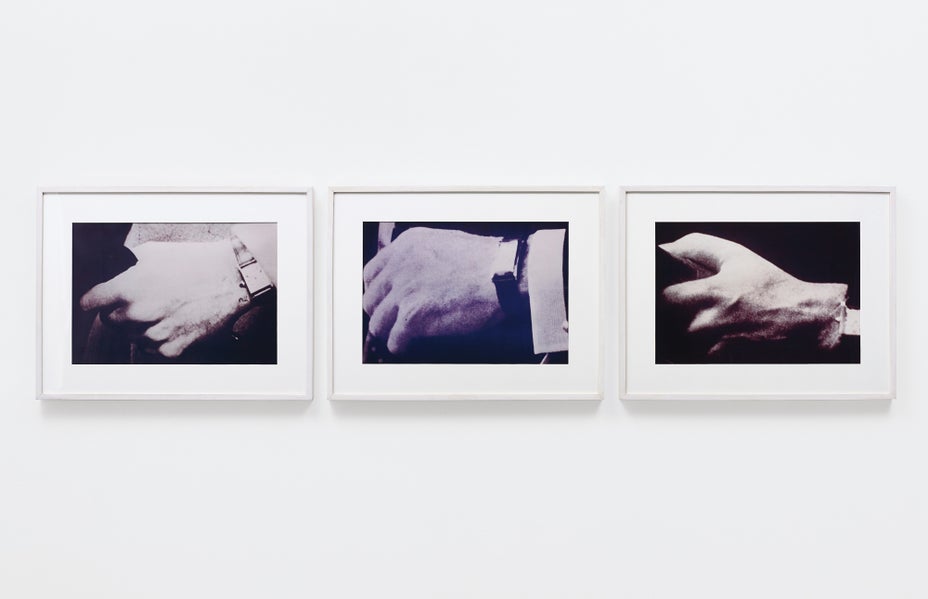
Untitled (Three Men's Hands with Watches)
each image 41.2 x 59.5 cm (16 1/4 x 23 3/8 in.)
Full-Cataloguing
This practice traces back to the late 1970s and to the artist’s arrival in New York City. Untitled (Three Men’s Hands with Watches) dates from this early period, and finds the artist in confident form. The images themselves are likely lifted from advertisements, but Prince attends to them as aesthetic concerns, somehow divorced from their ostensibly commercial purpose. Testifying to the primacy of image in and of itself, Prince relates that ‘in the first photographs, there were certain accessories that were re-photographed. Whether they were pens, watches, jewellery, I remember not having anything to do with the objects themselves other than having a relationship with the pictures of those objects.’ (Richard Prince in conversation with Marvin Heiferman, Bomb Magazine, Issue 24, Summer 1988).
Like many of the artist’s pieces from the period, the present lot comprises three photographs in series. As in Untitled (three women looking in the same direction) from the same year, it draws together a succession of compositional likenesses. Yet Prince finds variation amidst comparability, attuning the viewer to the peculiarities of each image. Grouped in this way, one notices distinguishing details: the tilt of the hand, the dilation of the veins, or the position of the watch-face. There is a trace, too, of the triptych – a compositional form prevalent in Christian art and iconography. In the piece’s valorisation of luxury goods, we witness the sanctification of the consumer image.
Discussing the appeal of the watch, Prince recalls ‘the way they were presented in say, the magazines, looking like living things. That’s what I liked. They look like they had egos.’ (Richard Prince in conversation with Marvin Heiferman, Bomb Magazine, Issue 24, Summer 1988). This notion of character pervades Untitled (Three Men’s Hands with Watches); latent not only in the watch, but in the images as wholes. Whilst it never crystallizes into narrative, the work has an undoubted sense of scene. These furled hands grip forms that extend beyond the frames. The ticking clock meanwhile presides over three discrete moments. It is in these fragments, these traces and suggestions of meaning, that the work finds its particular voice: a voice that emerges from a chorus of others through Prince’s distinctive visual alchemy.
Richard Prince
American | 1947For more than three decades, Prince's universally celebrated practice has pursued the subversive strategy of appropriating commonplace imagery and themes – such as photographs of quintessential Western cowboys and "biker chicks," the front covers of nurse romance novellas, and jokes and cartoons – to deconstruct singular notions of authorship, authenticity and identity.
Starting his career as a member of the Pictures Generation in the 1970s alongside such contemporaries as Cindy Sherman, Robert Longo and Sherrie Levine, Prince is widely acknowledged as having expanded the accepted parameters of art-making with his so-called "re-photography" technique – a revolutionary appropriation strategy of photographing pre-existing images from magazine ads and presenting them as his own. Prince's practice of appropriating familiar subject matter exposes the inner mechanics of desire and power pervading the media and our cultural consciousness at large, particularly as they relate to identity and gender constructs.