132
Richard Prince
Untitled (Massage)
This work is a unique working print.
Full-Cataloguing
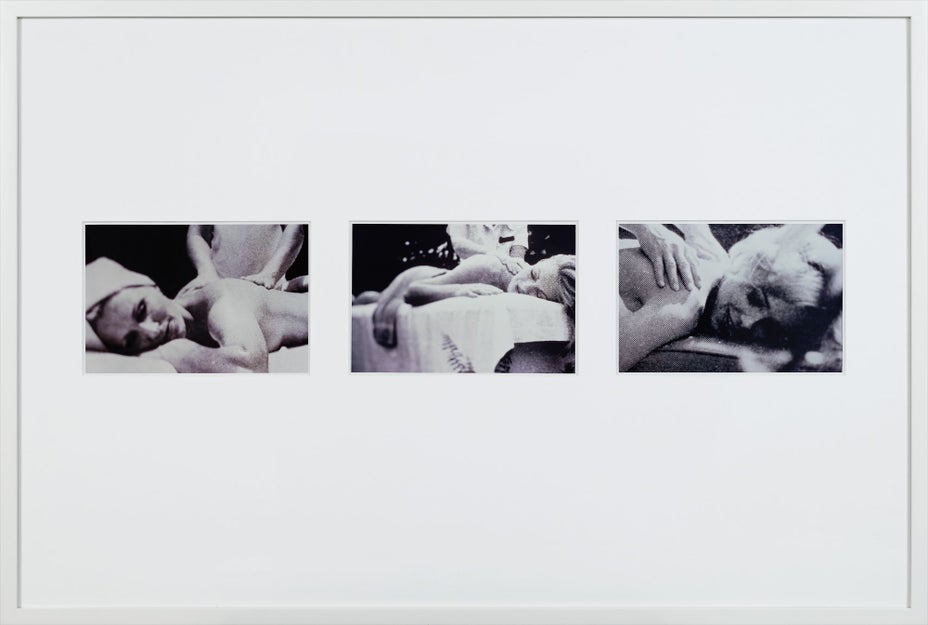
Through his inventive appropriation and restructuring of images, Richard Prince deftly investigates the truth of the photographic fact and at once transforms its reality into a tale that unfolds before us. His reinvention of what it means to exercise authorship enables his works to resonate as much with the viewer as the artist. His deeply-felt influences of American culture and the contemporary commodity cannot be overstated—a vast amount of his material is sourced directly from found advertisements and photographs, and it is his use of these commercial sources that allows him to rewrite their contexts. The present lot, Untitled (Massage), is a particularly powerful early example of Prince’s remarkable ability to disrupt the unique photograph through visual syntax, arranging the images as a triptych to draw upon their multiplicity, and illustrating the ubiquity of imagery in the American consciousness.
In 1980, at age 31, Prince found himself employed in the tear-sheet department at Time/Life, and his exposure to these processes enabled him to formulate a practice that solidified his position as one of the most paradigmatic artists of the late twentieth century. Untitled (Massage) is comprised of three distinct photographs, each featuring a woman in a state of total relaxation, framed by a set of ambiguous hands planted firmly between her shoulder blades. Her pleasure is immediate and palpable, her eyes closed and hands resting squarely on the table, and yet we cannot help but feel perturbed by the anonymity of her masseuse. Untitled (Massage) sees the dawn of Prince’s soon-to-be hallmark style of cinematic flair and reveals a great deal about the artist’s dynamic and evolving relationship with his subjects and technique. Although Prince identifies his practice as essentially additive to the formal processes inherent to collage, “instead of ripping [a] page out and pasting it up, the gesture [is] photographing the page, but in a way that look[s] like a photograph” (Marvin Heiferman, “Richard Prince,” BOMB, issue 24, Summer 1988).
Richard Prince
American | 1947For more than three decades, Prince's universally celebrated practice has pursued the subversive strategy of appropriating commonplace imagery and themes – such as photographs of quintessential Western cowboys and "biker chicks," the front covers of nurse romance novellas, and jokes and cartoons – to deconstruct singular notions of authorship, authenticity and identity.
Starting his career as a member of the Pictures Generation in the 1970s alongside such contemporaries as Cindy Sherman, Robert Longo and Sherrie Levine, Prince is widely acknowledged as having expanded the accepted parameters of art-making with his so-called "re-photography" technique – a revolutionary appropriation strategy of photographing pre-existing images from magazine ads and presenting them as his own. Prince's practice of appropriating familiar subject matter exposes the inner mechanics of desire and power pervading the media and our cultural consciousness at large, particularly as they relate to identity and gender constructs.