Priority Bidding is here! Secure a lower Buyer’s Premium today (excludes Online Auctions and Watches). Learn More

26

Richard Prince

Untitled (Publicity)

Estimate
HK$600,000 - 900,000
€67,500 - 101,000
$76,900 - 115,000
HK$750,000
Lot Details
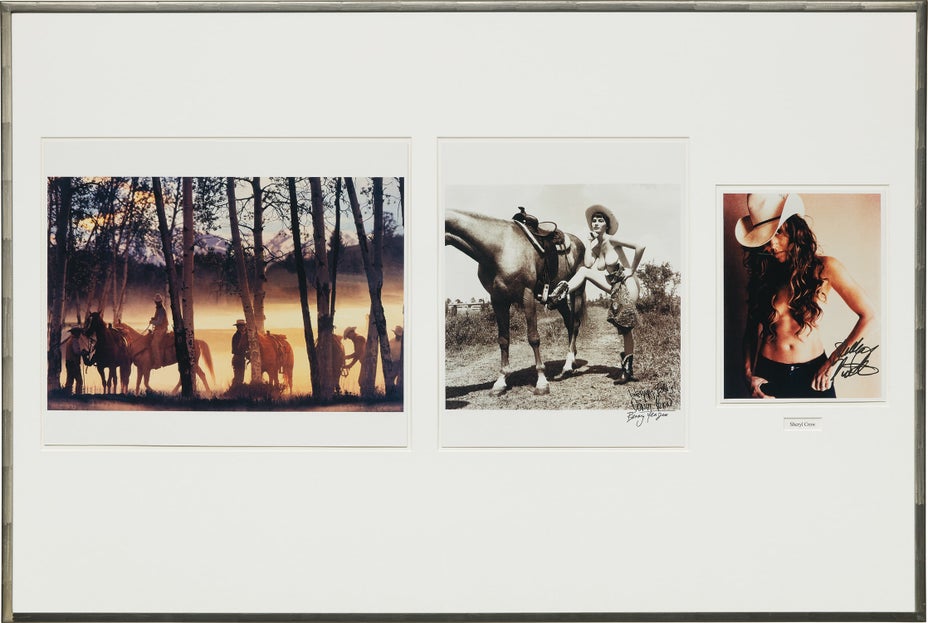
ink on color and black and white photographs in three parts and printed paper in the artist’s frame
signed, titled and dated ‘R. Prince 2003 "untitled"’ on the reverse
104.1 x 154.9 cm. (40 7/8 x 60 7/8 in.)
Executed in 2003.
Catalogue Essay
Richard Prince’s Untitled (Publicity) juxtaposes one of his most iconic images—that of the Marlboro Cowboy—with two publicity photographs of topless cowgirls. The cowboy photograph on the left exhibits Prince’s famed ‘rephotography’, a technique in which the artist photographs an advertisement—presently a Marlboro ad—and reoffers it as high art. A response to American consumerism and identity, Prince’s focus on Cowboys aimed to scrutinise the notions surrounding originality and authorship, and to deconstruct the privileged status of the unique art object. Prince began rephotographing these advertisement images after the Marlboro Man stopped being used in marketing materials for the cigarette brand. As Prince recalls, ‘without him as an identifying factor, it was easier to present these pictures as something other than they were.’ (Lisa Phillips, Richard Prince, New York, 1992, p. 95). Fittingly, his found publicity photographs, here pin-up Betty Page photographed by Bunny Yeager, and pop musician Sheryl Crow, take on new scrutiny and symbology when presented and framed alongside his own rephotograph, a reconstructed and appropriated version of truth. With the repetition of the cowgirl emphasised, these images explore the meaning behind ‘truth’ in pop culture, and thus are repositioned in order to reveal their collective superficiality. When considered alongside each other, one is able to draw comparisons between the ‘Marlboro Man’—an exaggerated, hyper-masculine icon as depicted by the all-American cowboy—and the pin-up girl—an overly sexualised and fetishised version of the all-American girl.

The merging of these three images thus perfectly capture Prince’s term ‘Spiritual America’, a sense of unattainable glamour: “‘Spiritual America addresses that broad cultural yearning for something more—and how it is often expressed in the most tawdry, illicit manner…the image has come to embody that strangely motivating desire on the part of the viewer to know, to have, and even to be the person in the frame.” (Nancy Spector, Richard Prince, 2008, p. 79)

Richard Prince

American | 1947
For more than three decades, Prince's universally celebrated practice has pursued the subversive strategy of appropriating commonplace imagery and themes – such as photographs of quintessential Western cowboys and "biker chicks," the front covers of nurse romance novellas, and jokes and cartoons – to deconstruct singular notions of authorship, authenticity and identity.Starting his career as a member of the Pictures Generation in the 1970s alongside such contemporaries as Cindy Sherman, Robert Longo and Sherrie Levine, Prince is widely acknowledged as having expanded the accepted parameters of art-making with his so-called "re-photography" technique – a revolutionary appropriation strategy of photographing pre-existing images from magazine ads and presenting them as his own. Prince's practice of appropriating familiar subject matter exposes the inner mechanics of desire and power pervading the media and our cultural consciousness at large, particularly as they relate to identity and gender constructs.
Browse Artist