20
Robert Frank
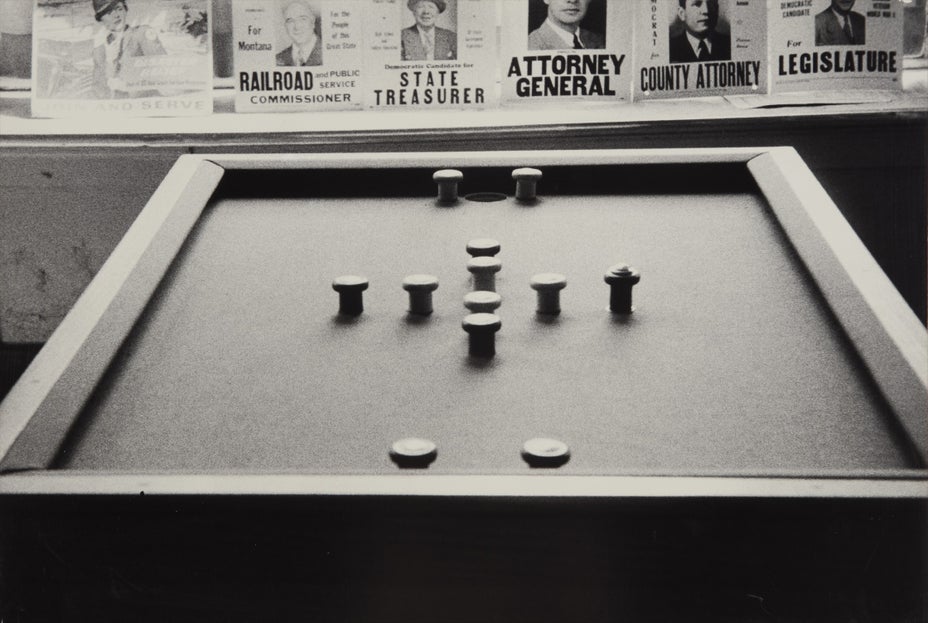
Luncheonette—Butte, Montana
Estimate
$40,000–60,000
Sold For
$56,250
1956
Gelatin silver print, printed no later than 1969.
12 5/8 x 18 3/4 in. (32.1 x 47.6 cm)
Signed and dated in ink on the reverse of the Masonite flush-mount.
Full-Cataloguing
This large print of Luncheonette—Butte, Montana was shown in The Photographs of Robert Frank, the important exhibition of Frank’s work which opened at the Philadelphia Museum of Art in 1969 and traveled to four other venues through 1971. The exhibition celebrated the publication of the 1969 edition of The Americans by Aperture and was curated by Aperture’s Michael Hoffman, also an adjunct curator at the Museum. This was the largest exhibition of Frank’s work to date, and was drawn almost exclusively from The Americans. According to Frank authority Sarah Greenough, the exhibition was notable for the size and quality of the prints. She writes: “Printed by Frank and the photographer Sid Kaplan, these photographs were larger than those he had made for his 1962 exhibition at MoMA and even more lush. Because of their size, the graphic strength of these images became far more apparent, as details that were lost in the approximately 4-by-7-inch or 8-by-5-inch reproductions in the book assumed much greater prominence and authority and were often transformed into bold, abstract forms. In addition, the luminosity and the sense that light was emanating from within the images was greatly magnified” (Looking In: Robert Frank’s The Americans, p. 317).
Robert Frank
Swiss | 1924As one of the leading visionaries of mid-century American photography, Robert Frank has created an indelible body of work, rich in insight and poignant in foresight. In his famed series The Americans, Frank travelled the United States, capturing the parade of characters, hierarchies and imbalances that conveyed his view of the great American social landscape.
Frank broke the mold of what was considered successful documentary photography with his "snapshot aesthetic." It is Frank's portrayal of the United States through grit and grain that once brought his work to the apex of criticism, but has now come to define the art of documentary photography.