97
Rolex
Ref. 3668
Monoblocco
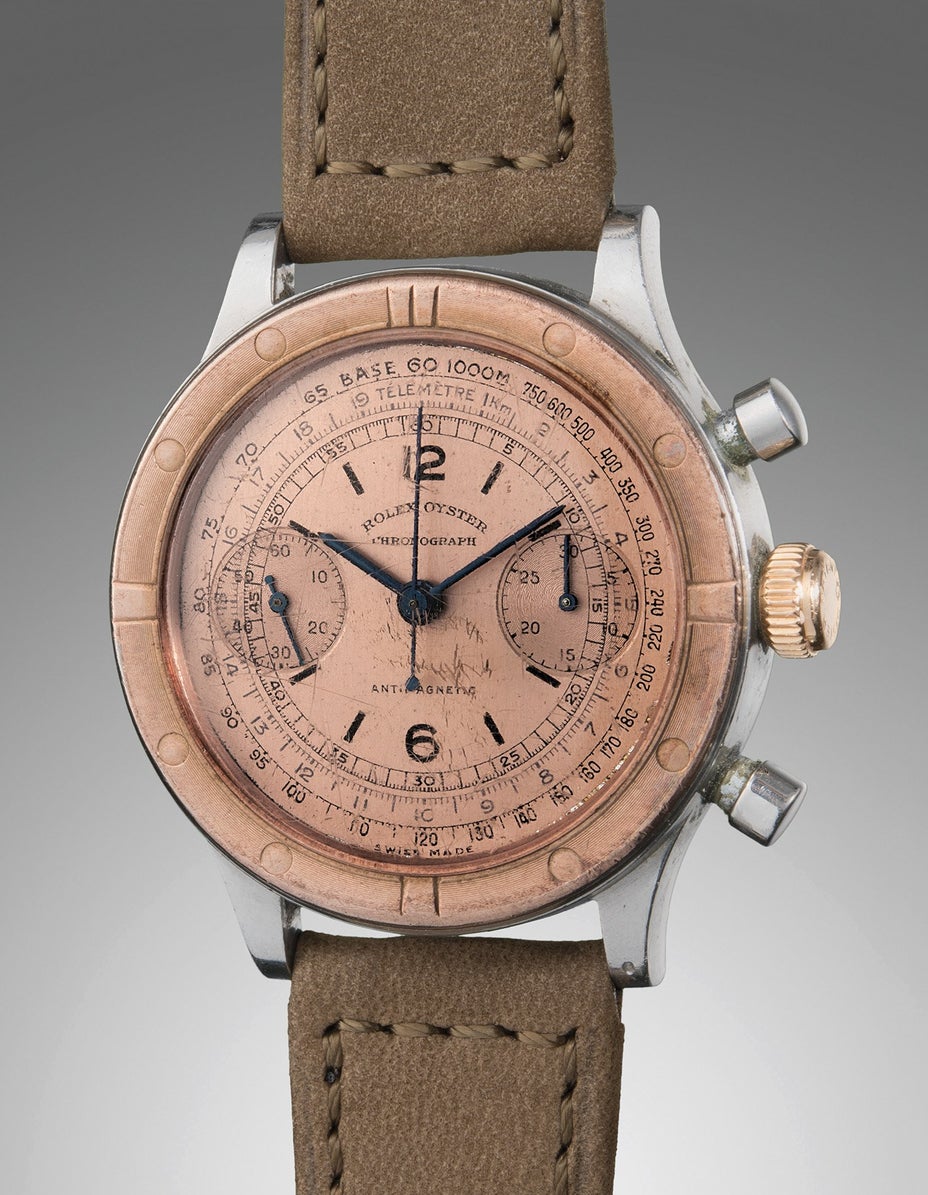
A fine, extremely rare, and very early stainless steel and pink gold chronograph wristwatch with salmon dial, tachymeter, and telemeter scales
Full-Cataloguing
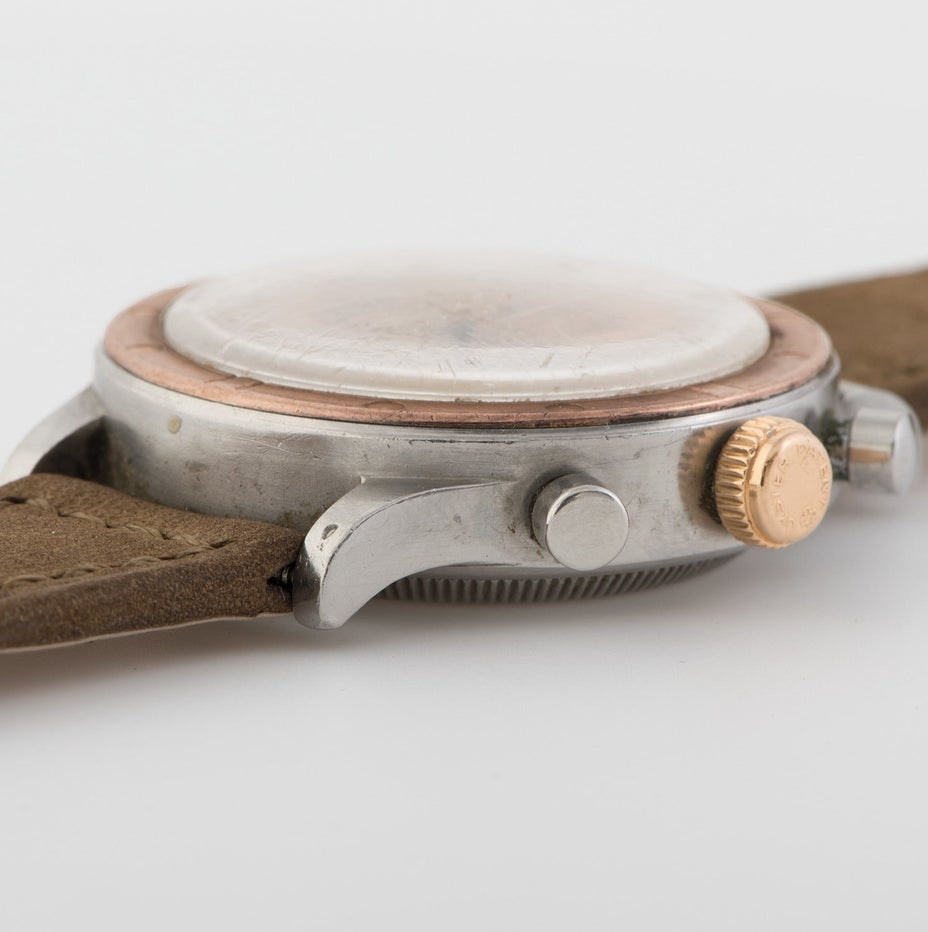
Documented in literature, but rarely seen on the open market, the reference 3668 is amongst Rolex’s earliest Oyster chronographs – alongside the well-known and highly coveted reference 3525. The 3668 differs from the 3525 with its unusual precious metal bezel, thus far documented only in pink or yellow gold. The first Oyster chronographs were released in the late 1930s, when the Second World War was ramping up in Europe, and they never attained much popularity with the public. In fact, only about thirty examples of the 3668 are believed to have been produced, making this an incredibly rare and fascinating reference. Pucci Papaleo, in his monolith publication I Cronografi Rolex – La Leggenda, comments that this specific type of reeded bezel, with circular and rectangular hour markers, is usually seen on the "Ovetto" or "Bubbleback" type watches, such as the reference 3372.
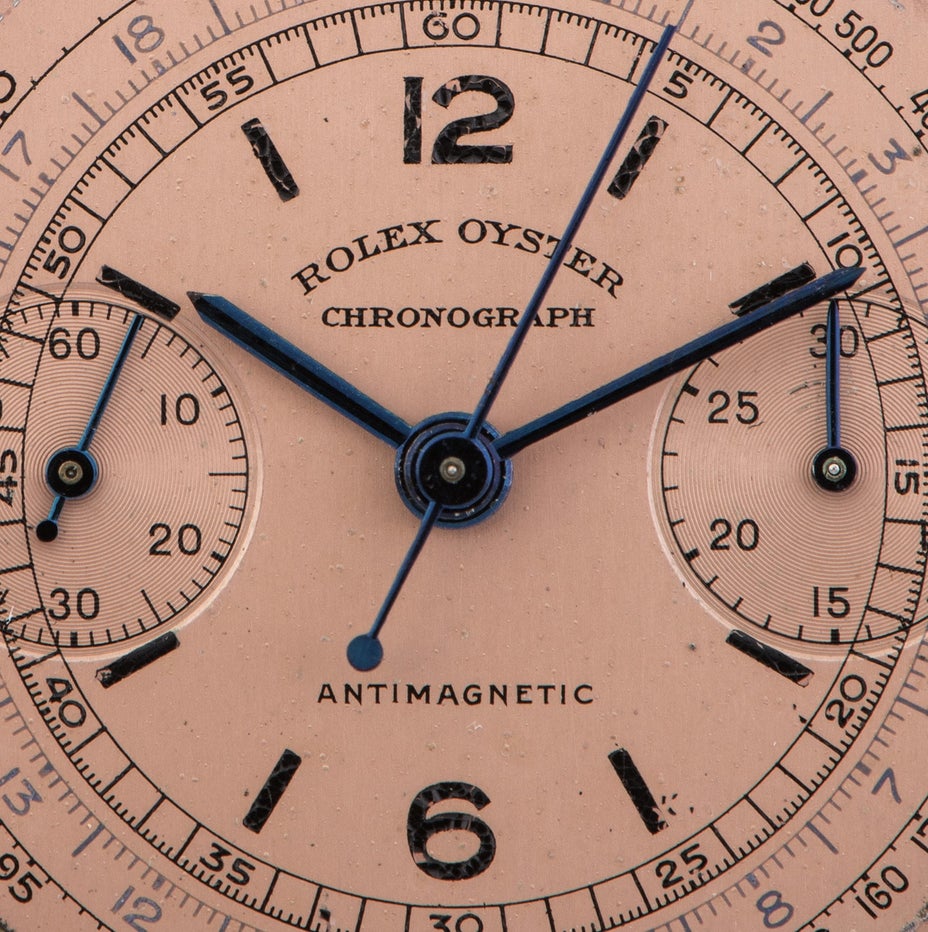
The dial is much more familiar, closely resembling that of the reference 3525, and combining both a tachymeter and telemeter scale. The dial itself is a lovely rose color, almost matching in hue to the pink gold bezel. The boldly printed inner dial and numerals, coupled with the sharp blued steel handset, make the dial both immensely charming and highly legible.
Only a handful of reference 3668s have surfaced publicly in recent history, and very few in as stunning original condition as the present example. And to the best of our knowledge, none have been discovered at a local thrift shop. The present watch offers the unique opportunity to own a truly fresh-to-the-market timepiece that adds a small link in the DNA chain of early Rolex Oyster chronograph history.
Rolex
Swiss | 1905Founded in 1905 England by Hans Wilsdorf and Alfred Davis as Wilsdorf & Davis, it soon became known as the Rolex Watch Company in 1915, moving its headquarters to Geneva in 1919. Like no other company, the success of the wristwatch can be attributed to many of Rolex's innovations that made them one of the most respected and well-known of all luxury brands. These innovations include their famous "Oyster" case — the world's first water resistant and dustproof watch case, invented in 1926 — and their "Perpetual" — the first reliable self-winding movement for wristwatches launched in 1933. They would form the foundation for Rolex's Datejust and Day-Date, respectively introduced in 1945 and 1956, but also importantly for their sports watches, such as the Explorer, Submariner and GMT-Master launched in the mid-1950s.
One of its most famous models is the Cosmograph Daytona. Launched in 1963, these chronographs are without any doubt amongst the most iconic and coveted of all collectible wristwatches. Other key collectible models include their most complicated vintage watches, including references 8171 and 6062 with triple calendar and moon phase, "Jean Claude Killy" triple date chronograph models and the Submariner, including early "big-crown" models and military-issued variants.