

12
Rolex
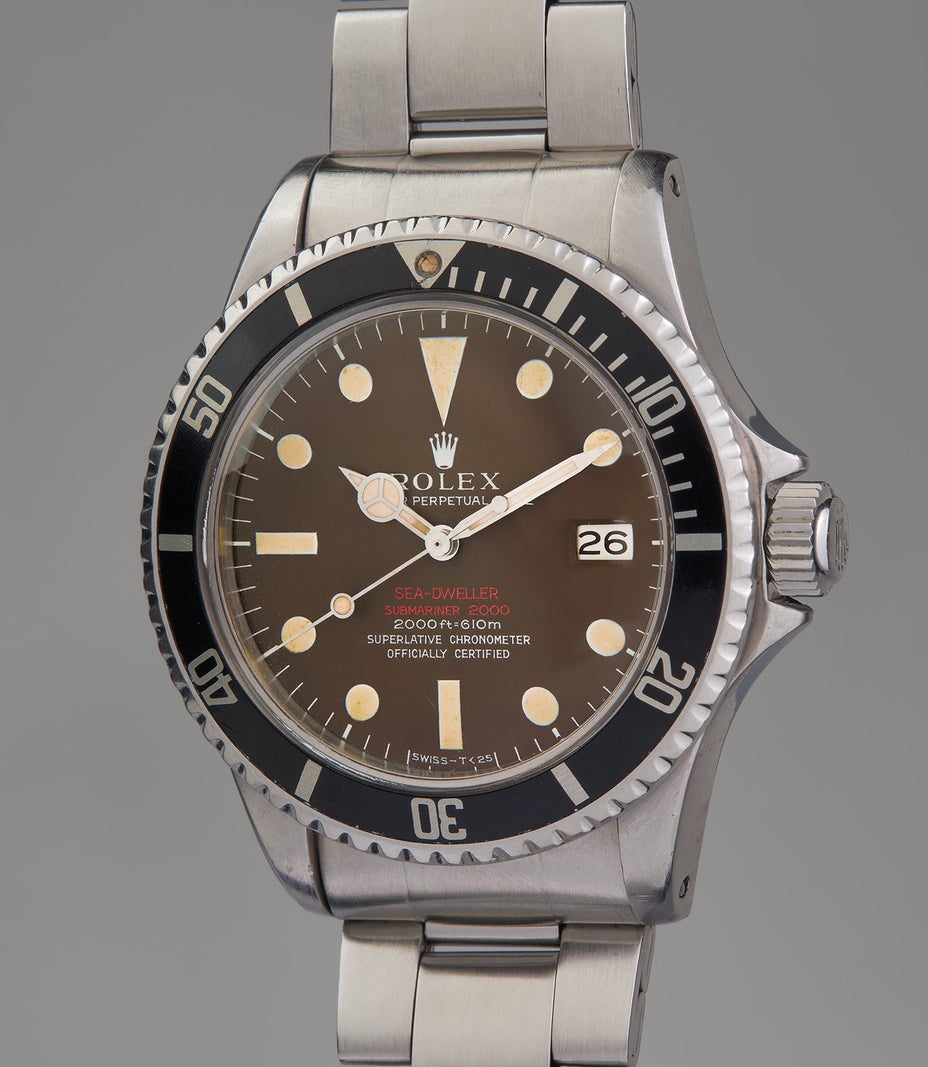
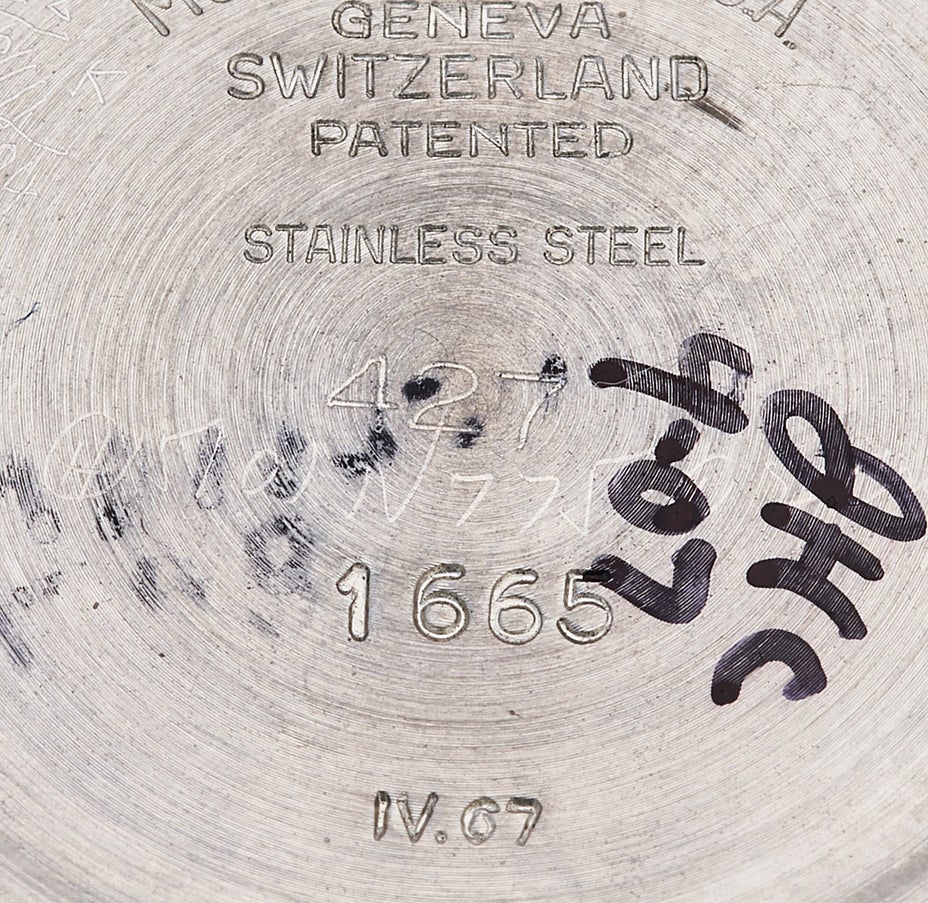
Ref. 1665; inner caseback stamped IV.67 and 427
Sea-Dweller “Double Red”
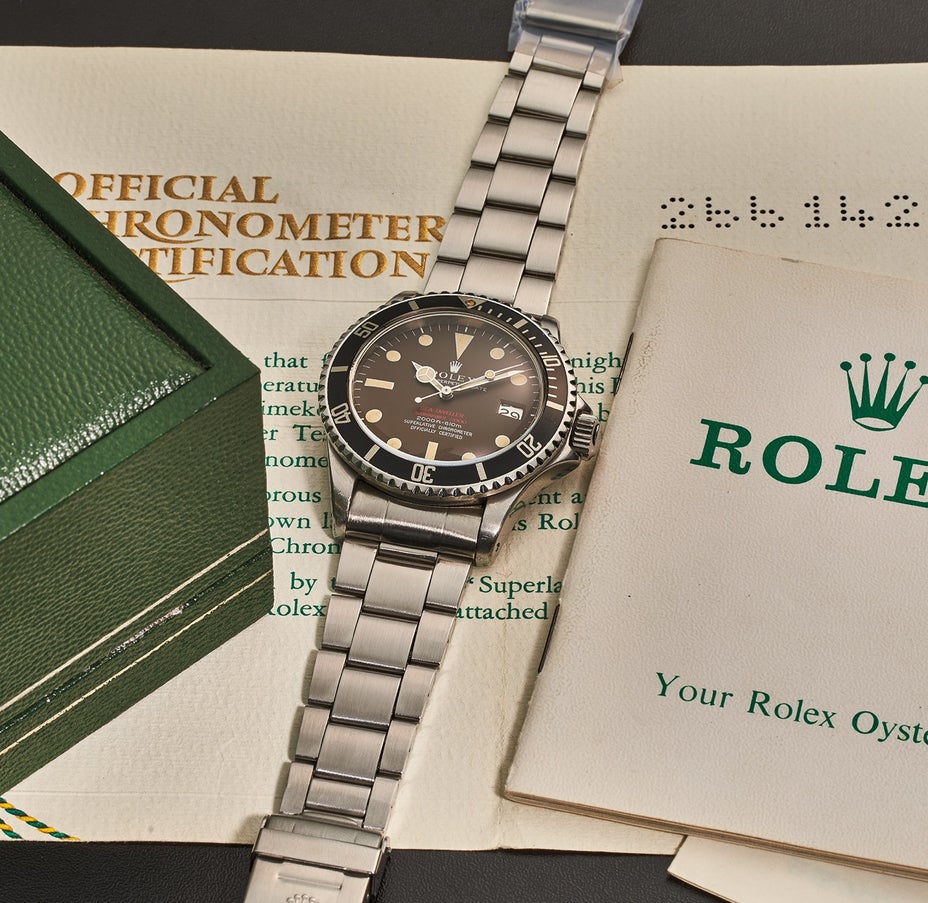
A rare and attractive stainless steel wristwatch with date, “tropical” dial, helium escape valve, bracelet, chronometer certificate, punched guarantee card, and inner and outer presentation boxes
- Estimate
- $40,000 - 80,000
$125,000
Lot Details
- Manufacturer
- Rolex
- Year
- 1968
- Reference No
- 1665; inner caseback stamped IV.67 and 427
- Movement No
- D’984’571
- Case No
- 2’661’427
- Model Name
- Sea-Dweller “Double Red”
- Material
- Stainless steel
- Calibre
- Automatic, cal. 1570, 26 jewels
- Bracelet/Strap
- Stainless steel Rolex Oyster bracelet, reference 9315, endlinks stamped 380, max. length 215mm
- Clasp/Buckle
- Stainless steel Rolex Oyster deployant clasp
- Dimensions
- 40mm Diameter
- Signed
- Case, dial, movement, and bracelet signed.
- Accessories
- Accompanied by fitted inner and outer presentation boxes, product literature, punched guarantee card dated May 29th, 1972 by Italian retailer Hausmann, punched chronometer certificate, and hangtag.
Specialist
Full-Cataloguing
Catalogue Essay
In 1967, the Sea-Dweller joined the Milgauss, Daytona, Submariner, and GMT-Master as part of Rolex’s tool watch line up. The Sea-Dweller may on the surface seem redundant to the Submariner, which could at the time reach a respectable 660 feet, more than necessary for most divers. However, Rolex wanted to accompany those pioneers seeking to reach the deepest parts of the ocean. Shortly after, the Sean Dweller was born, for those determined to push the limitations of humanity. In the post-World War II Rolex – A rare and attractive stainless steel wristwatch with date, “tropical” dial, helium escape valve, bracelet, chronometer certificate, punched guarantee card, and inner and outer presentation boxes era, where scientific developments had accelerated with the innovation of the war years, projects such as SEALAB, the underwater parallel to the Space Race, saw its first underwater habitat successfully tested in 1964 (astronaut Scott Carpenter of Mercury 7 was among the four “aquanauts” sent to live for eleven days in the SEALAB I habitat).
Instrumental to the development of the Sea-Dweller was Robert “Bob” Barth, the only member of the Navy Experimental Diving Unit to participate and dive in all three SEALAB missions, and reaching a depth of 1,025 feet. He, in partnership with a Rolex U.S.A. executive, took up the mantle of solving the issue of the team’s Submariners’ crystal popping of due to the build-up of helium molecules. Together, they solved the problem by incorporating an ingenious helium escape valve (HEV) into the left side of the Sea-Dweller case, a revolutionary invention now in use by so many brands today.
The present Rolex Sea-Dweller, bearing the serial number 2’661’427, has been preserved in beautiful original condition and is fitted with a remarkable “tropical” dial that uniformly aged to a stunning milk chocolate brown color. The dial details are characteristic of the Mark II variant of DRSD dials, with the small oval at the base of the coronet and the “D” in “Dweller” aligned with the “I” in “Submariner”. Typical of the earliest of Sea-Dwellers, the current example has the last three digits of the serial numbers engraved on the inside caseback. Moreover, it retains its original accessories, including its guarantee, as well as the hardly ever seen punched chronometer certificate.
Instrumental to the development of the Sea-Dweller was Robert “Bob” Barth, the only member of the Navy Experimental Diving Unit to participate and dive in all three SEALAB missions, and reaching a depth of 1,025 feet. He, in partnership with a Rolex U.S.A. executive, took up the mantle of solving the issue of the team’s Submariners’ crystal popping of due to the build-up of helium molecules. Together, they solved the problem by incorporating an ingenious helium escape valve (HEV) into the left side of the Sea-Dweller case, a revolutionary invention now in use by so many brands today.
The present Rolex Sea-Dweller, bearing the serial number 2’661’427, has been preserved in beautiful original condition and is fitted with a remarkable “tropical” dial that uniformly aged to a stunning milk chocolate brown color. The dial details are characteristic of the Mark II variant of DRSD dials, with the small oval at the base of the coronet and the “D” in “Dweller” aligned with the “I” in “Submariner”. Typical of the earliest of Sea-Dwellers, the current example has the last three digits of the serial numbers engraved on the inside caseback. Moreover, it retains its original accessories, including its guarantee, as well as the hardly ever seen punched chronometer certificate.
Rolex
Swiss | 1905Founded in 1905 England by Hans Wilsdorf and Alfred Davis as Wilsdorf & Davis, it soon became known as the Rolex Watch Company in 1915, moving its headquarters to Geneva in 1919. Like no other company, the success of the wristwatch can be attributed to many of Rolex's innovations that made them one of the most respected and well-known of all luxury brands. These innovations include their famous "Oyster" case — the world's first water resistant and dustproof watch case, invented in 1926 — and their "Perpetual" — the first reliable self-winding movement for wristwatches launched in 1933. They would form the foundation for Rolex's Datejust and Day-Date, respectively introduced in 1945 and 1956, but also importantly for their sports watches, such as the Explorer, Submariner and GMT-Master launched in the mid-1950s.One of its most famous models is the Cosmograph Daytona. Launched in 1963, these chronographs are without any doubt amongst the most iconic and coveted of all collectible wristwatches. Other key collectible models include their most complicated vintage watches, including references 8171 and 6062 with triple calendar and moon phase, "Jean Claude Killy" triple date chronograph models and the Submariner, including early "big-crown" models and military-issued variants.
Browse Maker