Priority Bidding is here! Secure a lower Buyer’s Premium today (excludes Online Auctions and Watches). Learn More
US import tariffs: Non-US origin lots in this sale (including watches and timepieces with Swiss-made or non-US made movements) will be subject to special tariffs upon import to the USA, currently ranging from 10% to 39% on the total invoice price (hammer price plus buyer’s premium). Buyers are responsible for paying any applicable tariffs, duties, taxes and charges when importing their purchased lots. Due to the evolving nature of international trade regulations, we recommend clients consult with their local customs office or advisor for up-to-date information on the applicable tariffs.

52

Rolex

Ref. 16528

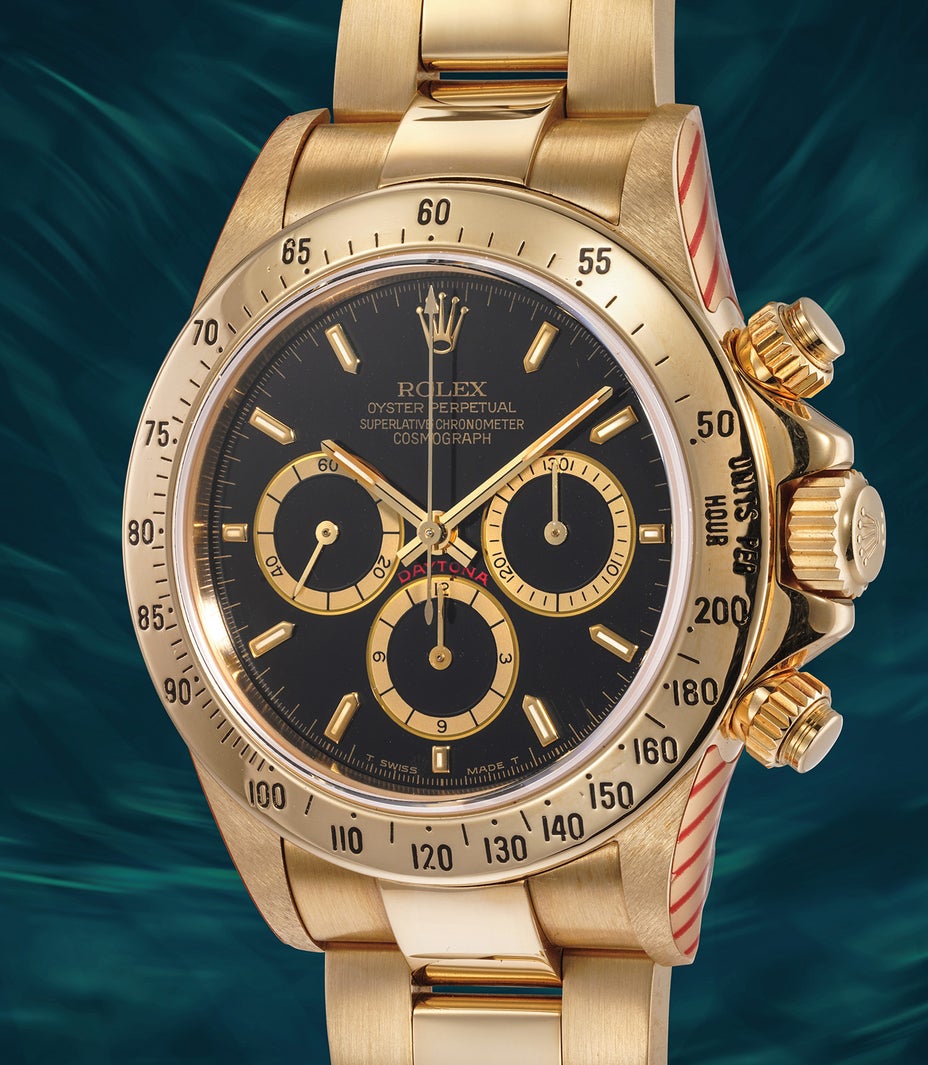
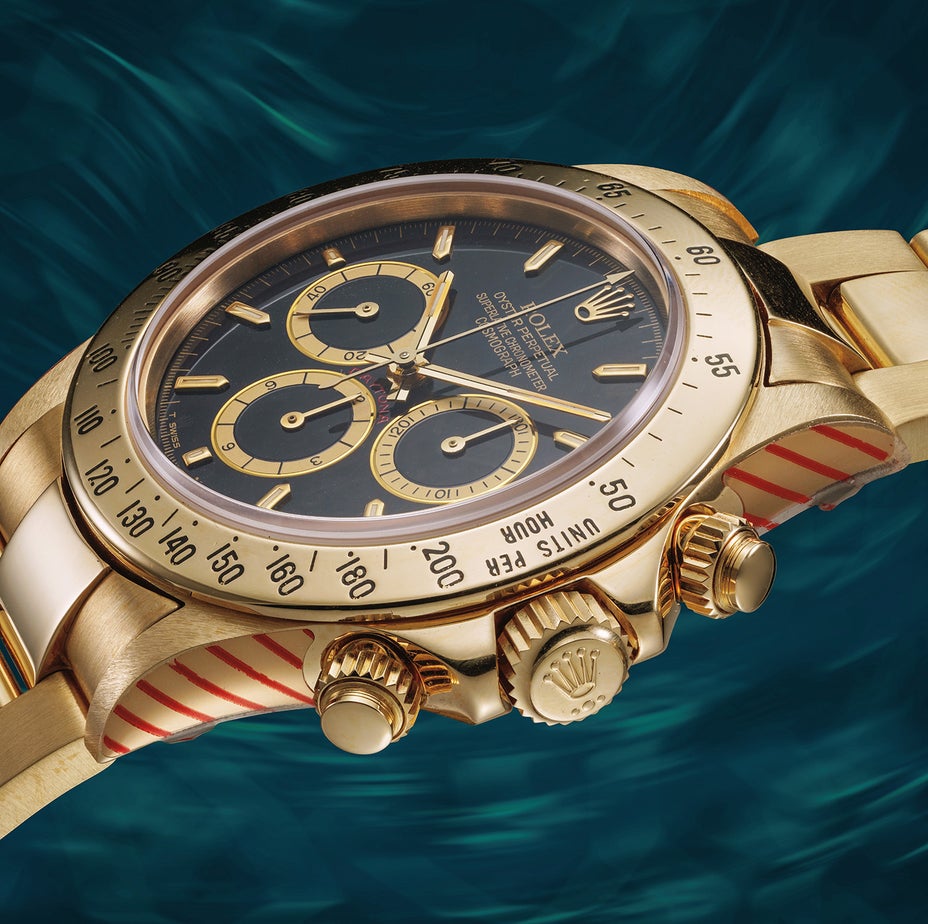
Cosmograph Daytona, "4-Liner", "4 Scritte"

An early and sought-after yellow gold automatic chronograph wristwatch with "4-liner" black dial, bracelet, guarantee and service guarantee

Estimate
CHF30,000 - 60,000
€32,400 - 64,700
$37,700 - 75,400
CHF60,960
Lot Details
Manufacturer
Rolex
Year
Circa 1991
Reference No
16528
Movement No
32'319
Case No
L874595
Model Name
Cosmograph Daytona, "4-Liner", "4 Scritte"
Material
18k yellow gold
Calibre
Automatic, cal. 4030, 31 jewels
Bracelet/Strap
18k yellow gold Rolex Oyster bracelet stamped "103" to the endlinks, max length 195 mm
Clasp/Buckle
18k yellow gold Rolex deployant clasp stamped "78668" and "N4"
Dimensions
40mm diameter
Signed
Case, dial, movement and clasp signed
Accessories
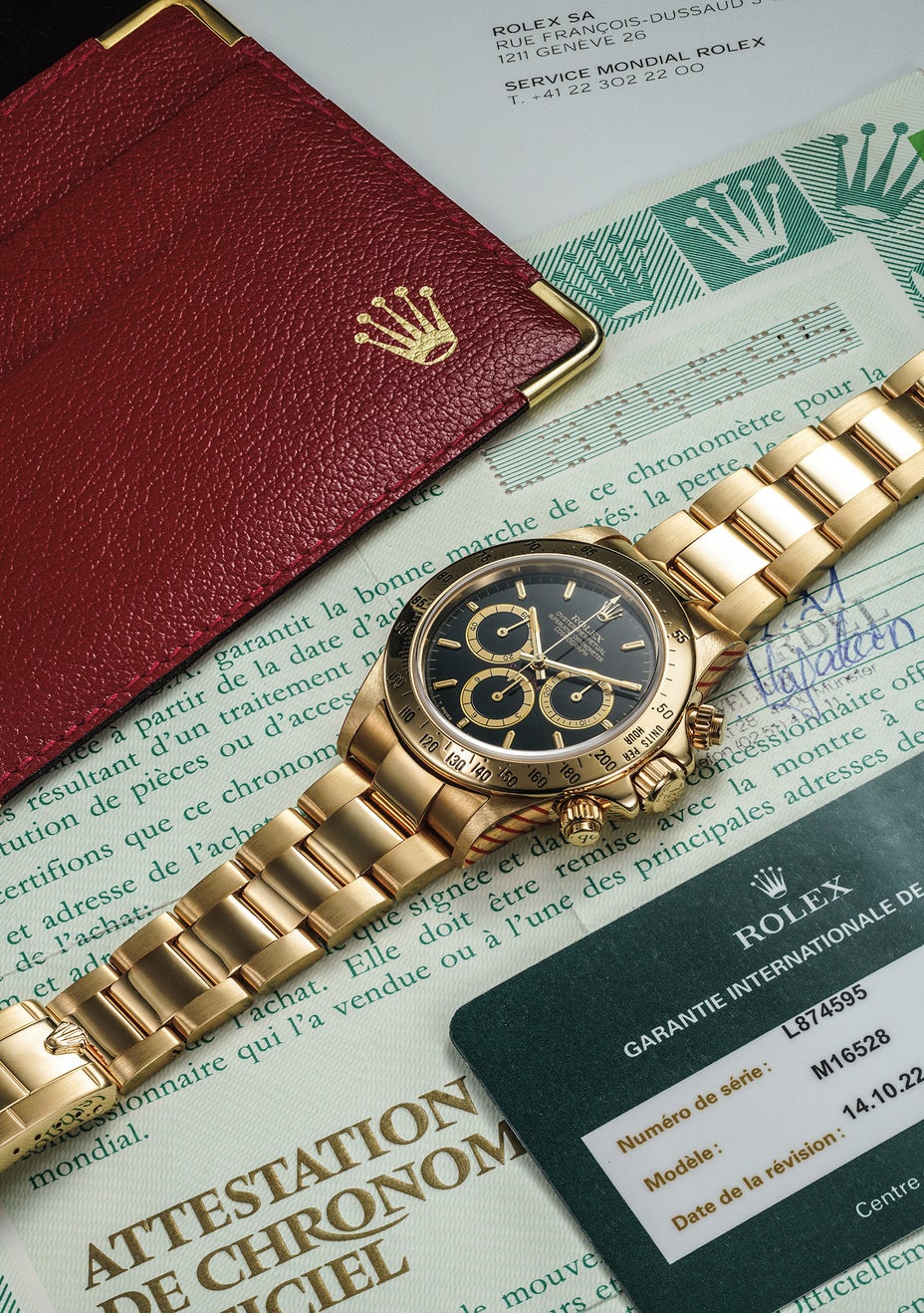
Accompanied by Rolex punched Guarantee stamped by Munich retailer "Oeding-Erdel" and dated December 5, 1991, Service Guarantee card date October 14, 2022, service invoice dated October 14, 2022 and document holder.
Catalogue Essay
Introduced in 1988, the Rolex Daytona reference 16528 marked a bold evolution for the iconic chronograph—ushering in the era of automatic movements and solid gold opulence. Crafted in 18K yellow gold, it was part of the first series of Daytona models to feature the self-winding Zenith El Primero-based calibre 4030, together with its stainless steel, and steel&gold models 16520 and 16523. Among the early examples of these models, the so-called “4-liner” dial—with just four lines of text below the 12 o’clock marker—is a highly collectible rarity. It appears usually in the L serial range, after the earliest floating dials (featuring five lines of text, but the fifth one removed from the other 4 by markedly larger spacing) and before the later standard five liners. It appears that Rolex could not live for more than a few months without making sure the world knows their movements are “Officially Certified”.

The 4-liner dial offers a cleaner, more balanced aesthetic that appeals to purists and collectors alike. Often paired with glossy black or white dials and contrasting sub-registers, these early executions exude a minimalist refinement that sets them apart from later models. Combined with the full yellow gold case, screw-down pushers, and matching Oyster bracelet, the result is a striking and historically significant watch at the intersection of tool and luxury.

Early 16528s with 4-line dials are increasingly coveted for their transitional status and extreme scarcity. As the first automatic, all-gold Daytona, the reference 16528 holds a key place in Rolex’s chronograph legacy. The present example of this coveted model is not only offered complete of its original 1991 Warranty, but also with a Rolex service invoice dated 2022.

Rolex

Swiss | 1905
Founded in 1905 England by Hans Wilsdorf and Alfred Davis as Wilsdorf & Davis, it soon became known as the Rolex Watch Company in 1915, moving its headquarters to Geneva in 1919. Like no other company, the success of the wristwatch can be attributed to many of Rolex's innovations that made them one of the most respected and well-known of all luxury brands. These innovations include their famous "Oyster" case — the world's first water resistant and dustproof watch case, invented in 1926 — and their "Perpetual" — the first reliable self-winding movement for wristwatches launched in 1933. They would form the foundation for Rolex's Datejust and Day-Date, respectively introduced in 1945 and 1956, but also importantly for their sports watches, such as the Explorer, Submariner and GMT-Master launched in the mid-1950s.One of its most famous models is the Cosmograph Daytona. Launched in 1963, these chronographs are without any doubt amongst the most iconic and coveted of all collectible wristwatches. Other key collectible models include their most complicated vintage watches, including references 8171 and 6062 with triple calendar and moon phase, "Jean Claude Killy" triple date chronograph models and the Submariner, including early "big-crown" models and military-issued variants.
Browse Maker