15
Ron Mueck
Man in Blankets
Estimate
$500,000–700,000
Sold For
$447,000
mixed media
15 x 18 x 28 in. (38.1 x 45.7 x 71.1 cm)
Executed in 2000, this work is number 1 from an edition of 1 plus 1 artist's proof.
Full-Cataloguing
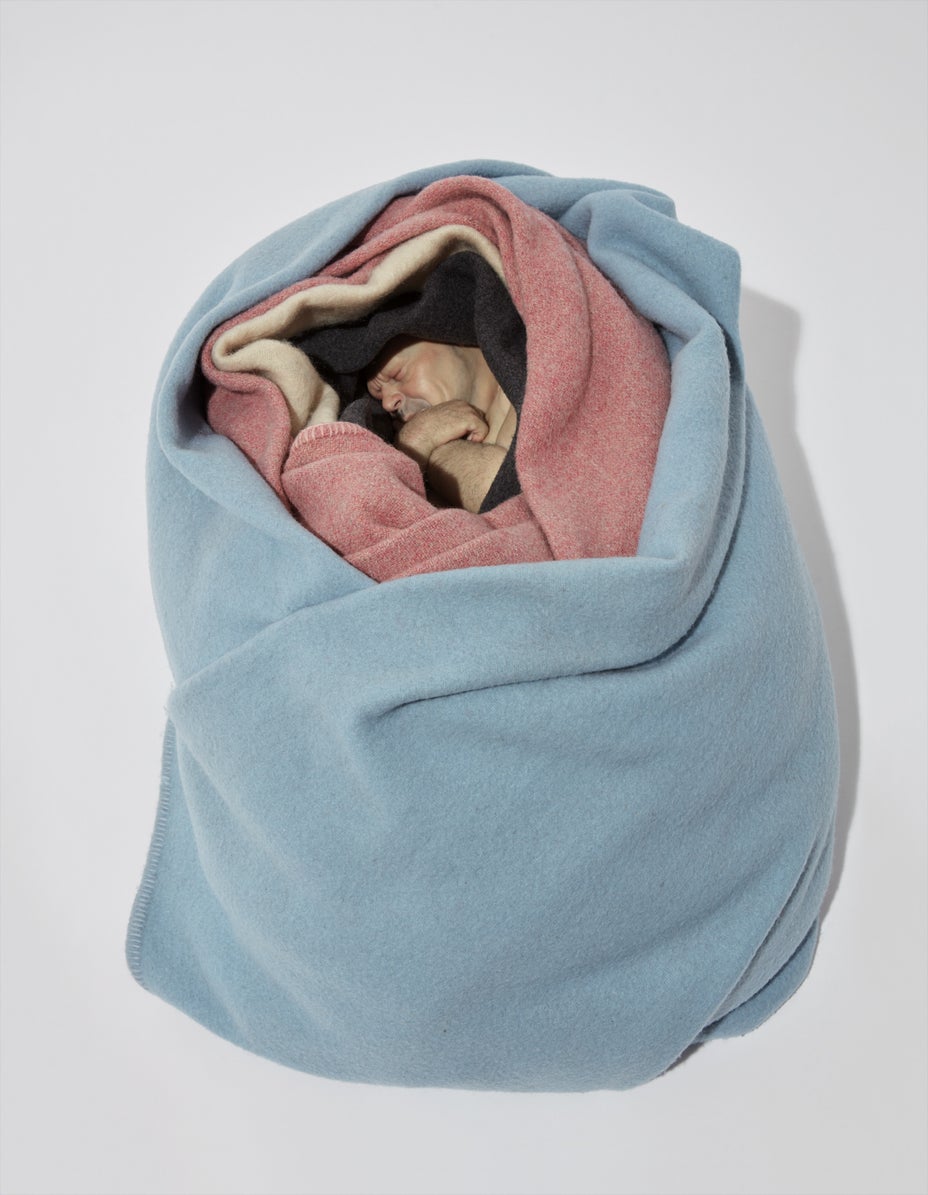
Achieving unparalleled verisimilitude and commanding an arresting position between the natural and the surreal, Ron Mueck’s Man in Blankets, 2000, provides a captivating thesis on the human condition. As one of the most intimate works in the artist’s oeuvre, here Mueck has created a miniaturized likeness of a sleeping man, swaddled in womb-like folds of felt. Disquieting in its hyper-reality, this presentation of an elderly subject as a child deftly probes notions of human care and the cycle of mortality. Providing an all-too-real allegory of truth and lies, it was sculptures similar to the present one that first captivated influential collector Charles Saatchi, who subsequently acquired many of Mueck’s works and included the artist in the groundbreaking Sensation exhibition of 1997 that launched the YBA movement. Created in 2000, when Mueck began his two year tenure as Associate Artist at the National Gallery in London, this important work stems from a crucial point in the artist’s career and stands as testament to his enduring institutional recognition across the globe, evidenced most recently in his solo exhibitions at the Museum of Fine Arts, Houston, in 2017 and the Modern Art Museum of Fort Worth in 2018.
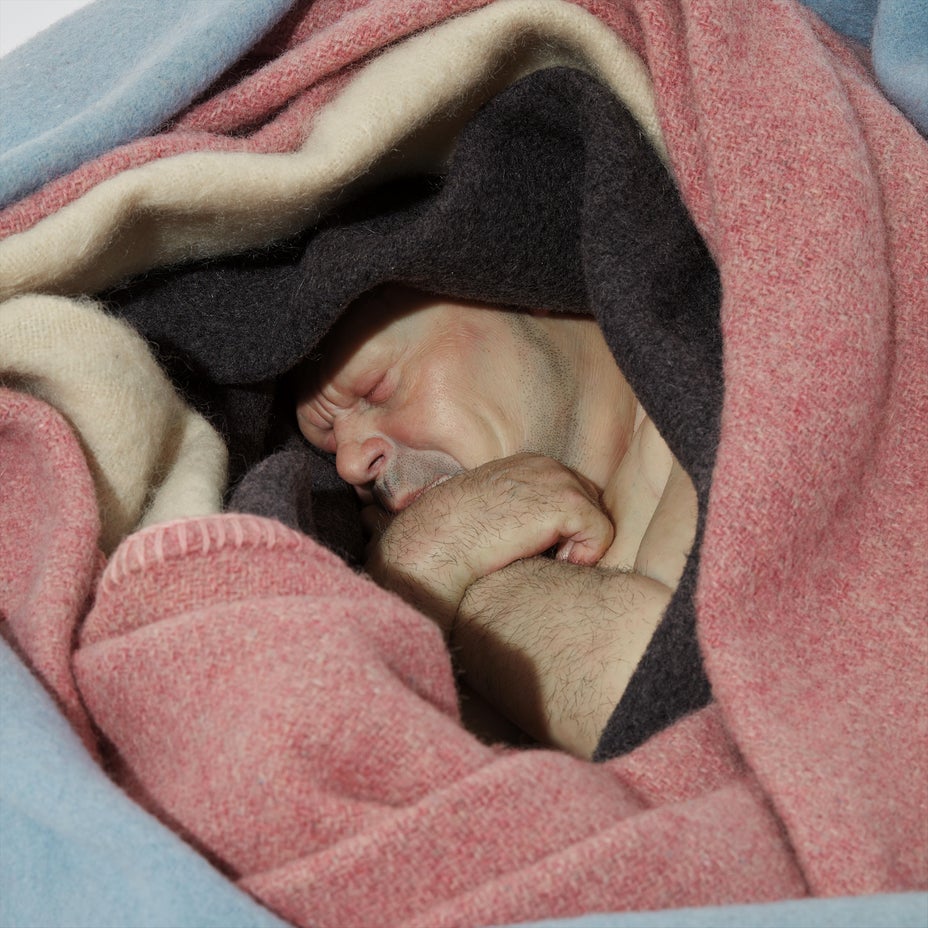
It is Mueck’s unparalleled virtuosity and ability to capture an uncanny essence off humanity that has sustained his widespread appreciation. Mueck builds works such as Man in Blankets through a multilayered process that begins with drawing and transitions through clay maquettes that are then cast in fiber glass. These casts are painted with meticulous detail and applied with human hair. From the corporal translucency of the skin, to the varied depth of wrinkles, enlarged pores and facial stubble, it is the virtuosic micro-detailing of Man in Blankets that imbues the figure with a captivating realism that we are instantly drawn to recognize elements of ourselves within. Mueck’s perpetual play with scale soon shatters this illusion however, and we experience a profound sense of distance as we realize that the humanity we view is merely a projection, a facade. The artist has neatly summarized this deep sense of intrigue: “I never made life-size figures because it never seemed to be interesting. We meet life-size people every day” (Ron Mueck, quoted in Sarah Tanguy, “The Progress Big Man A Conversation with Ron Mueck”, Sculpture, vol. 26, no. 6, July-August 2003, online).
The exquisitely molded furrows of the figure's brow all gather towards an emotional intensity that elicits an empathetic reaction from the viewer. But the social dimension of this empathy is confused by Mueck’s challenge to scale and identity. The swaddled figure is far closer to the size of a newborn baby than an elderly male. Sleeping tensely in the fetal position, the figure presented in Man with Blankets, offers a compendium of the cycle of life – from birth to old age – with an emotive thread of vulnerability binding this holistic arc. Crucially the blanket sets up a theatrical viewing situation in which we peer into the orifice-like opening to enter the soft psychological realm of the infantilized sleeping adult. As such, it is reminiscent of Marcel Duchamp’s last major artwork, Étant donnés, 1946-66, which showed the tableau of a nude female visible only through two small peepholes. But unlike Duchamp, Mueck plays with a less sinister voyeurism by privileging the beauty of human vulnerability. Tensely sleeping in a dream state, between anguish and comfort, Man in Blankets provides a moving portrait of the fragility and temporality of human life.
It is Mueck’s unparalleled virtuosity and ability to capture an uncanny essence off humanity that has sustained his widespread appreciation. Mueck builds works such as Man in Blankets through a multilayered process that begins with drawing and transitions through clay maquettes that are then cast in fiber glass. These casts are painted with meticulous detail and applied with human hair. From the corporal translucency of the skin, to the varied depth of wrinkles, enlarged pores and facial stubble, it is the virtuosic micro-detailing of Man in Blankets that imbues the figure with a captivating realism that we are instantly drawn to recognize elements of ourselves within. Mueck’s perpetual play with scale soon shatters this illusion however, and we experience a profound sense of distance as we realize that the humanity we view is merely a projection, a facade. The artist has neatly summarized this deep sense of intrigue: “I never made life-size figures because it never seemed to be interesting. We meet life-size people every day” (Ron Mueck, quoted in Sarah Tanguy, “The Progress Big Man A Conversation with Ron Mueck”, Sculpture, vol. 26, no. 6, July-August 2003, online).
The exquisitely molded furrows of the figure's brow all gather towards an emotional intensity that elicits an empathetic reaction from the viewer. But the social dimension of this empathy is confused by Mueck’s challenge to scale and identity. The swaddled figure is far closer to the size of a newborn baby than an elderly male. Sleeping tensely in the fetal position, the figure presented in Man with Blankets, offers a compendium of the cycle of life – from birth to old age – with an emotive thread of vulnerability binding this holistic arc. Crucially the blanket sets up a theatrical viewing situation in which we peer into the orifice-like opening to enter the soft psychological realm of the infantilized sleeping adult. As such, it is reminiscent of Marcel Duchamp’s last major artwork, Étant donnés, 1946-66, which showed the tableau of a nude female visible only through two small peepholes. But unlike Duchamp, Mueck plays with a less sinister voyeurism by privileging the beauty of human vulnerability. Tensely sleeping in a dream state, between anguish and comfort, Man in Blankets provides a moving portrait of the fragility and temporality of human life.