14
Roy Lichtenstein
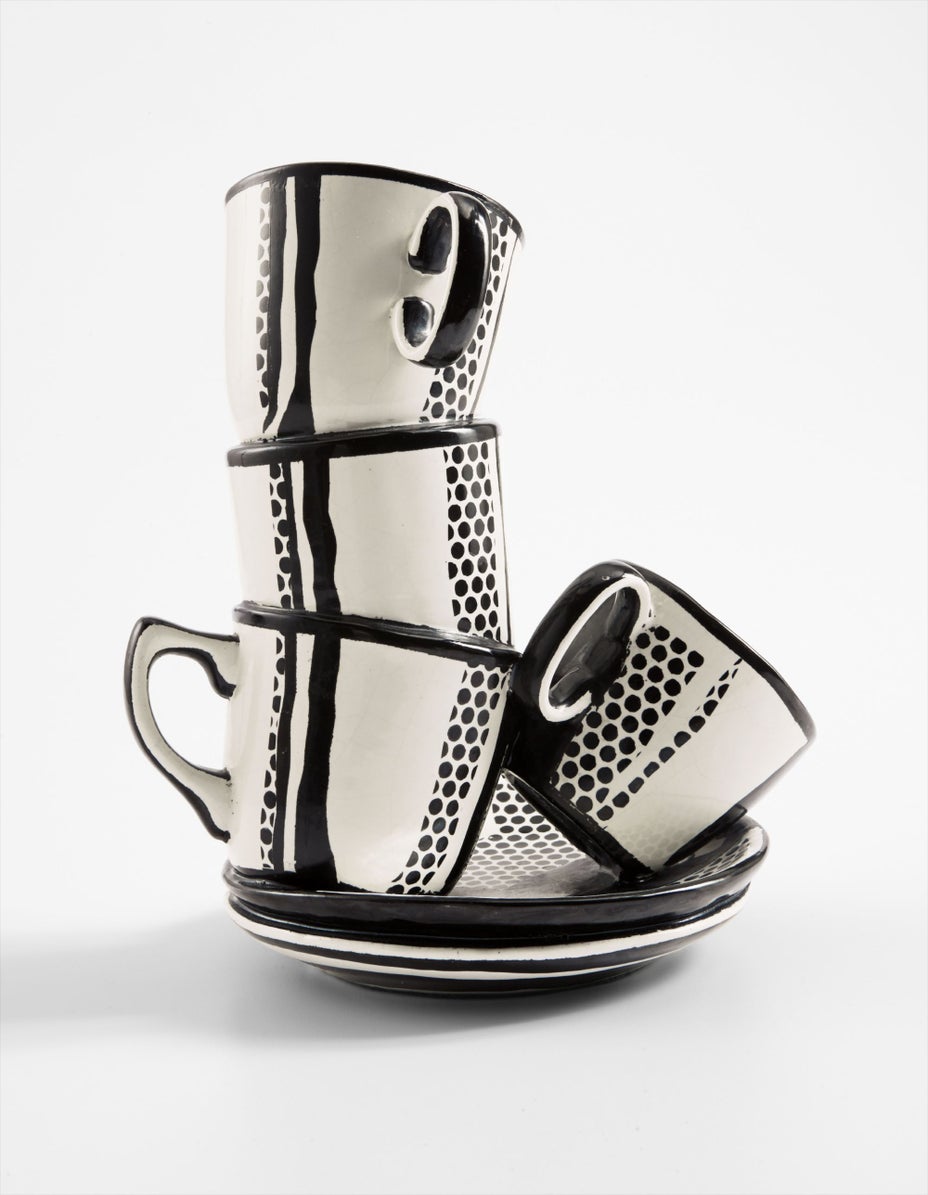
Ceramic Sculpture #7
Estimate
$400,000–600,000
Sold For
$394,000
signed and dated "rf Lichtenstein 1965" on the underside
painted and glazed ceramic
9 1/2 x 7 x 7 in. (24.1 x 17.8 x 17.8 cm.)
Executed in 1965, this work is unique.
Full-Cataloguing
“It becomes a very exaggerated, a very compelling symbol that has almost nothing to do with the original” -Roy Lichtenstein on the coffee cup
In a glossy black and white finish, Roy Lichtenstein’s coffee cups and saucers are a paradigm of the artist’s characteristic pop iconography of the 1960s, which feels ever more relevant in contemporary culture. Composed of the artist’s quintessential Benday dots, the coffee cups are stacked atop each other in a teetering tower, as if left on the counter in haste. First exhibited alongside the artist’s large-scale brushstroke paintings and other ceramic sculptures at Leo Castelli Gallery in his 1965 solo show, Ceramic Sculpture #7 stands out as a reminder of the pop artist’s interest, and in turn influence on, artistic re-appropriations of the most mundane objects from our everyday lives.
Known for his mastery of two and three-dimensional practices, Lichtenstein first began experimenting with sculpture in the 1940s and 50s, originally with more natural materials such as wood and terracotta. His style further developed in the 1960s when he started producing glazed ceramics, a surface which better allowed him to paint the graphic imagery for which he is most well-known. The repetitive nature of the dots and lines in the present lot attempt to reduce the three-dimensional objects to two-dimensional form, breaking down the sculpture into its pure graphic elements. These designs in black and white, however, distinguish this work amongst his other ceramic sculptures produced at this time, lacking the blue and red that the others feature. It is this quality that makes the monochromatic Ceramic Sculpture #7 a stronger indication of Lichtenstein’s inspiration that directly recalls the artist’s interest in newspaper advertisements, with the tower of mugs reminding the viewer of a black and white ad from the Sunday paper. In this way, Lichtenstein connects with the American consumer on an even more direct level, overtly challenging this notion of pop art—the mundane can be celebrated in the simplest of forms, and further, can be elevated to the highest form of art.
In its painterly qualities, Lichtenstein’s Ceramic Sculpture #7 reminds coffee drinkers that these cups intentionally lack functionality. “I don’t care what, say, a cup of coffee looks like,” Lichtenstein stated. “I only care about how it’s drawn.” (Roy Lichtenstein quoted in Jack Cowart, ed., Roy Lichtenstein: Beginning to End, exh. cat., Fundación Juan March, Madrid, 2007, pp. 118-19) Thus, in typical pop art fashion, the artist plays with a recognizable symbol and in turn challenges the viewer’s expectations and interpretations. Ceramic Sculpture #7 brings to mind something familiar, while also declaring that art can be found in all sorts of places, even the local diner.
In a glossy black and white finish, Roy Lichtenstein’s coffee cups and saucers are a paradigm of the artist’s characteristic pop iconography of the 1960s, which feels ever more relevant in contemporary culture. Composed of the artist’s quintessential Benday dots, the coffee cups are stacked atop each other in a teetering tower, as if left on the counter in haste. First exhibited alongside the artist’s large-scale brushstroke paintings and other ceramic sculptures at Leo Castelli Gallery in his 1965 solo show, Ceramic Sculpture #7 stands out as a reminder of the pop artist’s interest, and in turn influence on, artistic re-appropriations of the most mundane objects from our everyday lives.
Known for his mastery of two and three-dimensional practices, Lichtenstein first began experimenting with sculpture in the 1940s and 50s, originally with more natural materials such as wood and terracotta. His style further developed in the 1960s when he started producing glazed ceramics, a surface which better allowed him to paint the graphic imagery for which he is most well-known. The repetitive nature of the dots and lines in the present lot attempt to reduce the three-dimensional objects to two-dimensional form, breaking down the sculpture into its pure graphic elements. These designs in black and white, however, distinguish this work amongst his other ceramic sculptures produced at this time, lacking the blue and red that the others feature. It is this quality that makes the monochromatic Ceramic Sculpture #7 a stronger indication of Lichtenstein’s inspiration that directly recalls the artist’s interest in newspaper advertisements, with the tower of mugs reminding the viewer of a black and white ad from the Sunday paper. In this way, Lichtenstein connects with the American consumer on an even more direct level, overtly challenging this notion of pop art—the mundane can be celebrated in the simplest of forms, and further, can be elevated to the highest form of art.
In its painterly qualities, Lichtenstein’s Ceramic Sculpture #7 reminds coffee drinkers that these cups intentionally lack functionality. “I don’t care what, say, a cup of coffee looks like,” Lichtenstein stated. “I only care about how it’s drawn.” (Roy Lichtenstein quoted in Jack Cowart, ed., Roy Lichtenstein: Beginning to End, exh. cat., Fundación Juan March, Madrid, 2007, pp. 118-19) Thus, in typical pop art fashion, the artist plays with a recognizable symbol and in turn challenges the viewer’s expectations and interpretations. Ceramic Sculpture #7 brings to mind something familiar, while also declaring that art can be found in all sorts of places, even the local diner.