28
Roy Lichtenstein
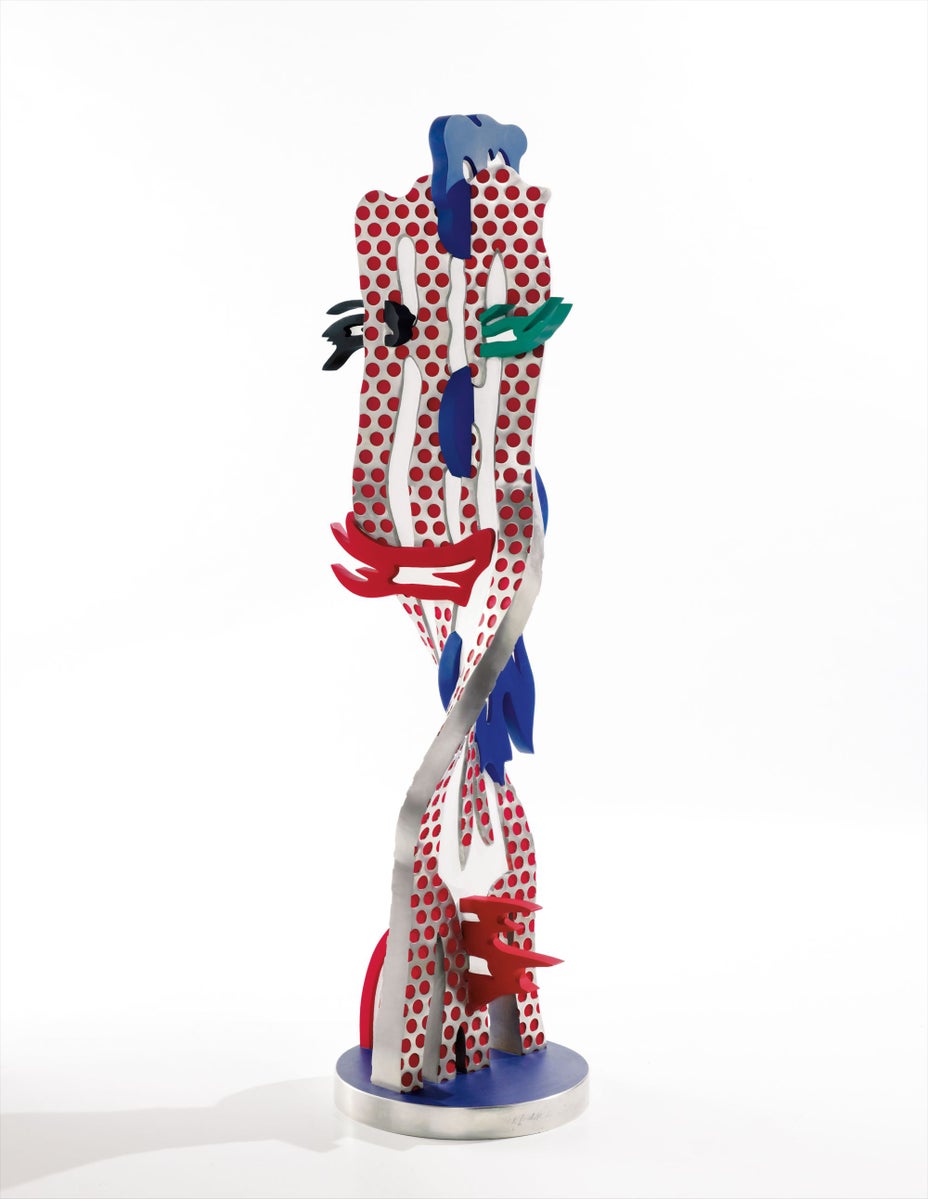
Metallic Brushstroke Head
Estimate
$2,500,000–3,500,000
nickel plated bronze, painted with enamel
83 x 24 x 22 in. (210.8 x 61 x 55.9 cm.)
base 3 x 21 1/2 x 21 1/2 in. (7.6 x 54.6 x 54.6 cm.)
base 3 x 21 1/2 x 21 1/2 in. (7.6 x 54.6 x 54.6 cm.)
Signed, inscribed, numbered and dated "rf Lichtenstein '94 AP 1/2 W.W.F." on the base. This work is artist proof 1 from an edition of 6 plus 2 artist's proofs.
Full-Cataloguing
“I mean a brush-stroke really doesn't look anything like these things: you'd have black lines around solid color’s, and it just isn't anything like a brush-stroke any more than a cartoon head is like a head.”
ROY LICHTENSTEIN, 1966
Roy Lichtenstein is an American icon of the Pop Art movement, and the present lot, created later in his prestigious career, perfectly exemplifies his well-defined style. Drawing his source materials from a myriad of comic strips and advertisement clippings, Lichtenstein based his artistic language on an already recognizable lexicon of commercial art. Lichtenstein’s brushstroke motif arose in 1965 shortly after his famous Benday-Dot, a pattern implemented in advertising printing process. The brushstroke and Benday-Dot both originated from comic strip imagery, which Lichtenstein duplicated on an enormous scale to emphasize the abstraction inherent in these commercial illustrations. David Hickey states that “Lichtenstein’s brushstrokes were, clearly and at first glance, generational icons. They proposed a critique of the immediate past, clearly intending to supersede it without destroying it—to propose something new that would renew the past, as well.” (D. Hickey, “Brushstrokes,” from Brushstrokes: Four Decades, New York, 2002, p. 10) Lichtenstein’s artistic process depended on this amplification and arrangement of his source images; typically the source images were created to sell an item or to tell a simplified comic book story. By re-appropriating these bits of imagery, Lichtenstein monumentally compressed emotion and action into a stylized, often highly ironic, icon.
Triggered by a comic strip entitled “The Painting” in Charlton Comics’ Strange Suspense Stories in October 1964, this stylized brushstroke emerged as one of Lichtenstein’s most renowned motifs. In “The Painting,” a young painter attempts to paint the face of a man. Once the figure is rendered, the canvas comes to life and the figure speaks to his creator. The artist, terrified by what he has made, ferociously stabs the canvas figure with a knife. The final line of the comic poses a haunting question “WHAT WAS THE STRANGE POWER OF…..’THE PAINTING’?” Lichtenstein was engrossed by this comic strip - the way that the cartoonist had chosen to represent paint and the manner in which it was moved across a canvas. Lichtenstein explains that his brushstrokes “would be very large brush strokes for anybody's painting. They're blown up and magnified even by comparison with brush-stroke paintings that were very large when they were done. I wasn't able to make anything that would look like a brush-stroke, they all looked like something else, and it took me a while to develop the symbolism which would remind people enough of brush-strokes and would be the kind of shape I could use in painting. I mean a brush-stroke really doesn't look anything like these things: you'd have black lines around solid colours, and it just isn't anything like a brush-stroke any more than a cartoon head is like a head. Or a photograph of a head. It was a question of developing some kind of cliché or some kind of archetypal brush-stroke appearance which would be convincing as a brush-stroke, and which would be in line with elements I like to use and am familiar with using.” (D. Sylvester in conversation with Roy Lichtenstein, Broadcast by BBC Third Programme, New York City, January 1966)
Metallic Brushstroke Head, 1994, captures in three-dimensional form this enduring and prominent motif. Employing and reinterpreting the brushstroke throughout thirty years of his prolific career, Lichtenstein calls into question the uniqueness and originality of the artist’s mark and “raises the question of the difference between commercial trademark and artistic style.” (K. Honnef, POP ART, New York: Taschen, 2004, p. 54) Metallic Brushstroke Head also re-processes the female form through the built, historical, visual tropes of Lichtenstein’s own work. Seen in a twisting stance, Metallic Brushstroke Head shines in brightly painted aluminum. She is composed of Benday-dots, bright paints of red, blue and turquoise and, of course, the highly stylized brushstroke that compose her eyelashes and lips. Peeking through these colored forms are elements of unpainted aluminum, imbuing the statue with a “mirroresque,” reflective quality. Utilizing the female face as a blank slate, Lichtenstein re-filters her features through his abstracted translation of commercial motifs-in essence transforming the remnants of the figure into a Roy Lichtenstein pop icon.
By isolating the brushstroke, Lichtenstein investigates its painterly existence both within and outside of established artistic traditions. He credits the 17th-century Dutch Old Master portrait painter Frans Hals for awakening his interest in fluid brushwork and rich artistic markings, which further informed the creation of his Brushstroke series. Although realized by Lichtenstein in an almost light-hearted manner, the signal motif of the brushstroke was developed into a highly-charged symbol that imparted to momentary action a lasting visual impression. Lichtenstein explains that the brushstrokes “are certainly reworked when you look at them, not spontaneous brush-strokes. I think this is true of all of them really, that they were symbolising brush-strokes, they were symbolising that art is art, but at the same time they were drawing a picture of a brush-stroke.” (D. Sylvester in conversation with Roy Lichtenstein, Broadcast by BBC Third Programme, New York City, January 1966)
ROY LICHTENSTEIN, 1966
Roy Lichtenstein is an American icon of the Pop Art movement, and the present lot, created later in his prestigious career, perfectly exemplifies his well-defined style. Drawing his source materials from a myriad of comic strips and advertisement clippings, Lichtenstein based his artistic language on an already recognizable lexicon of commercial art. Lichtenstein’s brushstroke motif arose in 1965 shortly after his famous Benday-Dot, a pattern implemented in advertising printing process. The brushstroke and Benday-Dot both originated from comic strip imagery, which Lichtenstein duplicated on an enormous scale to emphasize the abstraction inherent in these commercial illustrations. David Hickey states that “Lichtenstein’s brushstrokes were, clearly and at first glance, generational icons. They proposed a critique of the immediate past, clearly intending to supersede it without destroying it—to propose something new that would renew the past, as well.” (D. Hickey, “Brushstrokes,” from Brushstrokes: Four Decades, New York, 2002, p. 10) Lichtenstein’s artistic process depended on this amplification and arrangement of his source images; typically the source images were created to sell an item or to tell a simplified comic book story. By re-appropriating these bits of imagery, Lichtenstein monumentally compressed emotion and action into a stylized, often highly ironic, icon.
Triggered by a comic strip entitled “The Painting” in Charlton Comics’ Strange Suspense Stories in October 1964, this stylized brushstroke emerged as one of Lichtenstein’s most renowned motifs. In “The Painting,” a young painter attempts to paint the face of a man. Once the figure is rendered, the canvas comes to life and the figure speaks to his creator. The artist, terrified by what he has made, ferociously stabs the canvas figure with a knife. The final line of the comic poses a haunting question “WHAT WAS THE STRANGE POWER OF…..’THE PAINTING’?” Lichtenstein was engrossed by this comic strip - the way that the cartoonist had chosen to represent paint and the manner in which it was moved across a canvas. Lichtenstein explains that his brushstrokes “would be very large brush strokes for anybody's painting. They're blown up and magnified even by comparison with brush-stroke paintings that were very large when they were done. I wasn't able to make anything that would look like a brush-stroke, they all looked like something else, and it took me a while to develop the symbolism which would remind people enough of brush-strokes and would be the kind of shape I could use in painting. I mean a brush-stroke really doesn't look anything like these things: you'd have black lines around solid colours, and it just isn't anything like a brush-stroke any more than a cartoon head is like a head. Or a photograph of a head. It was a question of developing some kind of cliché or some kind of archetypal brush-stroke appearance which would be convincing as a brush-stroke, and which would be in line with elements I like to use and am familiar with using.” (D. Sylvester in conversation with Roy Lichtenstein, Broadcast by BBC Third Programme, New York City, January 1966)
Metallic Brushstroke Head, 1994, captures in three-dimensional form this enduring and prominent motif. Employing and reinterpreting the brushstroke throughout thirty years of his prolific career, Lichtenstein calls into question the uniqueness and originality of the artist’s mark and “raises the question of the difference between commercial trademark and artistic style.” (K. Honnef, POP ART, New York: Taschen, 2004, p. 54) Metallic Brushstroke Head also re-processes the female form through the built, historical, visual tropes of Lichtenstein’s own work. Seen in a twisting stance, Metallic Brushstroke Head shines in brightly painted aluminum. She is composed of Benday-dots, bright paints of red, blue and turquoise and, of course, the highly stylized brushstroke that compose her eyelashes and lips. Peeking through these colored forms are elements of unpainted aluminum, imbuing the statue with a “mirroresque,” reflective quality. Utilizing the female face as a blank slate, Lichtenstein re-filters her features through his abstracted translation of commercial motifs-in essence transforming the remnants of the figure into a Roy Lichtenstein pop icon.
By isolating the brushstroke, Lichtenstein investigates its painterly existence both within and outside of established artistic traditions. He credits the 17th-century Dutch Old Master portrait painter Frans Hals for awakening his interest in fluid brushwork and rich artistic markings, which further informed the creation of his Brushstroke series. Although realized by Lichtenstein in an almost light-hearted manner, the signal motif of the brushstroke was developed into a highly-charged symbol that imparted to momentary action a lasting visual impression. Lichtenstein explains that the brushstrokes “are certainly reworked when you look at them, not spontaneous brush-strokes. I think this is true of all of them really, that they were symbolising brush-strokes, they were symbolising that art is art, but at the same time they were drawing a picture of a brush-stroke.” (D. Sylvester in conversation with Roy Lichtenstein, Broadcast by BBC Third Programme, New York City, January 1966)