35
Rudolf Stingel
Untitled
Full-Cataloguing
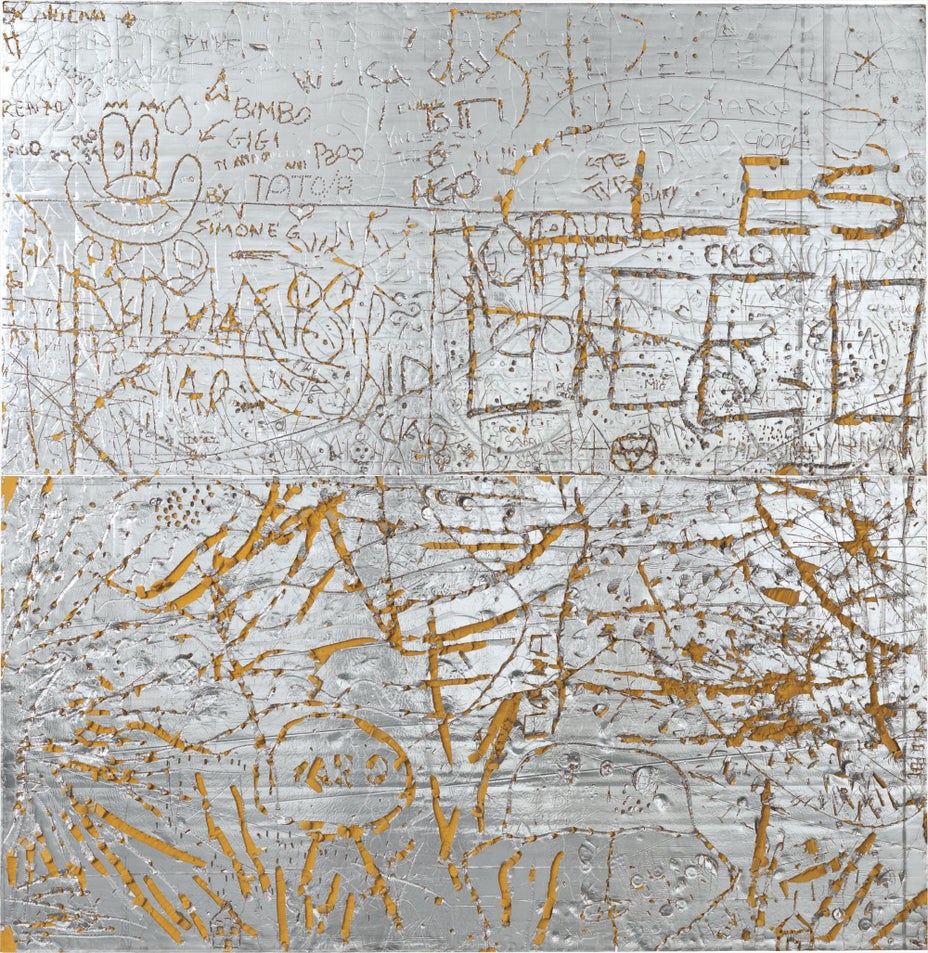
Untitled, 2002, exemplifies in Rudolf Stingel’s oeuvre a perfect fusion of sculpture and painting. As a member of Stingel’s landmark series in which he placed aluminum foil over top of celotex board, then allowed his observers to mark them as he pleased, Stingel blurs the line between the artist and observer. As a recurrent theme in his celebrated thirty-year career in visual art, Stingel has increasingly placed the onus of meaning within the observer’s own familiar environment, either in artistic manipulation of tapestry or in the viewer’s ability to form the piece through his own graffiti.
The present lot is a perfect model for understanding Stingel’s gradually shifting use of the verb “paint.” Here, it is defined by the formation of a new reality by the hand of the observer: “The mere act of painting does not create a painting but simply some painting. But if the action of painting is used as a lens to observe reality to create another reality, then we have a painting…Stingel creates a transitive way to recede from abstraction into the subject and to push the subject into a different kind of time.” (Francesco Bonami, ed., 'Paintings of Paintings for Paintings—The Kairology and Kronology of Rudolf Stingel', Rudolf Stingel, London, 2007, pp. 13-14).
The X-ray mentioned above is a memory itself; the creation of Untitled, 2002, was a mere moment in time, allowing for the development of the piece by a variety of onlookers. In allowing us a look into this fleeting moment, Stingel has made use of the most abundant form of paint: time.
Rudolf Stingel
Italian | 1956Rudolf Stingel came to prominence in the late 1980s for his insistence on the conceptual act of painting in a context in which it had been famously declared dead. Despite the prevailing minimalist and conceptual narrative of the time, the Italian-born artist sought to confront the fundamental aspirations and failures of Modernist painting through the very medium of painting itself. While his works do not always conform to the traditional definitions of painting, their attention to surface, space, color and image provide new and expanded ways of thinking about the process and "idea" of painting. Central to his multifarious and prolific oeuvre is an examination of the passage of time and the probing of the fundamental questions of authenticity, meaning, hierarchy, authorship and context by dislocating painting both internally and in time and space. Stingel is best known for his wall-to-wall installations, constructed of fabric or malleable Celotex sheets, as well as his seemingly more traditional oil-on-canvas paintings.