24
Rudolf Stingel
Untitled
Full-Cataloguing
twenty years Stingel has been concerned with the nature of painting, and has sought to redefine it through his innovative use of materials
and techniques, which challenge the traditional concepts of originality, authorship and fine art.
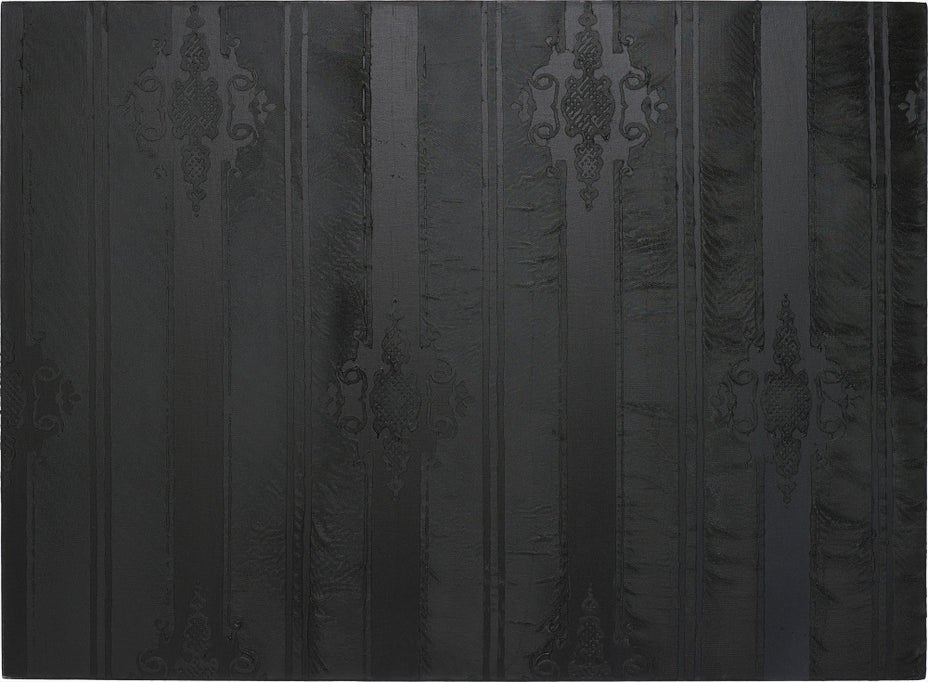
This piece is a quintessential example of his series of wall-paper inspired monochromes. The opulent black-on-black pattern of this work replicates
traditional damask, a woven textile originally produced from silk in Syria, and later applied to ornate rococo and baroque wallpaper and carving.
Stingel’s upbringing in the Italian Tyrol and Vienna undoubtedly influenced this choice as he was exposed to this lavish style from a young age. By
reproducing such a pattern Stingel not only invokes the artistic traditions of the 16th and 17th centuries in Europe, but also highlights issues of
authorship and originality as the visual concept and pattern are not Stingel’s own design. The only hints of Stingel’s own intervention in the
painting are the slight corruptions in the pattern and distribution of paint. By reproducing wallpaper patterns onto paint and canvas, Stingel is also
wryly commenting upon the conventional hierarchy of fine art and craft – by merging the two, Untitled becomes a destabilizing force, disrupting
the accepted distinctions between fine art and wall decoration. Andy Warhol similarly fused the two, creating wallpapers which were overtly
Kitsch, again challenging notions of fine art. the two are confounded further by the fact that Untitled is a single, autonomous work that hangs
on the wall like a traditional painting. The viewer of these works is left unsettled by this flux between wallpaper and painting, fine art and craft.
This piece is therefore an ironic statement – painting and wallpaper are shown to be almost synonymous and the fragility of notions of authorship
and originality are exposed. This is effectively counterbalanced by Stingel’s sensual application of paint and elegant pattern, invoking the rich artistic
history of decadence in Europe.
Rudolf Stingel
Italian | 1956Rudolf Stingel came to prominence in the late 1980s for his insistence on the conceptual act of painting in a context in which it had been famously declared dead. Despite the prevailing minimalist and conceptual narrative of the time, the Italian-born artist sought to confront the fundamental aspirations and failures of Modernist painting through the very medium of painting itself. While his works do not always conform to the traditional definitions of painting, their attention to surface, space, color and image provide new and expanded ways of thinking about the process and "idea" of painting. Central to his multifarious and prolific oeuvre is an examination of the passage of time and the probing of the fundamental questions of authenticity, meaning, hierarchy, authorship and context by dislocating painting both internally and in time and space. Stingel is best known for his wall-to-wall installations, constructed of fabric or malleable Celotex sheets, as well as his seemingly more traditional oil-on-canvas paintings.