220
Rudolf Stingel
Untitled
Full-Cataloguing
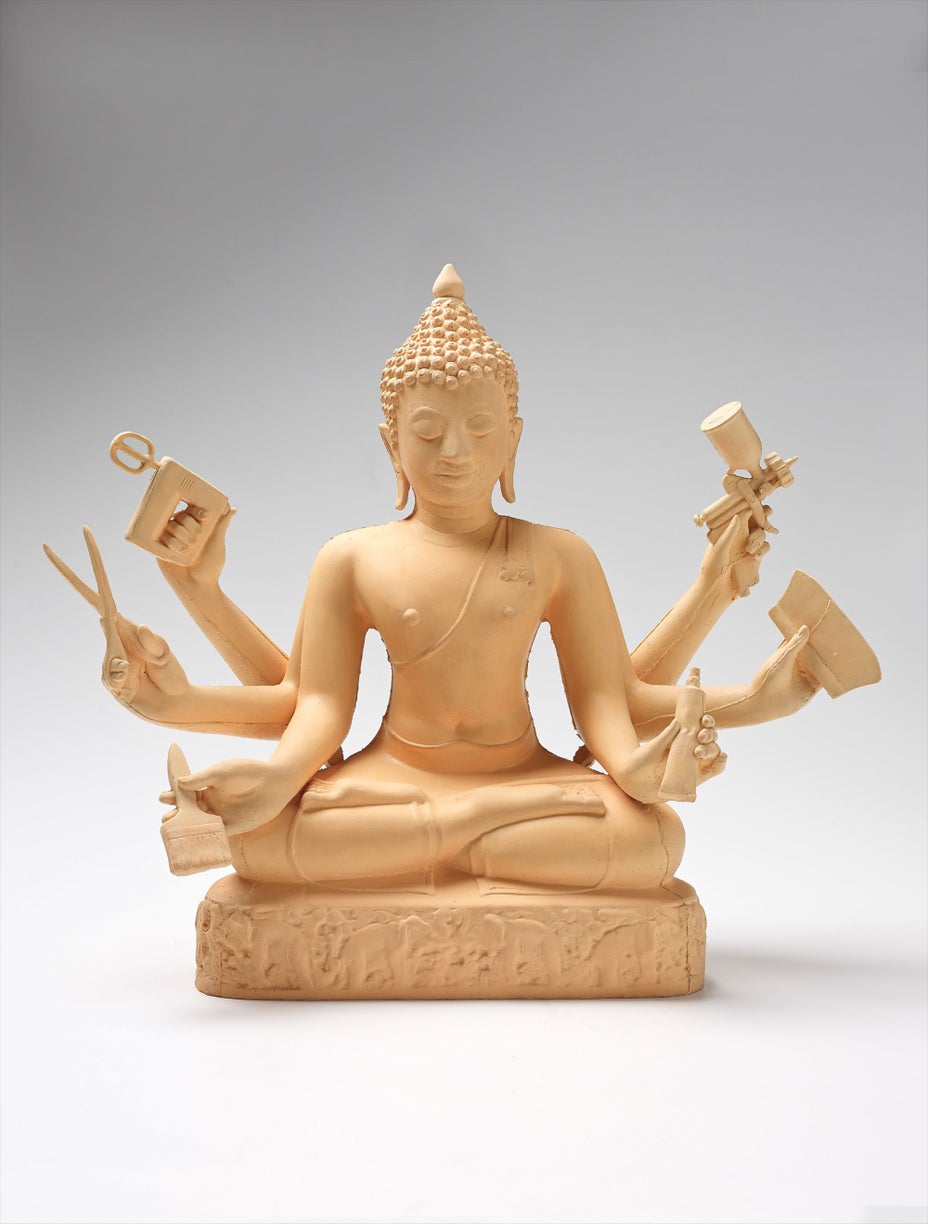
Rudolf Stingel’s affinity for the decorative is a consistent theme throughout the artist’s multi-faceted oeuvre of painting, drawing and sculpture. Stingel’s Buddha sculptures, composed of cast rubber, fit this decorative mold, lacking the overt spirituality of other representations of the Asian deity. In an interview from 2007 regarding his Buddha statues, he says “I don’t think it has anything to do with religion. It’s pure decoration. It’s a taste, a lifestyle” (Rudolf Stingel quoted in David Coleman, "Not a Believer but Just in Case Om", in The New York Times, July 2007). Thus, Stingel’s twenty-four uniquely colored variants of which the present lot belongs exist as ironic symbols of the modernity of spirituality in a world of mass-produced decoration.
In Untitled, 1994, the meditative Buddha depicted is the six-armed Hindu deity Vishnu who holds tools from the artist’s 1998 Untitled (Instructions), a how-to manual in which he explains the process used to create one of his early abstract paintings. The deity holds these objects as if ready to use the pair of electric hand mixers, scissors, a tube of paint, and a series of brushes. These objects are the same bright color of the Buddha himself, sculpted in a smooth and simple finish. With eyes closed, Stingel portrays the meditation central to the Buddhist religion and in turn, calls attention to his own painting practice as being meditative in itself. Therefore, in typical Stingel fashion, the resulting sculpture derives its imagery equally from the past and present, referencing the ancient religion from which it is derived while simultaneously looking to modern art practices in self-referential testimony.
Rudolf Stingel
Italian | 1956Rudolf Stingel came to prominence in the late 1980s for his insistence on the conceptual act of painting in a context in which it had been famously declared dead. Despite the prevailing minimalist and conceptual narrative of the time, the Italian-born artist sought to confront the fundamental aspirations and failures of Modernist painting through the very medium of painting itself. While his works do not always conform to the traditional definitions of painting, their attention to surface, space, color and image provide new and expanded ways of thinking about the process and "idea" of painting. Central to his multifarious and prolific oeuvre is an examination of the passage of time and the probing of the fundamental questions of authenticity, meaning, hierarchy, authorship and context by dislocating painting both internally and in time and space. Stingel is best known for his wall-to-wall installations, constructed of fabric or malleable Celotex sheets, as well as his seemingly more traditional oil-on-canvas paintings.