Property From The Miles And Shirley Fiterman Collection
55Ο︎
Sam Francis
E VIII
Estimate
$350,000–450,000
Sold For
$350,000
acrylic on canvas
79 x 138 in. (200.7 x 350.5 cm.)
Painted in 1971.
This work is identified with the interim identification number of SFF.541; in consideration for the forthcoming addendum to Sam Francis: Catalogue Raisonné of Canvas and Panel Paintings. This information is subject to change as scholarship continues by the Sam Francis Foundation.
This work is identified with the interim identification number of SFF.541; in consideration for the forthcoming addendum to Sam Francis: Catalogue Raisonné of Canvas and Panel Paintings. This information is subject to change as scholarship continues by the Sam Francis Foundation.
Full-Cataloguing
The Miles and Shirley Fiterman Collection reads like a cross-continental survey of the 20th century’s most influential artists. Born out of the seminal decade of the 1960s, the collection is not only a tribute to the dawning of a revolutionary cultural era but a witness to its making. To look at how Miles and Shirley Fiterman collected is to understand the importance of the collector at this crucial point in post-war history; when contemporary art solidified its institutional recognition and found relevance with a wider public. The selection of artworks they assembled dance between abstraction and figuration and feature some of the most esteemed all-American artists, including Sam Francis, Frank Stella, Alexander Calder and John Chamberlain.
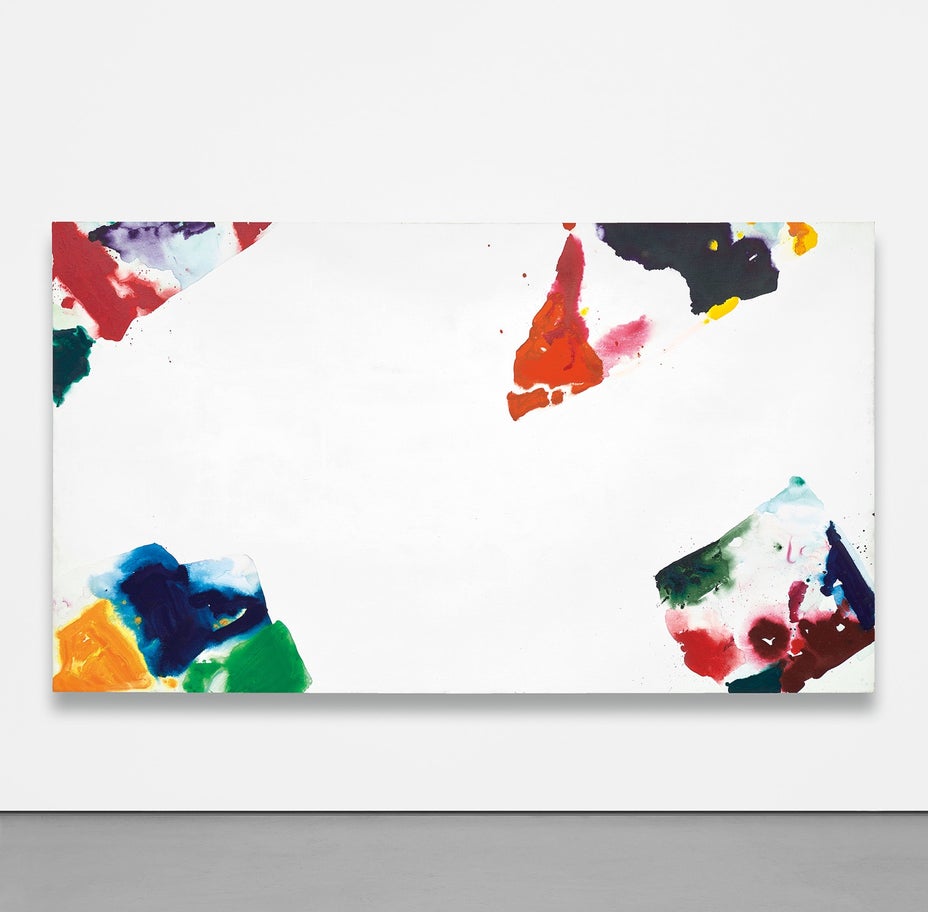
Sam Francis’s EVIII, 1971, represents the artist’s love of color, light and travel. Francis renders spontaneous clouds of exquisite color to the corners of the work, reminiscent of a gentle Parisian atmosphere. In contrast, the vast negative space that spans across the large-scale canvas, central to Francis’ style after the mid-1960s, embraces the sharp energy of New York Minimalism. The bursts of pigment that frame the work evokes an edgeless nature that pulls the dynamic abstraction off the canvas.
Drawing from the history of the Nazi takeover during World War II, Frank Stella’s Narwola II, 1971 is a geometric interpretation of Polish synagogues and their distinct architecture. Created with wood, brightly colored felt and canvas, this work is part of the Polish Village series prominent to Stella’s practice from 1971-1973. In this series, he appropriated graphic elements such as diagonally slanted roofs and wooden beams typical of Polish villages. Coupling these dynamic designs with Stella’s flattened perspective, this work speaks to the resulting demolition in post-war Poland.
This selection from the Fiterman Collection is a wonderful window into what made their collecting so seminal even in its own time – a great blend of paintings, works on paper, and sculpture of the two predominant movements from mid-century America, Pop and Abstract Expressionism.
Sam Francis’s EVIII, 1971, represents the artist’s love of color, light and travel. Francis renders spontaneous clouds of exquisite color to the corners of the work, reminiscent of a gentle Parisian atmosphere. In contrast, the vast negative space that spans across the large-scale canvas, central to Francis’ style after the mid-1960s, embraces the sharp energy of New York Minimalism. The bursts of pigment that frame the work evokes an edgeless nature that pulls the dynamic abstraction off the canvas.
Drawing from the history of the Nazi takeover during World War II, Frank Stella’s Narwola II, 1971 is a geometric interpretation of Polish synagogues and their distinct architecture. Created with wood, brightly colored felt and canvas, this work is part of the Polish Village series prominent to Stella’s practice from 1971-1973. In this series, he appropriated graphic elements such as diagonally slanted roofs and wooden beams typical of Polish villages. Coupling these dynamic designs with Stella’s flattened perspective, this work speaks to the resulting demolition in post-war Poland.
This selection from the Fiterman Collection is a wonderful window into what made their collecting so seminal even in its own time – a great blend of paintings, works on paper, and sculpture of the two predominant movements from mid-century America, Pop and Abstract Expressionism.