44
Sean Scully
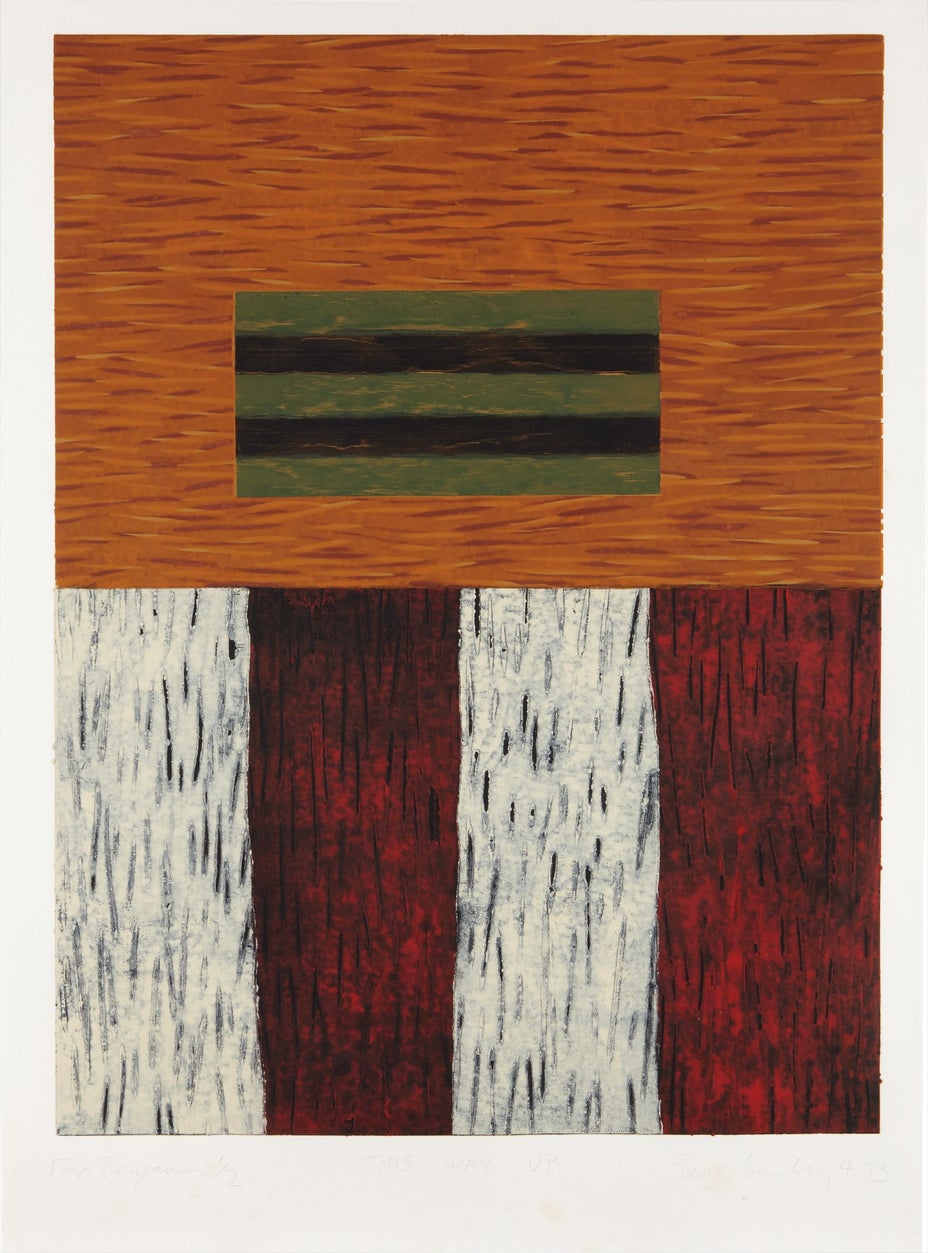
This Way Up
Estimate
$20,000–30,000
Sold For
$25,000
1993
Monotype in colors, on wove paper, with full margins.
I. 43 3/4 x 33 in. (111.1 x 83.8 cm)
S. 50 x 36 3/4 in. (127 x 93.3 cm)
S. 50 x 36 3/4 in. (127 x 93.3 cm)
Signed, dated, inscribed 'For Benjamin' and numbered 1/2 in pencil (one of two variants), published by the artist and printed by Garner Tullis at Garner Tullis Workshop, Santa Barbara, framed.
Full-Cataloguing
This Way Up is one of a series of thirty-nine monotypes which Scully made over a period of eleven days at the Garner Tullis Workshop.
Scully had previously made etchings and woodcuts but this series marked his first attempt to make monotypes.
The series was printed from pieces of Douglas Fir timber which were painted and pressed onto paper. This wood has a hard grain and a soft heart, and is indigenous to the West Coast of America. The pieces of wood were cut initially in the proportion of three to one, that is their length was three times their width. Some were then cut to shorter lengths, but always as a proportion of the width. The use of wood blocks has given the image a grained texture which has an affinity with the combed and rubbed surface of Scully's paintings.
The printing was achieved as follows: the blocks were laid down like a jigsaw, inked and then paper laid on top and pressed. The paper was taken off, and then a freshly inked board was placed on top of the paper and pressed, superimposing a layer of color. Subsequent layers of color were then added using blocks laid down in exactly the configuration of the first printing. While the first printing was in ink, the later printings may have been in ink or oil paint.
Scully had previously made etchings and woodcuts but this series marked his first attempt to make monotypes.
The series was printed from pieces of Douglas Fir timber which were painted and pressed onto paper. This wood has a hard grain and a soft heart, and is indigenous to the West Coast of America. The pieces of wood were cut initially in the proportion of three to one, that is their length was three times their width. Some were then cut to shorter lengths, but always as a proportion of the width. The use of wood blocks has given the image a grained texture which has an affinity with the combed and rubbed surface of Scully's paintings.
The printing was achieved as follows: the blocks were laid down like a jigsaw, inked and then paper laid on top and pressed. The paper was taken off, and then a freshly inked board was placed on top of the paper and pressed, superimposing a layer of color. Subsequent layers of color were then added using blocks laid down in exactly the configuration of the first printing. While the first printing was in ink, the later printings may have been in ink or oil paint.