31Ο︎
Tatsuo Kawaguchi
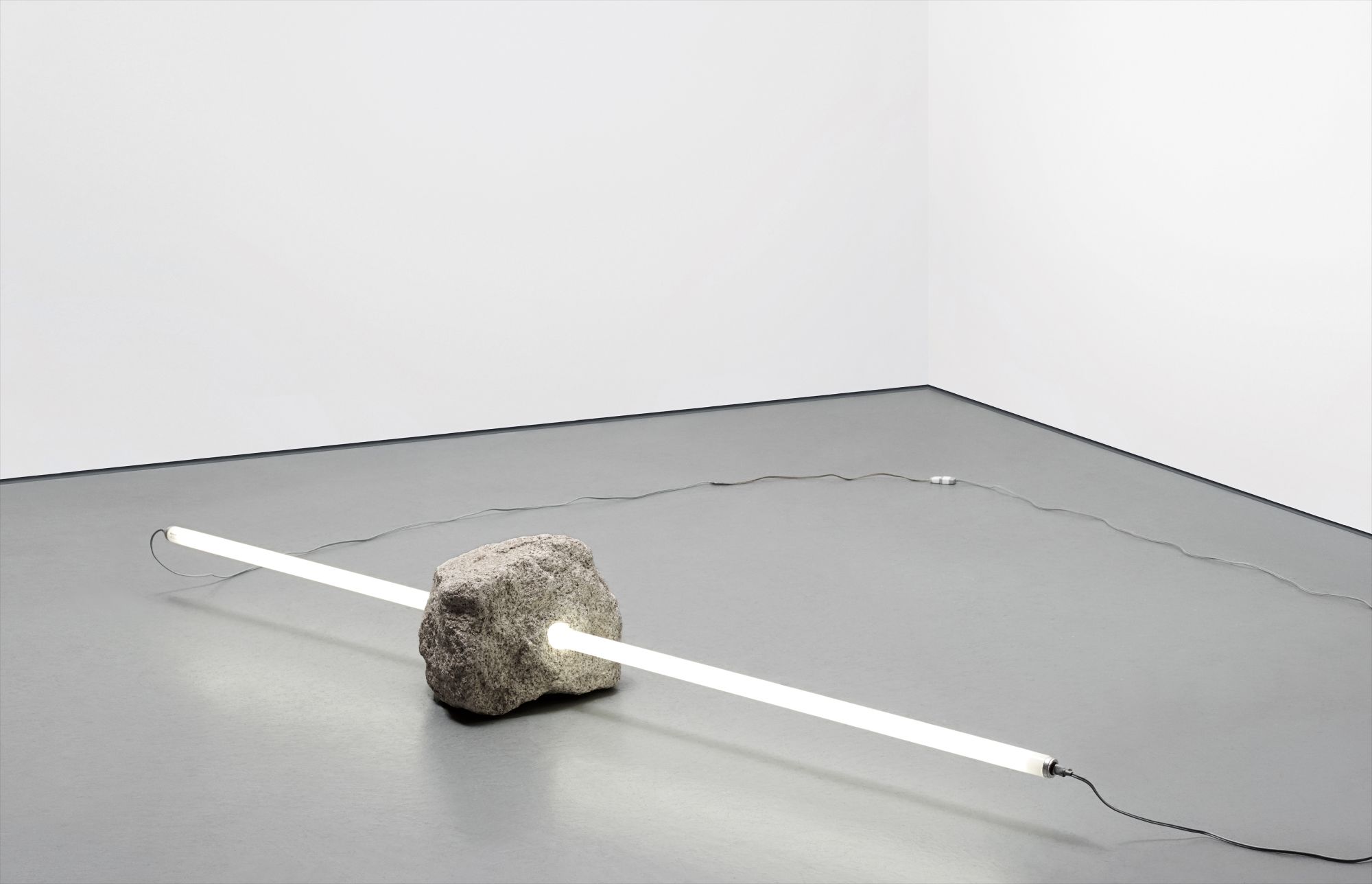
Stone and Light
Estimate
$150,000 - 250,000
Lot Details
stone and fluorescent light
19 3/4 x 93 1/4 x 14 1/8 in. (50.2 x 236.9 x 35.9 cm)
Signed "Tatsuo Kawaguchi" on the stone element. This work is number 5 from an edition of 5 unique variants.
Specialist
Full-Cataloguing
Catalogue Essay
I don’t think visual art is necessarily just about the sense of vision… I am making the invisible darkness even more invisible, thereby making a breakthrough in the artistic discourse that prioritizes the issue of vision.
A graduate of Tama Art University in Tokyo, Tatsuo Kawaguchi is best known for works that incorporate a variety of materials ranging from stones and seeds to metal and light. Despite his initial training in painting, he has been critically rethinking the role of art as an agent of paradigm shift—from art as representation to art as relation—since the 1960s. In 1965, along with eight other artists, Kawaguchi formed Group I in his hometown of Kobe in Hyogo prefecture. One of the most iconic works and the de facto manifesto of Mono-ha (School of Things) came out of this group wasPhase—Mother Earth, 1968 by his fellow artist Nobuo Sekine (b. 1942). Phase was an outdoor happening in which the group artists, including Kawaguchi, collectively dug a deep cylindrical hole on the ground in a park as they simultaneously built a cylinder in the exact same shape above the ground next to the hole using the soil from the hole. After completion, the artists promptly returned the soil back into the hole essentially erasing the act of making. The experience of taking part in this outdoor ephemeral installation left a lasting influence on how Kawaguchi would later approach his art making.
For example, in 1970 he created an important series of twenty-four photographic records of an outdoor installation Land and Sea that examined what may be called relational existentialism. The four wooden planks were laid neatly on the beach with each plank’s one end clinging to the sand beach while the other end submerged into the edge of water. The photographs recorded the passage of time as it is revealed to our eyes as the ebb and flow. Land and Sea visualized the ocean's tidal shifts, a phenomenon of a cosmic grandeur that is constantly occurring, in a scale perceivable by man.
This relational thinking continued in the creation of another iconic work by Kawaguchi, Stone and Light. As a sculpture, it opens up a new perspective into the world by the stark contrast between the stillness of the stone and the constant electric current inside the fluorescent tube that pierces through the stone. The choice of the materials was a result of the artist's skepticism in painting to effectively capture the concept of time. By juxtaposing the immobile dark presence of the stone and the ephemerality of light, Kawaguchi produced a kind of visualization device that allows us to sense a series of extreme ends in the spectrum of environment in which we exist—stillness and movement, darkness and brightness, the ancient and the new.
Kawaguchi has constantly expressed in his work his strong sense of balance in all existence in the world. "Relation" is, to him, a "very effective word to dissect the worldly phenomena." The essence of Stone and Light is not so much in its material nature but more in its function as a generator of a new relation between art and our sphere of living.
A graduate of Tama Art University in Tokyo, Tatsuo Kawaguchi is best known for works that incorporate a variety of materials ranging from stones and seeds to metal and light. Despite his initial training in painting, he has been critically rethinking the role of art as an agent of paradigm shift—from art as representation to art as relation—since the 1960s. In 1965, along with eight other artists, Kawaguchi formed Group I in his hometown of Kobe in Hyogo prefecture. One of the most iconic works and the de facto manifesto of Mono-ha (School of Things) came out of this group wasPhase—Mother Earth, 1968 by his fellow artist Nobuo Sekine (b. 1942). Phase was an outdoor happening in which the group artists, including Kawaguchi, collectively dug a deep cylindrical hole on the ground in a park as they simultaneously built a cylinder in the exact same shape above the ground next to the hole using the soil from the hole. After completion, the artists promptly returned the soil back into the hole essentially erasing the act of making. The experience of taking part in this outdoor ephemeral installation left a lasting influence on how Kawaguchi would later approach his art making.
For example, in 1970 he created an important series of twenty-four photographic records of an outdoor installation Land and Sea that examined what may be called relational existentialism. The four wooden planks were laid neatly on the beach with each plank’s one end clinging to the sand beach while the other end submerged into the edge of water. The photographs recorded the passage of time as it is revealed to our eyes as the ebb and flow. Land and Sea visualized the ocean's tidal shifts, a phenomenon of a cosmic grandeur that is constantly occurring, in a scale perceivable by man.
This relational thinking continued in the creation of another iconic work by Kawaguchi, Stone and Light. As a sculpture, it opens up a new perspective into the world by the stark contrast between the stillness of the stone and the constant electric current inside the fluorescent tube that pierces through the stone. The choice of the materials was a result of the artist's skepticism in painting to effectively capture the concept of time. By juxtaposing the immobile dark presence of the stone and the ephemerality of light, Kawaguchi produced a kind of visualization device that allows us to sense a series of extreme ends in the spectrum of environment in which we exist—stillness and movement, darkness and brightness, the ancient and the new.
Kawaguchi has constantly expressed in his work his strong sense of balance in all existence in the world. "Relation" is, to him, a "very effective word to dissect the worldly phenomena." The essence of Stone and Light is not so much in its material nature but more in its function as a generator of a new relation between art and our sphere of living.
Provenance
Exhibited