27
Tony Fitzpatrick
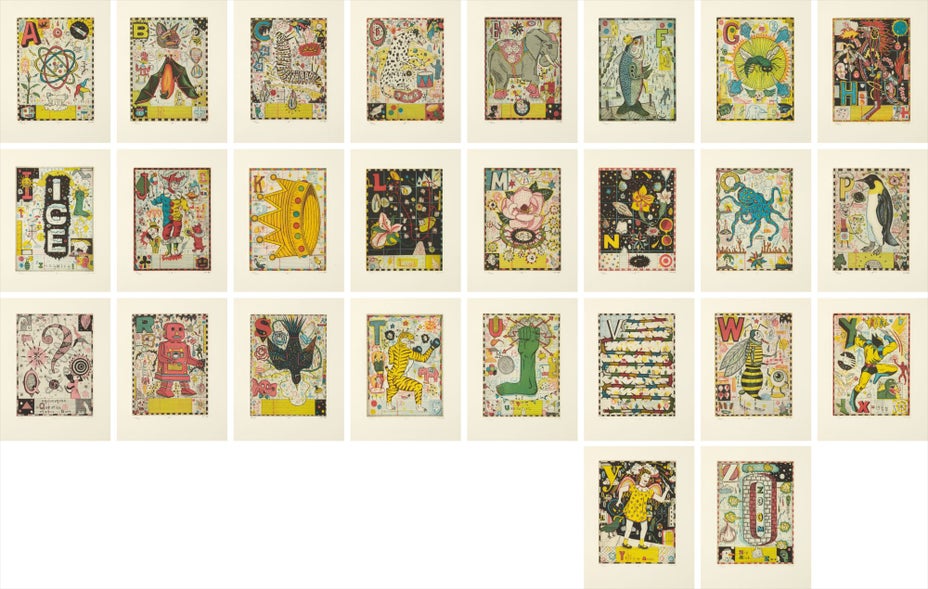
Max and Gaby’s Alphabet portfolio
Estimate
$12,000–18,000
2000
The complete set of 26 etchings and aquatint in colors, on wove paper, with full margins, and artist's book,
all I. 8 x 6 in (20.3 x 15.2 cm)
all S. 13 x 11 in (33 x 27.9 cm)
book 11 x 9 x 1/2 in (27.9 x 22.9 x 1.3 cm)
all S. 13 x 11 in (33 x 27.9 cm)
book 11 x 9 x 1/2 in (27.9 x 22.9 x 1.3 cm)
all signed with initials, dated, annotated 'A' through 'Z' and numbered 17/50 (there were also artist's proofs), published by Big Cat Press, Chicago, all in excellent condition,contained in original gray cloth-covered portfolio case.
Full-Cataloguing
Each of the twenty-six images in Max and Gaby’s Alphabet began with the artist suggesting a letter from the alphabet and then challenging one or both of his children to describe something from their imagination beginning with that letter. The first image came from a conversation he had with his daughter, who was just four at the time, as she noticed a starling in their backyard. As Gaby wondered with amazement at how the apparently black bird could take on so many different colors as it reflected the sun’s light, an idea was born.
For Fitzpatrick, an idea does not give rise to one simple image. “S“ for example, includes many visual references to the richness of their conversation that day: a pink elephant with a blue bowtie, a uniformed jailbird, a dancing, bee-winged woman, and a pair of praying hands, all composed in the artist’s unique, molecular, signature style and unified by his eccentric vision. It also occurred to him at the time that he would create an alphabet book. His daughter’s curiosity not only inspired an etching, but led Fitzpatrick to a level of ambition that would require more than two years of work.
Mickey Cartin, Max and Gaby’s Alphabet, Museum of Contemporary Art, Chicago, 2001, p. 12
For Fitzpatrick, an idea does not give rise to one simple image. “S“ for example, includes many visual references to the richness of their conversation that day: a pink elephant with a blue bowtie, a uniformed jailbird, a dancing, bee-winged woman, and a pair of praying hands, all composed in the artist’s unique, molecular, signature style and unified by his eccentric vision. It also occurred to him at the time that he would create an alphabet book. His daughter’s curiosity not only inspired an etching, but led Fitzpatrick to a level of ambition that would require more than two years of work.
Mickey Cartin, Max and Gaby’s Alphabet, Museum of Contemporary Art, Chicago, 2001, p. 12