1
Tschabalala Self
Leda
Full-Cataloguing
Above the staggering girl, her thighs caressed
By the dark webs, her nape caught in his bill,
He holds her helpless breast upon his breast.
How can those terrified vague fingers push
The feathered glory from her loosening thighs?
And how can body, laid in that white rush,
But feel the strange heart beating where it lies?
- William Butler Yeats, Leda and the Swan, 1923
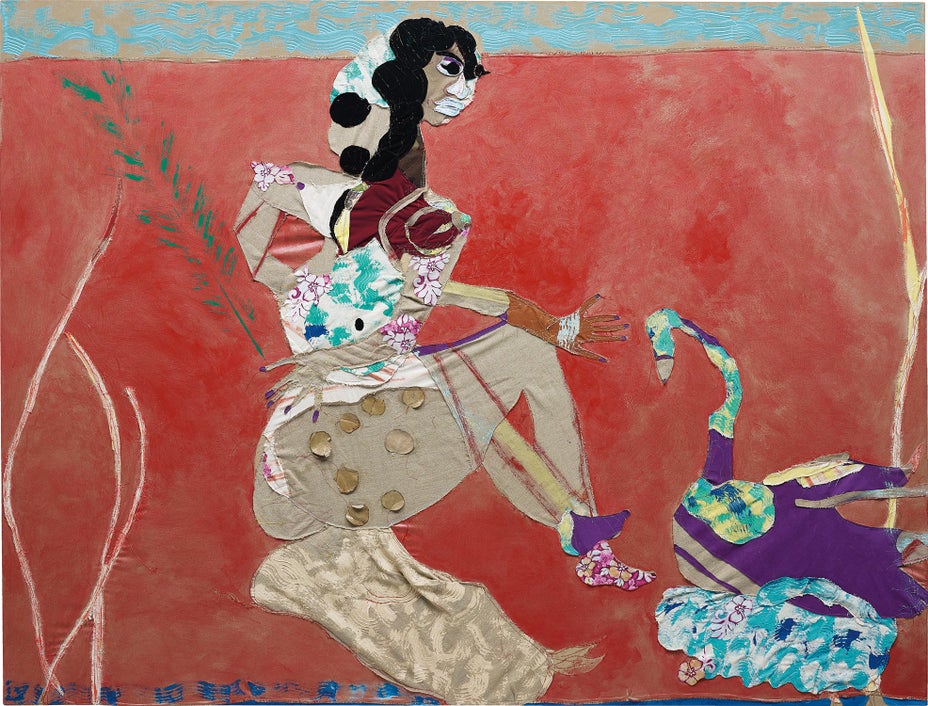
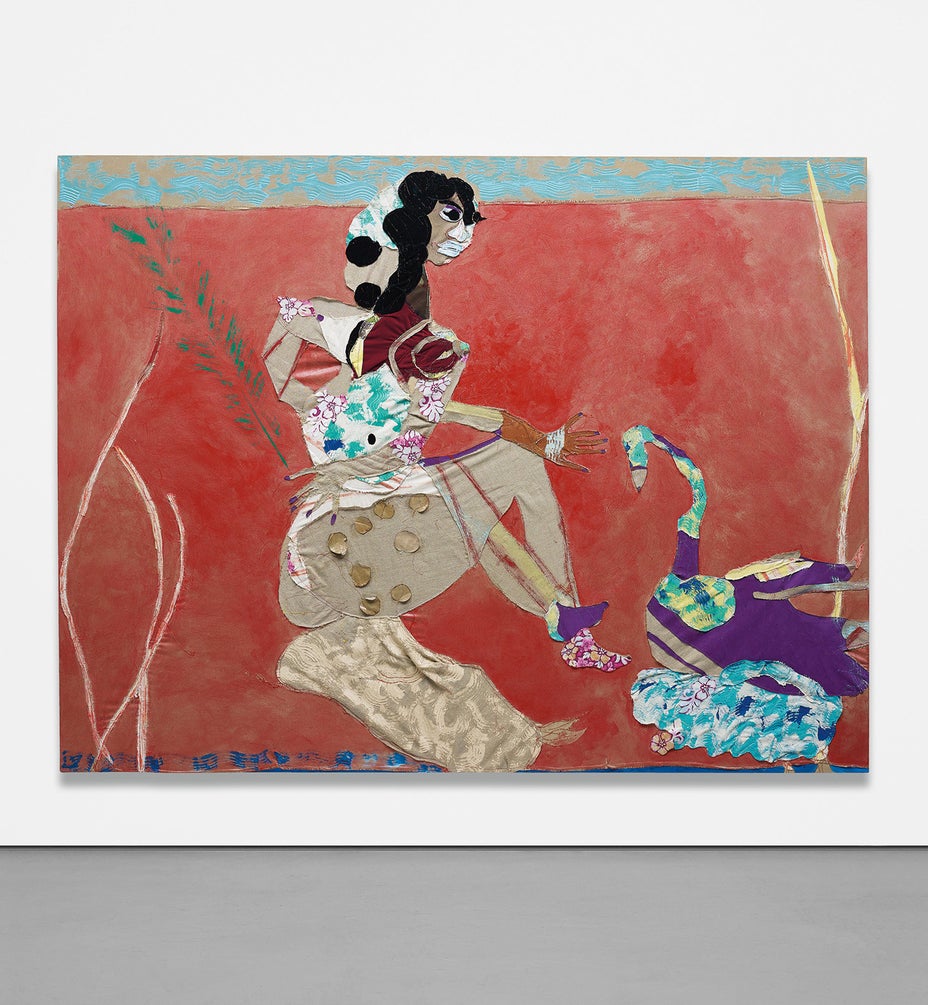
Challenging collective fantasies surrounding the black female body, Tschabalala Self’s artistic practice revolves around the seminal events and scenes that have punctuated history, mythology, and biblical narratives with strong female characters. In Leda, 2015, the artist reimagines the story of the eponymous Aetolian princess who, prior to becoming a Spartan queen, was seduced by Zeus in the guise of a swan. The canvas transforms into a dreamscape of unique visual codes: presenting the iconic scene in various colours, patterns and materials, it portrays the two protagonists in a polyvalent and experimental manner that is typical of Self’s creative process, developed during her MFA at Yale University, 2013-2015. With its multifarious adornments and textures, the composition exudes a tangible energy that matches the narrative content laid atop its surface; blown up to immense dimensions and set against an arresting carmine backdrop, it bears a sense of grandeur that only heightens the scene’s gravitas. First exhibited in the year of its execution at The Cabin in Los Angeles, Leda was subsequently shown at the Museum of Contemporary African Disaporan Arts in New York in 2016.
Staged either as a passive, peaceful encounter between the princess and the winged animal, or as a vigorously violent attack, the meeting of Leda and Zeus as a swan has made for a pungent mix of sexuality and violence in the art historical canon. A renowned myth throughout the Middle Ages, Leda prominently arose as a classicising theme during the Italian Renaissance and has continued to be celebrated throughout art history by masters including Leonardo da Vinci, Michelangelo, Théodore Géricault, Albrecht Dürer and Paul Cezanne. In Géricault's iconic rendering, the swan envelops Leda’s body in a commanding manner, whilst in Cézanne's depiction, Leda’s sensual, lounging posture denotes complicity in act of seduction. In Self’s work, Leda is at once threatening and threatened: she exudes an ambivalent energy that betrays the vulnerability of her position. ‘My subjects are fully aware of their conspicuousness and are unmoved by their viewers', the artist remarked. 'Their role is not to show, explain, or perform but rather “to be.” In being, their presence is acknowledged and their significance felt ’ (Tschabalala Self, quoted in her website description).
Tschabalala Self
American | 1990Harlem-born artist Tschabalala Self combines sewing, printing and painting in a singular style that speaks to her experience of contemporary black womanhood. Despite her extensive use of craft methods, Self considers herself to be a painter above all else. Her work is known for exaggerated colors and forms, allowing the personages within to “escape” from society’s narrow perceptions.
Explaining her practice, the artist stated: “I hope to correct misconceptions propagated within and projected upon the Black body. Multiplicity and possibility are essential to my practice and general philosophy. My subjects are fully aware of their conspicuousness and are unmoved by the viewer. Their role is not to show, explain, or perform but rather ‘to be.’ In being, their presence is acknowledged and their significance felt. My project is committed to this exchange, for my own edification and for the edification of those who resemble me.”