

Property of a Japanese Collector
1077
Tudor
Ref. 7149/0
Oysterdate “Monte Carlo”
A fine and attractive stainless steel chronograph wristwatch with date and bracelet
- Estimate
- HK$60,000 - 120,000€6,600 - 13,300$7,700 - 15,400
HK$139,700
Lot Details
- Manufacturer
- Tudor
- Year
- Circa 1974
- Reference No
- 7149/0
- Case No
- 825’967
- Model Name
- Oysterdate “Monte Carlo”
- Material
- Stainless steel
- Calibre
- Manual, cal. 234, 17 jewels
- Bracelet/Strap
- Stainless steel Rolex Oyster bracelet, endlink stamped “782” and “3876”, max length 185mm
- Clasp/Buckle
- Stainless steel Rolex Oyster deployant clasp, stamped “T-D”
- Dimensions
- 39.5mm diameter
- Signed
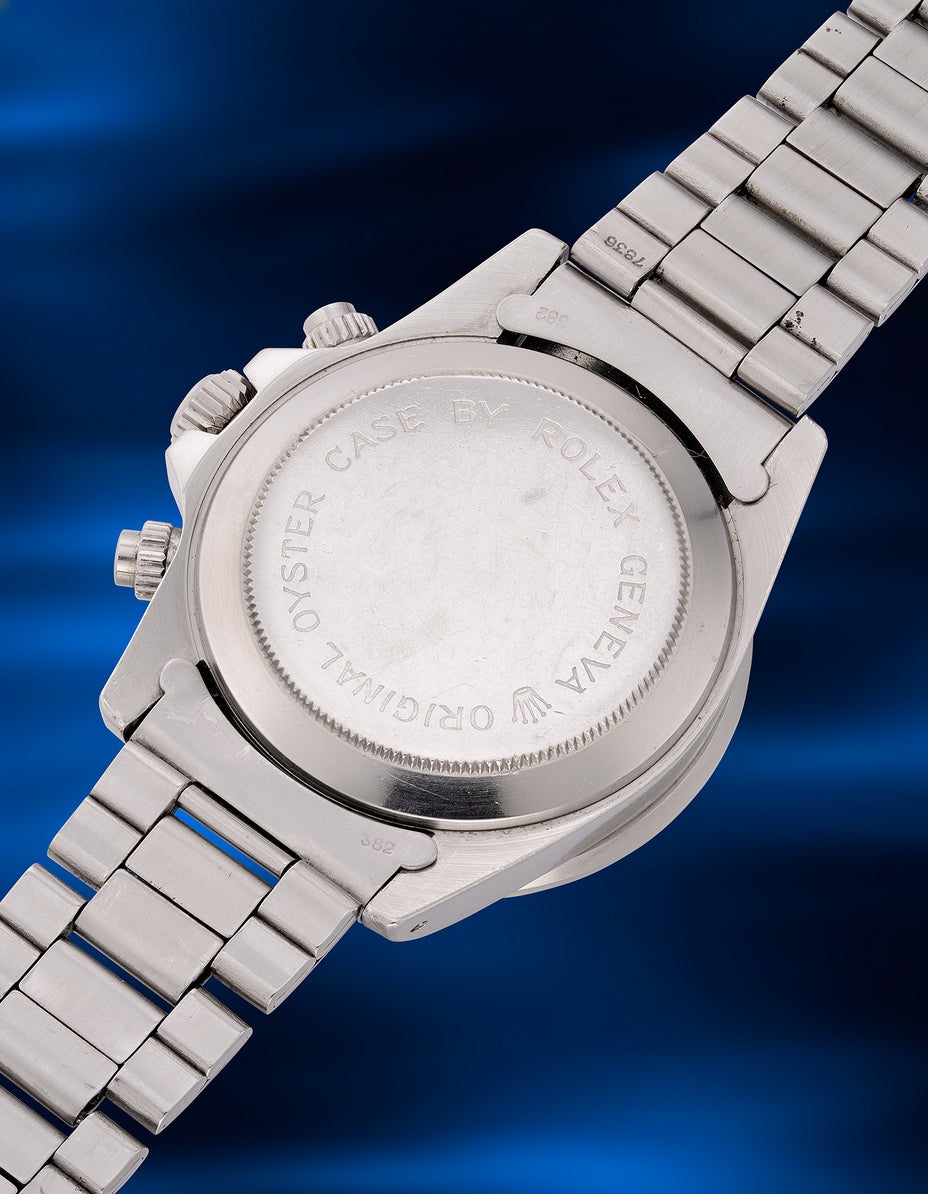
- Dial and movement signed; case, bracelet and clasp signed Rolex
Specialist
Full-Cataloguing
Catalogue Essay
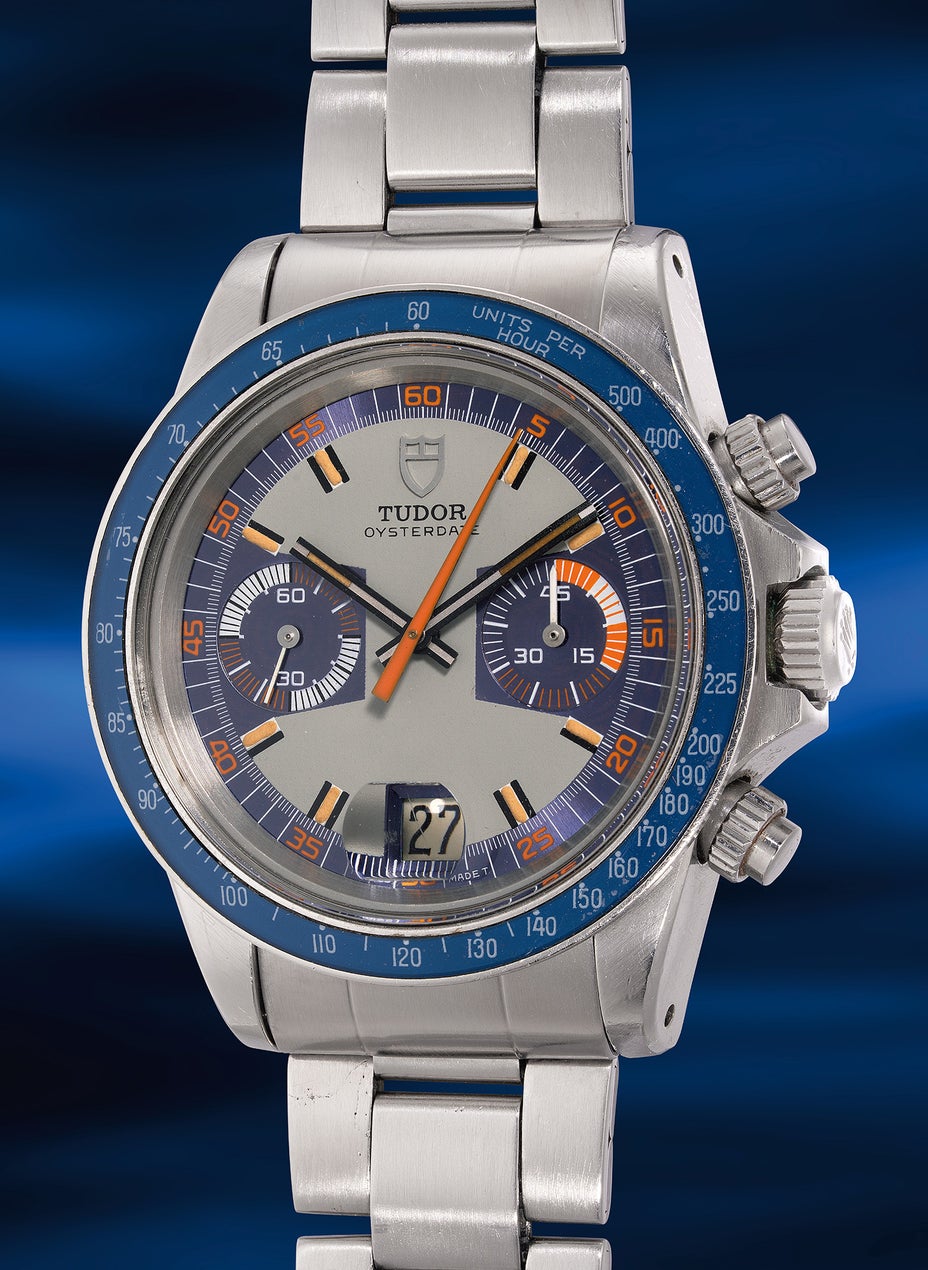
The Tudor Chronograph ref. 7149, affectionately nicknamed “Monte Carlo,” is a standout model from the brand’s golden era in the 1970s. Produced between approximately 1971 and 1977, it represents the second generation of Tudor chronographs, following the initial trio introduced in 1970. While retaining the 39.5mm case and bold dial design of its predecessor, the ref. 7149 introduced a significant upgrade in movement: the manually wound Valjoux Calibre 234. This calibre offered improved accuracy and featured a more refined column wheel chronograph mechanism, replacing the earlier cam-actuated system.
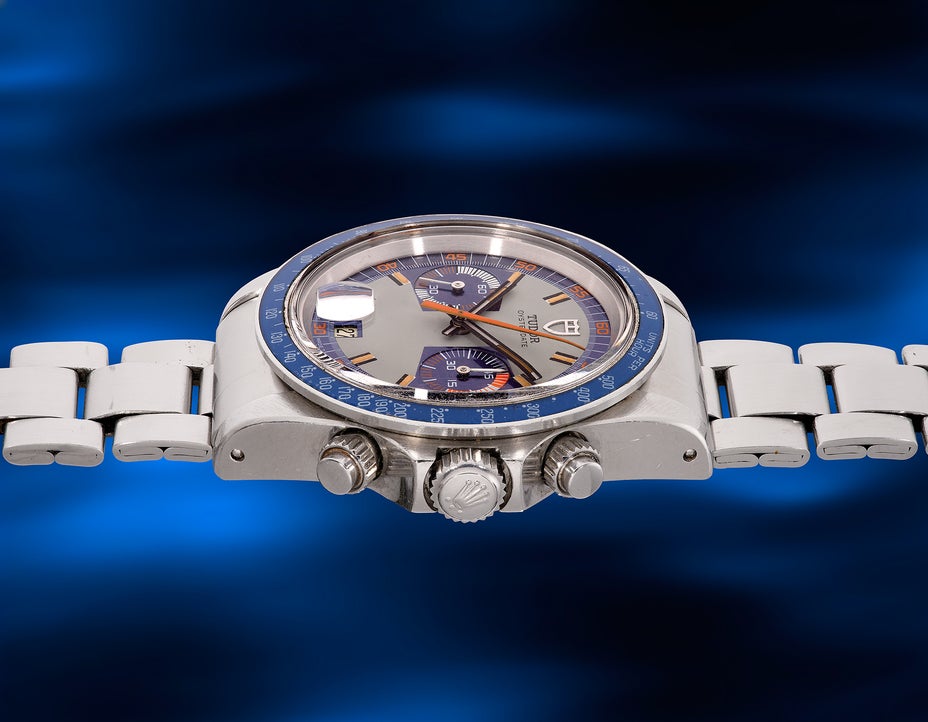
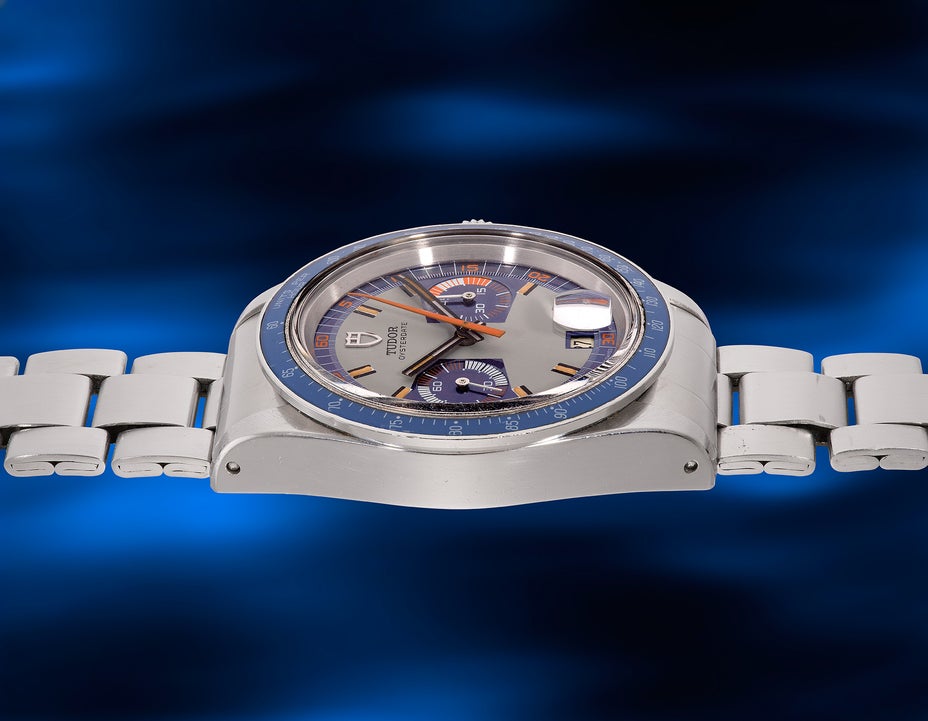
Ref. 7149 is celebrated for its vibrant and sporty aesthetic, with dial options in grey and black or grey and blue, accented with white and orange details. It features a fixed acrylic tachymeter bezel, screw-down chronograph pushers, and a box-shaped acrylic crystal with a cyclops lens positioned unusually at 6 o’clock. The watch’s design is distinctly retro, yet highly functional, with luminous baton-style hands and a date display.
The present example, offered in excellent condition, showcases the grey and blue dial variant, accented with white and orange details that lend a lively and distinctive character to the watch. The playful contrast of colours, combined with the dial’s unique layout, is widely believed to be the inspiration behind its nickname “Monte Carlo,” as the design loosely evokes the appearance of a roulette wheel.
Ref. 7149 is celebrated for its vibrant and sporty aesthetic, with dial options in grey and black or grey and blue, accented with white and orange details. It features a fixed acrylic tachymeter bezel, screw-down chronograph pushers, and a box-shaped acrylic crystal with a cyclops lens positioned unusually at 6 o’clock. The watch’s design is distinctly retro, yet highly functional, with luminous baton-style hands and a date display.
The present example, offered in excellent condition, showcases the grey and blue dial variant, accented with white and orange details that lend a lively and distinctive character to the watch. The playful contrast of colours, combined with the dial’s unique layout, is widely believed to be the inspiration behind its nickname “Monte Carlo,” as the design loosely evokes the appearance of a roulette wheel.
Tudor
Swiss | 1926Almost twenty years after Rolex was founded, Hans Wilsdorf established Tudor with the intention of making more affordable watches without compromising the quality for which Rolex was renowned. Tudor was named after the British Dynasty that ruled England from 1485 to 1603, and their symbol came from the "War of Roses." After interchanging Rose and Shield symbols for a number of years, the firm replaced the Rose with the Shield logo from the 1960s until today.
Some of the most recognized vintage models made by Tudor include the Submariner, a waterproof model first introduced in 1954, the Oysterdate, the earliest versions of which were nicknamed the "Monte-Carlo," the Heritage, which included the date at 6 o'clock, as well as the Pelagos, which translates to "deep sea" in Greek.
Browse MakerSome of the most recognized vintage models made by Tudor include the Submariner, a waterproof model first introduced in 1954, the Oysterdate, the earliest versions of which were nicknamed the "Monte-Carlo," the Heritage, which included the date at 6 o'clock, as well as the Pelagos, which translates to "deep sea" in Greek.