13
Vik Muniz
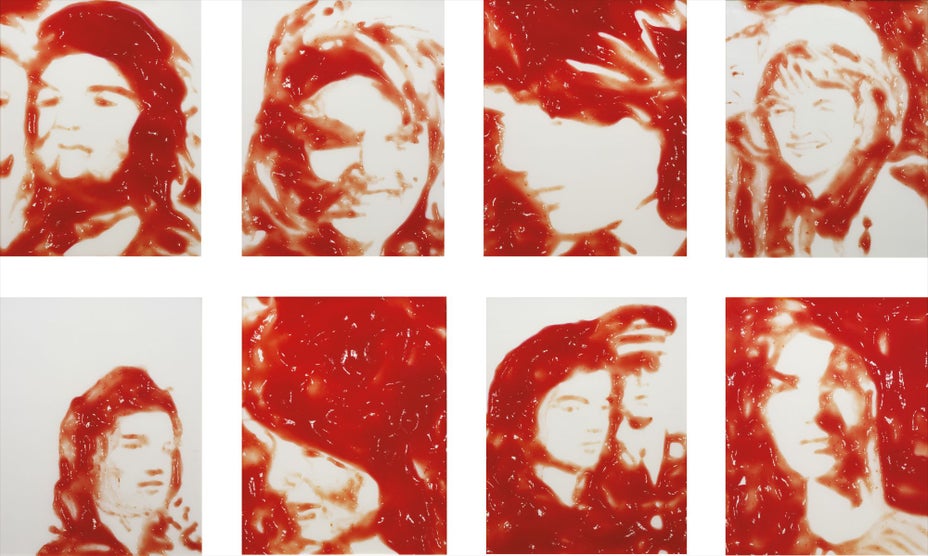
Jackie (Polyptich) (after Warhol)
Estimate
$150,000–250,000
Sold
1999
8 c-prints
each image 34 x 26 3/4 in. (86.4 x 67.9 cm.)
each frame 36 1/2 x 29 1/4 in. (92.7 x 74.3 cm.)
each frame 36 1/2 x 29 1/4 in. (92.7 x 74.3 cm.)
This work is number 1 from an edition of 3 plus 3 artist's proofs. This work is accompanied by a certificate of authenticity signed by the artist.
Full-Cataloguing
“ Process enters my work as a form of narrative. When people look at one of my pictures, I don’t want them to actually see something represented. I prefer for them to see how something gets to represent something else." Vik Muniz
A self-described “student of media,” there is virtually no medium that Vik Muniz has not explored to its most extensive limits. From Pictures of Chocolate to Pictures of Diamonds, Muniz is a master at blending a wide array of unlikely materials with iconic images borrowed from art history and popular culture. His vision of the reaches and possibilities of art is immense, and by linking his artistic past with our contemporary present, he has created his own personal visual language. In doing so, he invites us to reflect on the inexhaustibility and regenerative potential of the creative image.
In his After Warhol series, Muniz invokes the iconic images that Andy Warhol engraved into the global canon of contemporary art. In the present lot, Muniz engages specifically with Warhol’s portrait series of Jackie Kennedy from the 1960s. Building on Warhol’s appropriation of popular images and his commentary on their pervasive reproduction, Muniz actively joins in a discussion that has been ongoing since the very invention of photography: How does the widespread use of reproducible images affect our ability to intimately interact with their subjects? Have the effects of technology and photography in popular culture made us immune to an image’s aesthetic power? Art theory has long been rife with debates about the impossibility of initiating a powerful visual connection with an audience desensitized to imagery. As illustrated by his After Warhol series, Muniz firmly disagrees. He argues that the acts of looking and interpreting what we see are at the forefront of what makes us human. “Looking” is among the most instinctive and natural of all human actions.
The present lot thus exemplifies the artist’s foray into the science of visual observation and its creative manifestations. Muniz adds a layer of art historical engagement by recreating these historic portraits out of ketchup — a mundane substance that has permeated our everyday life, which Andy Warhol himself referenced in paintings and sculpture. Muniz’s use of the medium results in a collaborative process between art history, the artwork itself and its audience. The present lot is a dynamic center of exchanges, and Muniz’s lesson is the ultimate reversal: the true subject of these portraits may not be Jackie Kennedy, but rather the perceptive interplay between images and viewers.
A self-described “student of media,” there is virtually no medium that Vik Muniz has not explored to its most extensive limits. From Pictures of Chocolate to Pictures of Diamonds, Muniz is a master at blending a wide array of unlikely materials with iconic images borrowed from art history and popular culture. His vision of the reaches and possibilities of art is immense, and by linking his artistic past with our contemporary present, he has created his own personal visual language. In doing so, he invites us to reflect on the inexhaustibility and regenerative potential of the creative image.
In his After Warhol series, Muniz invokes the iconic images that Andy Warhol engraved into the global canon of contemporary art. In the present lot, Muniz engages specifically with Warhol’s portrait series of Jackie Kennedy from the 1960s. Building on Warhol’s appropriation of popular images and his commentary on their pervasive reproduction, Muniz actively joins in a discussion that has been ongoing since the very invention of photography: How does the widespread use of reproducible images affect our ability to intimately interact with their subjects? Have the effects of technology and photography in popular culture made us immune to an image’s aesthetic power? Art theory has long been rife with debates about the impossibility of initiating a powerful visual connection with an audience desensitized to imagery. As illustrated by his After Warhol series, Muniz firmly disagrees. He argues that the acts of looking and interpreting what we see are at the forefront of what makes us human. “Looking” is among the most instinctive and natural of all human actions.
The present lot thus exemplifies the artist’s foray into the science of visual observation and its creative manifestations. Muniz adds a layer of art historical engagement by recreating these historic portraits out of ketchup — a mundane substance that has permeated our everyday life, which Andy Warhol himself referenced in paintings and sculpture. Muniz’s use of the medium results in a collaborative process between art history, the artwork itself and its audience. The present lot is a dynamic center of exchanges, and Muniz’s lesson is the ultimate reversal: the true subject of these portraits may not be Jackie Kennedy, but rather the perceptive interplay between images and viewers.