3Ο︎◆︎
Wade Guyton
Untitled
Estimate
$1,200,000–1,500,000
Sold For
$1,990,000
signed and dated "Guyton 2009" on the overlap
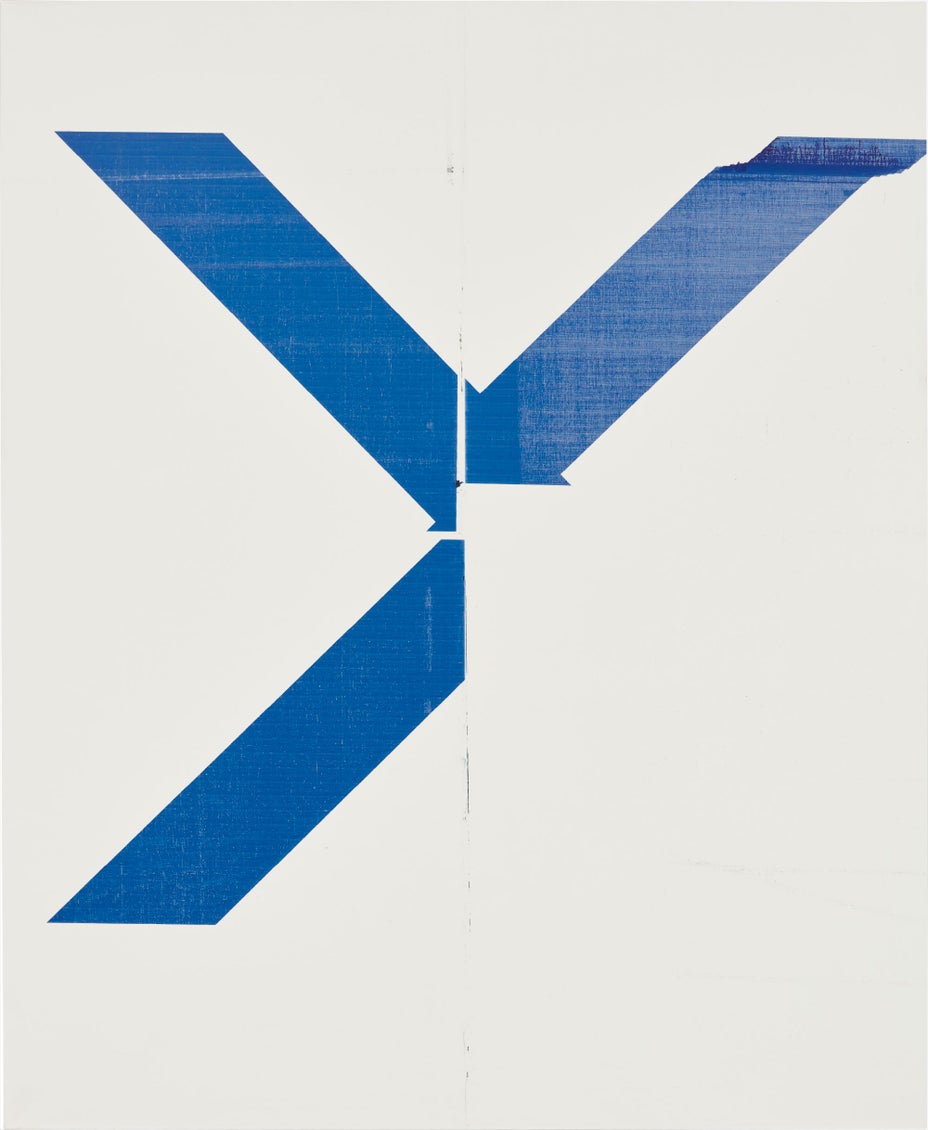
Epson UltraChrome inkjet on linen
84 1/4 x 69 in. (214 x 175.3 cm.)
Executed in 2009.
Full-Cataloguing
"All the artists I was interested in were involved with the manipulation of language or the malleability of the categories of art. There was a freedom in this way of thinking. There was a space where objects could be speculative." Wade Guyton
Wade Guyton's Untitled, 2009 is an iconic work by one of the most important artists of the current generation. The painting boldly depicts the artist's trademark “X” form, printed in blue with an Epson UltraChrome inkjet printer. Informed by chance and exploring the essence and limits of mechanization, Untitled also examines what it means to be a painter in the twenty-first century. Guyton challenges the limits of painting by almost entirely removing his hand from the production of the work. Similar to Duchamp, Guyton blurs the boundaries between "high" and "low," re-inventing appropriation in a new minimalist language.
A student of Robert Morris during his MFA at Hunter College in New York, Guyton admired his professor’s conceptual approach and his pioneering of Minimalist theory. He was drawn instinctively to artists who used art as an open-ended platform for thought and exploration. Guyton recalls, “All the artists I was interested in were involved with the manipulation of language or the malleability of the categories of art. There was a freedom in this way of thinking. There was a space where objects could be speculative.” (Wade Guyton: OS, exh. cat., Whitney Museum of American Art, New York, 2012-2013, p. 11). In this way, Guyton follows in the storied tradition of radically reestablishing the bounds of what painting is or could be, similar to what Kazimir Malevich accomplished with his Suprematist paintings, such as 1914’s Black Cross, which eschewed anything natural for the purely geometric.
Archetypal of Guyton’s oeuvre, the formal and conceptual identities of Untitled are defined by the spontaneity of its mechanical fabrication. As an elegantly made and brutally efficient analysis of the limits and restraints of creative production, Untitled is a testament to the vivacity of painting now, then, and forever.
Wade Guyton's Untitled, 2009 is an iconic work by one of the most important artists of the current generation. The painting boldly depicts the artist's trademark “X” form, printed in blue with an Epson UltraChrome inkjet printer. Informed by chance and exploring the essence and limits of mechanization, Untitled also examines what it means to be a painter in the twenty-first century. Guyton challenges the limits of painting by almost entirely removing his hand from the production of the work. Similar to Duchamp, Guyton blurs the boundaries between "high" and "low," re-inventing appropriation in a new minimalist language.
A student of Robert Morris during his MFA at Hunter College in New York, Guyton admired his professor’s conceptual approach and his pioneering of Minimalist theory. He was drawn instinctively to artists who used art as an open-ended platform for thought and exploration. Guyton recalls, “All the artists I was interested in were involved with the manipulation of language or the malleability of the categories of art. There was a freedom in this way of thinking. There was a space where objects could be speculative.” (Wade Guyton: OS, exh. cat., Whitney Museum of American Art, New York, 2012-2013, p. 11). In this way, Guyton follows in the storied tradition of radically reestablishing the bounds of what painting is or could be, similar to what Kazimir Malevich accomplished with his Suprematist paintings, such as 1914’s Black Cross, which eschewed anything natural for the purely geometric.
Archetypal of Guyton’s oeuvre, the formal and conceptual identities of Untitled are defined by the spontaneity of its mechanical fabrication. As an elegantly made and brutally efficient analysis of the limits and restraints of creative production, Untitled is a testament to the vivacity of painting now, then, and forever.