
Collection of Georges Bermann
2
William Eggleston
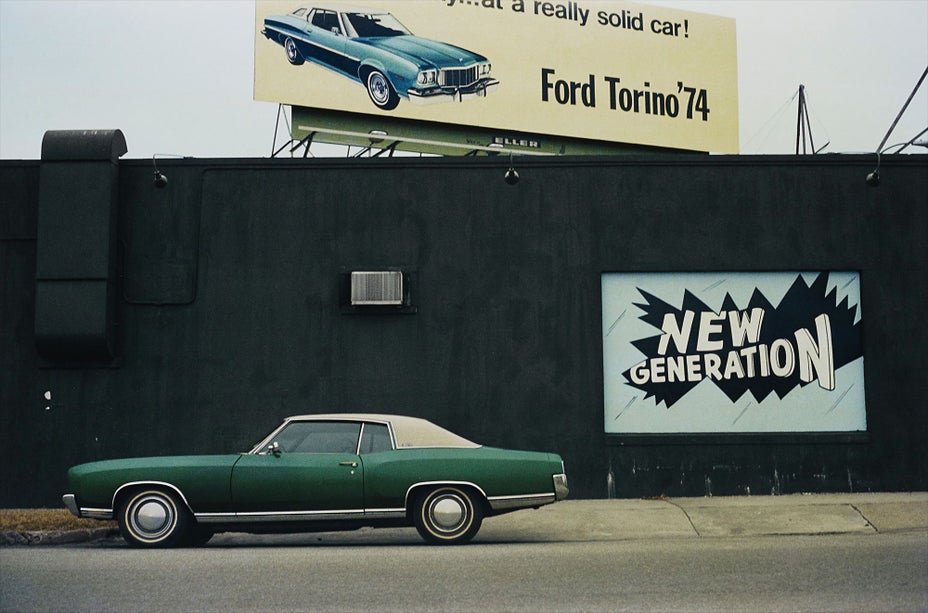
Untitled, 1971-1974
- Estimate
- £50,000 - 70,000
£197,000
Lot Details
Pigment print, printed 2012.
Image: 80.8 x 121.8 cm (31 3/4 x 47 7/8 in.)
Frame: 112.5 x 152 cm (44 1/4 x 59 7/8 in.)
Signed by the artist in ink, titled, dated, numbered 1/2 in an unidentified hand in pencil and printed Eggleston Artistic Trust copyright reproduction limitation on a label affixed to the reverse of the flush-mount.
Specialist
Full-Cataloguing
Catalogue Essay
‘I had this notion of what I called a democratic way of looking around, that nothing was more or less important.’
William Eggleston
The current lot was first published as part of Los Alamos Revisited in 2012, a clothbound box set that included many previously lost negatives from William Eggleston’s travels across the United States, 1965-1974.
William Eggleston
The current lot was first published as part of Los Alamos Revisited in 2012, a clothbound box set that included many previously lost negatives from William Eggleston’s travels across the United States, 1965-1974.
Provenance
Literature
William Eggleston
American | 1939William Eggleston's highly saturated, vivid images, predominantly capturing the American South, highlight the beauty and lush diversity in the unassuming everyday. Although influenced by legends of street photography Robert Frank and Henri Cartier-Bresson, Eggleston broke away from traditional black and white photography and started experimenting with color in the late 1960s.
At the time, color photography was widely associated with the commercial rather than fine art — something that Eggleston sought to change. His 1976 exhibition at the Museum of Modern Art, Color Photographs, fundamentally shifted how color photography was viewed within an art context, ushering in institutional acceptance and helping to ensure Eggleston's significant legacy in the history of photography.
Browse ArtistAt the time, color photography was widely associated with the commercial rather than fine art — something that Eggleston sought to change. His 1976 exhibition at the Museum of Modern Art, Color Photographs, fundamentally shifted how color photography was viewed within an art context, ushering in institutional acceptance and helping to ensure Eggleston's significant legacy in the history of photography.