
61
William Eggleston
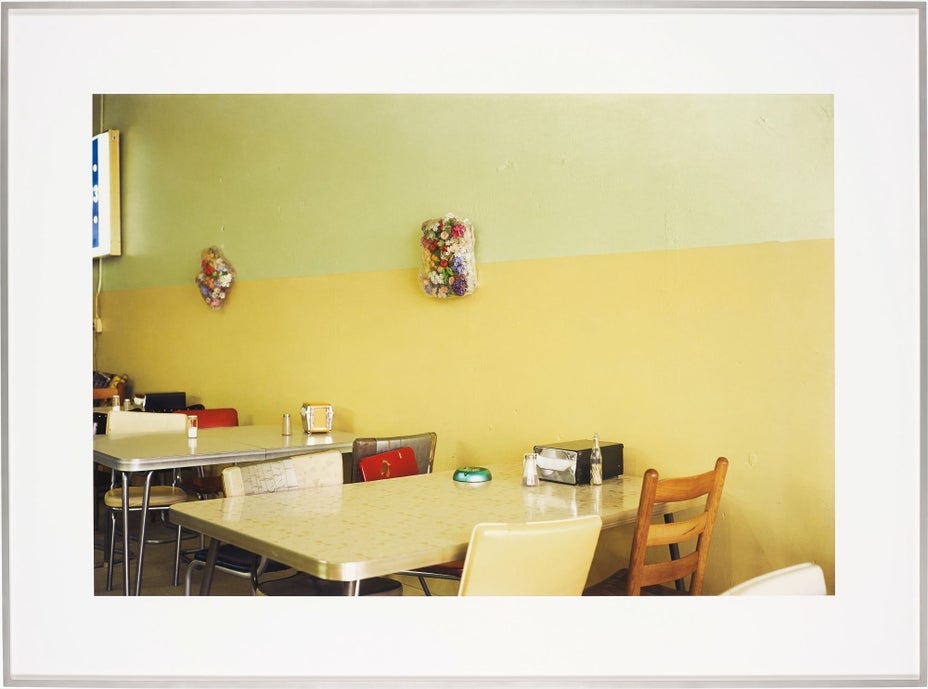
Untitled
- Estimate
- £60,000 - 80,000‡
Lot Details
Pigment print, printed 2011, flush-mounted.
1976
Image: 81.5 x 121.5 cm (32 1/8 x 47 7/8 in.)
Frame: 112.5 x 150 cm (44 1/4 x 59 in.)
Signed by the artist in ink, titled, dated, numbered 1/2 in an unidentified hand in ink and printed Eggleston Artistic Trust copyright reproduction limitation on a label affixed to the reverse of the flush-mount.
Specialist
Full-Cataloguing
Catalogue Essay
Election Eve, William Eggleston’s first artist’s book, documents his journey from Mississippi to Plains, Georgia, the hometown of then Democratic presidential candidate Jimmy Carter in the weeks leading up to the 1976 American presidential election. Characteristic of the photographer’s subtle, poetic aesthetic, this series of images avoids direct visual reference to the election’s heated, political moment, and instead captures images of the quiet roads and small towns that populate this primarily rural expanse of the American South.
The photograph presented here, taken at the Snak Shak diner in Montezuma, Georgia, about a 45 minute drive from Plains, conveys the unassuming beauty present in Eggleston’s greatest works. A true master of colour in a time when black and white was still viewed by many as the artistic ideal for photography, Eggleston creates in Untitled, 1976, a luminescent, almost Rothko-esque image, evocative of a Colour Field painting. Divided horizontally along the upper half, outside light brightens the multiple shades of yellow found throughout the composition: in the wall, mismatched chairs and tables. The odd red chairs, green ashtray, and multi-coloured wall decorations punctuate this energetic, yet tranquil sea of yellow, beige, cream and gold. In the preface to Election Eve, Lloyd Fonvielle notes, ‘On the eve of the election, when nothing had yet been decided, when everything — whatever that everything was — hung in the balance, Eggleston made an elegy ... a statement of perfect calm.’
Provenance
Literature
William Eggleston
American | 1939William Eggleston's highly saturated, vivid images, predominantly capturing the American South, highlight the beauty and lush diversity in the unassuming everyday. Although influenced by legends of street photography Robert Frank and Henri Cartier-Bresson, Eggleston broke away from traditional black and white photography and started experimenting with color in the late 1960s.
At the time, color photography was widely associated with the commercial rather than fine art — something that Eggleston sought to change. His 1976 exhibition at the Museum of Modern Art, Color Photographs, fundamentally shifted how color photography was viewed within an art context, ushering in institutional acceptance and helping to ensure Eggleston's significant legacy in the history of photography.
Browse ArtistAt the time, color photography was widely associated with the commercial rather than fine art — something that Eggleston sought to change. His 1976 exhibition at the Museum of Modern Art, Color Photographs, fundamentally shifted how color photography was viewed within an art context, ushering in institutional acceptance and helping to ensure Eggleston's significant legacy in the history of photography.