Property from a Private Asian Collection
131
Yoshitomo Nara
Wheels Go Round
Estimate
HK$2,000,000–3,000,000
€218,000–327,000
$256,000–385,000
Sold For
HK$3,750,000
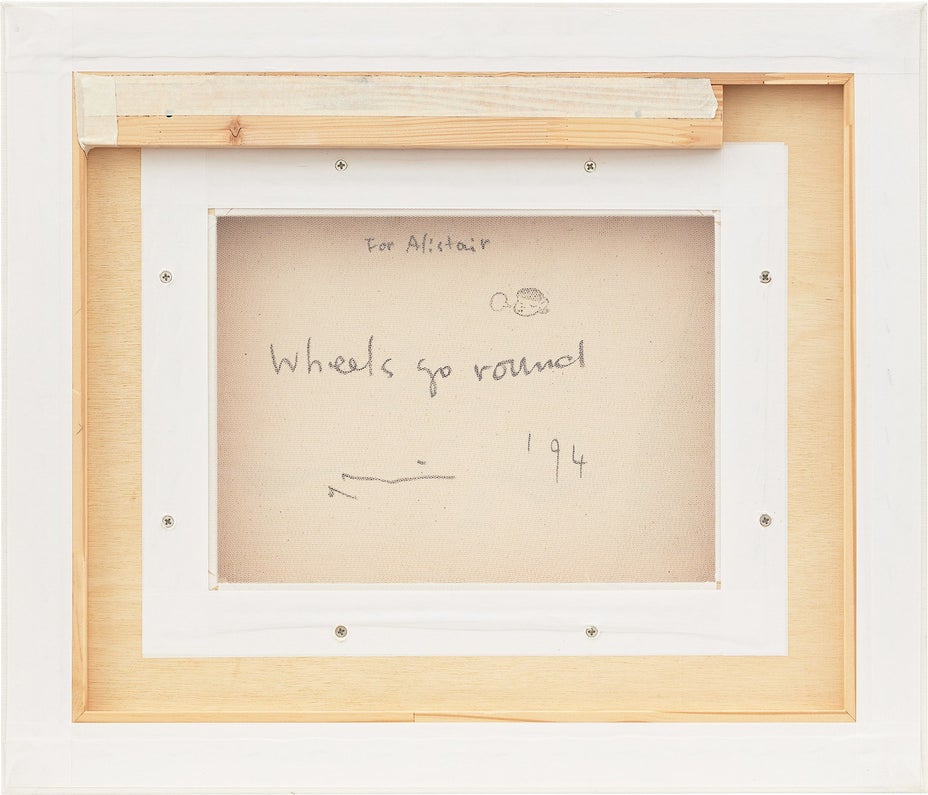
signed, titled, dedicated and dated 'For Alistair "Wheels go round" Yoshitomo Nara [in Japanese] '94' on the reverse
oil on canvas
32 x 40.3 cm. (12 5/8 x 15 7/8 in.)
Painted in 1994.
Full-Cataloguing
"Nara’s roly-poly children balance on the razor’s edge: they are cute embodiments of infantilism in their chubby-cheeked plumpness […] but at the same time true individuals who will not be defeated, quiet carriers of hope."Stephan Trescher
Quoted in ‘A Portrait of the Artist as a Young Dog’, in Yoshitomo Nara: Lullaby Supermarket, exh.cat., Institut für Kunst Nürnberg, Nuremberg, 2002, p. 15
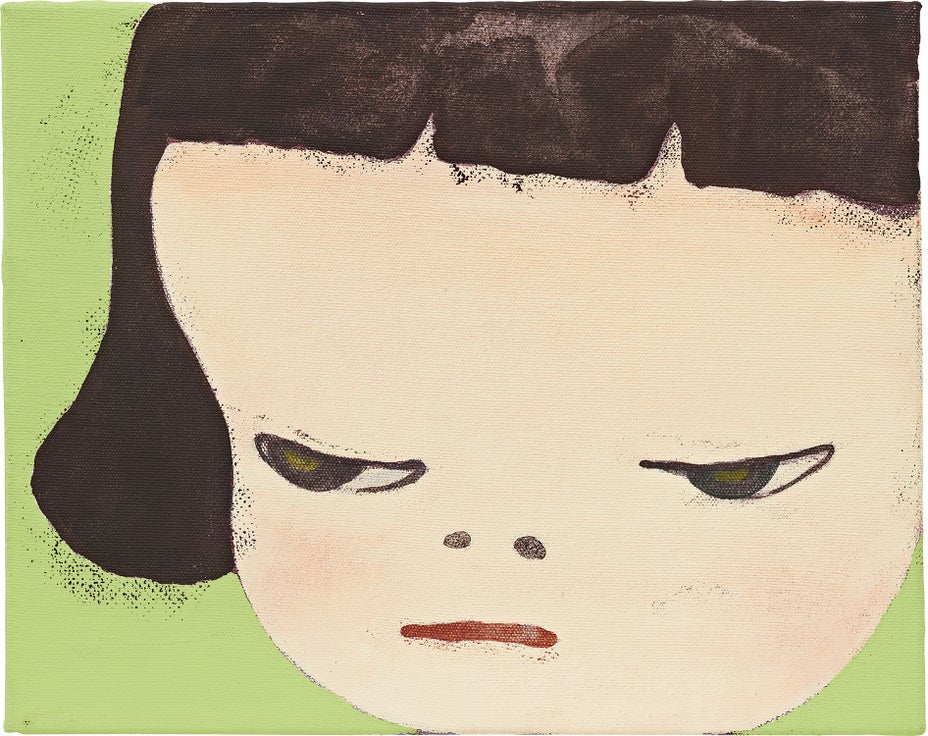
Rendered in pastel hues of pistachio green, blush pink-toned cream and deep chocolate brown, Wheels Go Round is an exquisite example of Japanese artist Yoshitomo Nara’s most acclaimed subject: the seemingly innocuous child-figure . In 1988, after having graduated from the Aichi University of the Arts, Nara moved to Germany to study at the Kunstakademie in Düsseldorf. When asked to reflect upon his time spent in the foreign city, Nara recalls how he ‘literally became “alone” there. It strongly reminded [him] of the memory of [his] lonely childhood’ (Yoshitomo Nara quoted in Hideo Furukawa, ‘An interview with Yoshitomo Nara’, Asymptote Journal, November 2013, online). During this period, Nara produced some of his most powerful works as he began stripping his compositions of unnecessary detail, thus intensifying the emotive potential of the central figure and their inner world.
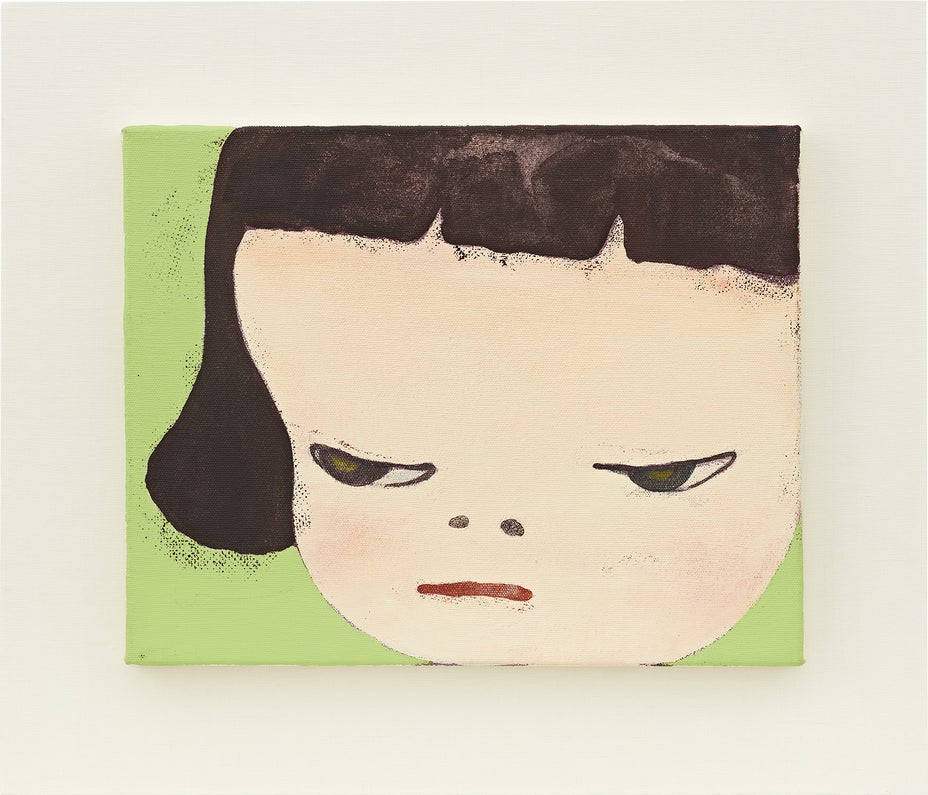
Executed in 1994, the luminously-painted cartoonish head of a little cherub fills the frame in Wheels Go Round, featuring ukiyo-e style slanted eyes, a snub nose and slightly downturned mouth. Although this minimal aesthetic is reminiscent of traditional Japanese ink painting’s focus on the void, Nara’s influences are far-reaching, including children’s literary classics such as Antoine de Saint-Exupéry’s Le Petit Prince, and Japanese fairy-tales from the 1940s and 1950s. Ostensibly innocent at first glance, the child’s look is concurrently defiant and mischievous, calling to mind universal child memories and perfectly demonstrating the global allure of Nara’s most enduring motif.
Quoted in ‘A Portrait of the Artist as a Young Dog’, in Yoshitomo Nara: Lullaby Supermarket, exh.cat., Institut für Kunst Nürnberg, Nuremberg, 2002, p. 15
Rendered in pastel hues of pistachio green, blush pink-toned cream and deep chocolate brown, Wheels Go Round is an exquisite example of Japanese artist Yoshitomo Nara’s most acclaimed subject: the seemingly innocuous child-figure . In 1988, after having graduated from the Aichi University of the Arts, Nara moved to Germany to study at the Kunstakademie in Düsseldorf. When asked to reflect upon his time spent in the foreign city, Nara recalls how he ‘literally became “alone” there. It strongly reminded [him] of the memory of [his] lonely childhood’ (Yoshitomo Nara quoted in Hideo Furukawa, ‘An interview with Yoshitomo Nara’, Asymptote Journal, November 2013, online). During this period, Nara produced some of his most powerful works as he began stripping his compositions of unnecessary detail, thus intensifying the emotive potential of the central figure and their inner world.
Executed in 1994, the luminously-painted cartoonish head of a little cherub fills the frame in Wheels Go Round, featuring ukiyo-e style slanted eyes, a snub nose and slightly downturned mouth. Although this minimal aesthetic is reminiscent of traditional Japanese ink painting’s focus on the void, Nara’s influences are far-reaching, including children’s literary classics such as Antoine de Saint-Exupéry’s Le Petit Prince, and Japanese fairy-tales from the 1940s and 1950s. Ostensibly innocent at first glance, the child’s look is concurrently defiant and mischievous, calling to mind universal child memories and perfectly demonstrating the global allure of Nara’s most enduring motif.