
13
Zenith
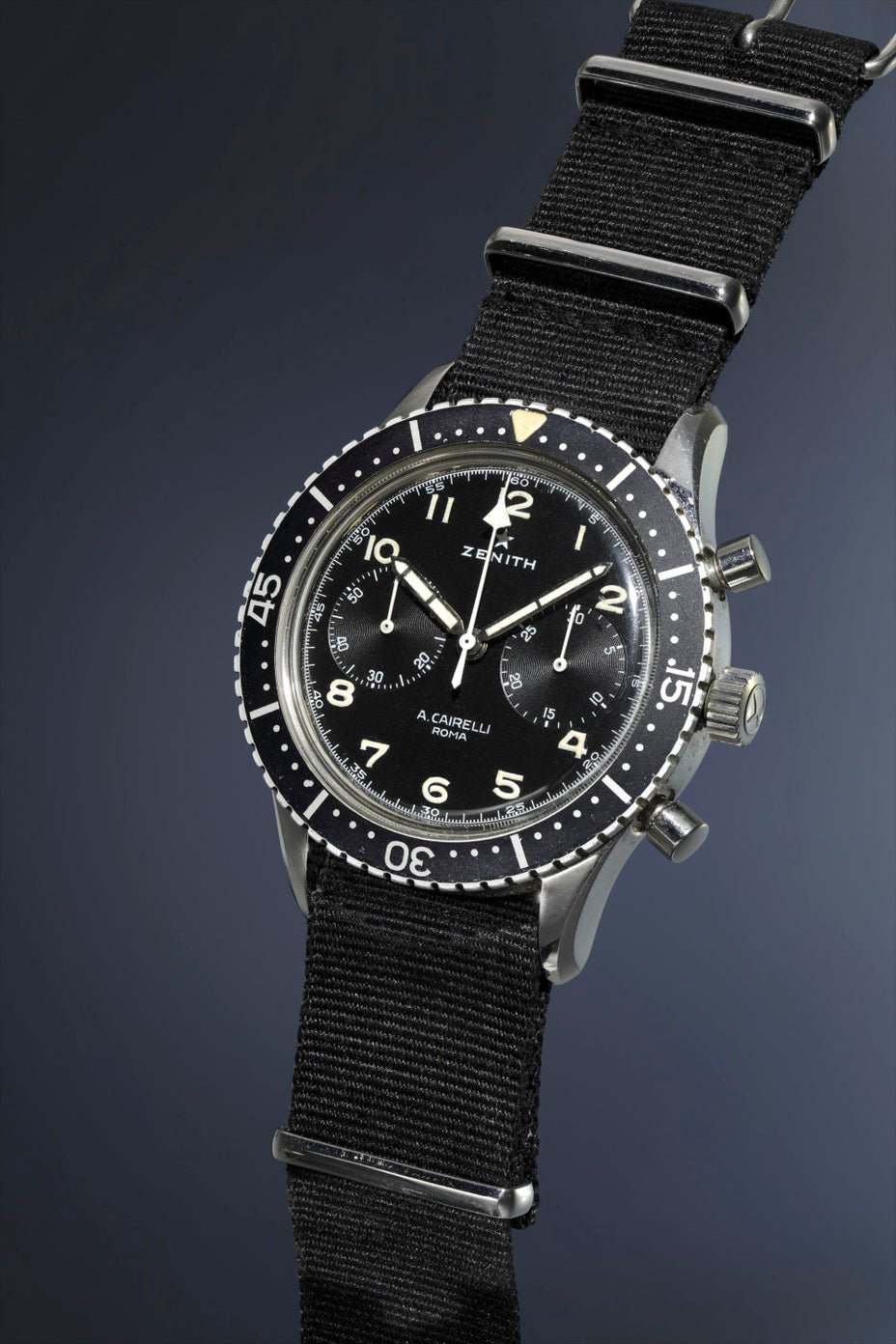
A very rare, oversized and important stainless steel chronograph wristwatch with matte black dial, rotating bezel, luminous Arabic hour markers, made for A. Cairelli Roma.
- Estimate
- CHF10,000 - 20,000
CHF62,500
Lot Details
- Manufacturer
- Zenith
- Year
- 1970
- Case No
- 201’228 (Registration Number)
- Material
- Stainless steel
- Calibre
- Manual, cal. 146DP, 17 jewels
- Bracelet/Strap
- Nylon
- Clasp/Buckle
- Stainless steel
- Dimensions
- 43mm diameter
- Signed
- Dial and movement signed. Caseback further engraved “A.M.I Cronometro Tipo CP-2 M.M. 201228”
Specialist
Full-Cataloguing
Catalogue Essay
One cannot help but be impressed by this distinguished and extremely rare vintage military issued Zenith stainless steel chronograph – the CP-2 (Cronometro da Polsa Type 2). Measuring a substantial 43mm in diameter, it is understood that Zenith in the 1960s and 70s produced approximately 2,500 examples of the reference for the Italian Air Force, the Aeronautica Militare Italiana (AMI).
They were all supplied through A. Cairelli, the prominent Roman retailer of watches, clocks, and mechanical instrumentation. Designed for AMI’s pilots for mission use, many were not issued due to an abrupt cancellation by the AMI. A. Cairelli sold the remaining stock – all with no military inscriptions on their casebacks – privately to civilians.
The present watch is therefore a rare military-issued version, illustrated by the engraving on this caseback, reading “AMI CRONOMETRO TIPO CP-2 MM 201'228”. It’s fitted with a beautiful, matte black dial adorned with luminous hour markers, with a classic two-register configuration enhanced by the prestigious “A. Cairelli Roma” signature at 6 o’clock.
Housing a high grade, hand-wound movement – the caliber 146, this historically significant chronograph remains in excellent overall condition. Combined with its masculine presence, military provenance, and eye-catching dial, it’s a superb timepiece for any vintage watch enthusiast.
They were all supplied through A. Cairelli, the prominent Roman retailer of watches, clocks, and mechanical instrumentation. Designed for AMI’s pilots for mission use, many were not issued due to an abrupt cancellation by the AMI. A. Cairelli sold the remaining stock – all with no military inscriptions on their casebacks – privately to civilians.
The present watch is therefore a rare military-issued version, illustrated by the engraving on this caseback, reading “AMI CRONOMETRO TIPO CP-2 MM 201'228”. It’s fitted with a beautiful, matte black dial adorned with luminous hour markers, with a classic two-register configuration enhanced by the prestigious “A. Cairelli Roma” signature at 6 o’clock.
Housing a high grade, hand-wound movement – the caliber 146, this historically significant chronograph remains in excellent overall condition. Combined with its masculine presence, military provenance, and eye-catching dial, it’s a superb timepiece for any vintage watch enthusiast.
Zenith
Swiss | 1865Since Zenith's beginnings, founder George Favre-Jacot sought to manufacture precision timepieces, realizing quality control was best maintained when production was housed under one roof. Zenith remains one of the few Swiss manufacturers to produce their own in-house movements to this day.
Today, the brand is best known for the "El Primero," the firm's most successful automatic chronograph movement. In an interesting twist of fate, the company that owned Zenith during the 1970s decided to move on to quartz movements and therefore sought to destroy the parts and tools necessary to make mechanical movements. One watchmaker realized this folly and hid the tools and parts before they were destroyed. In 1984, he returned them to Zenith so they could once again make the El Primero movement.
Browse MakerToday, the brand is best known for the "El Primero," the firm's most successful automatic chronograph movement. In an interesting twist of fate, the company that owned Zenith during the 1970s decided to move on to quartz movements and therefore sought to destroy the parts and tools necessary to make mechanical movements. One watchmaker realized this folly and hid the tools and parts before they were destroyed. In 1984, he returned them to Zenith so they could once again make the El Primero movement.