19
李察德.佩利斯
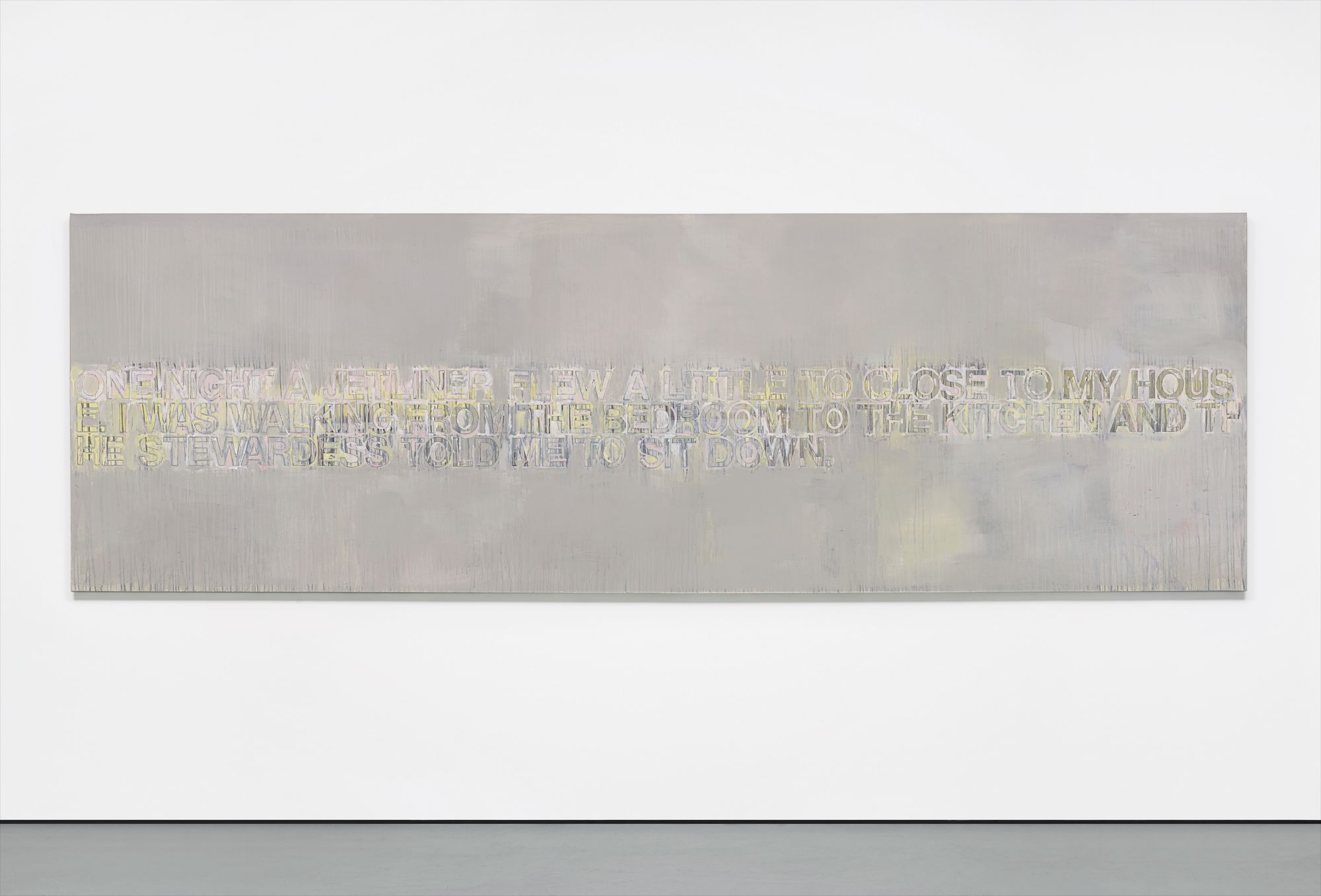
Too Close
完整圖錄內容
Prince’s early paintings are celebrated for their successful appropriation of advertisement images and photographs from the early 1970’s. The use of satirical one-liners, taken from book, magazines and other literary influences, are paired with powerful images and recognisable photographs to explore the relationship between image and language. At once superimposing and merging the two media, the artist presents a multi-faceted yet cohesive amalgamation of concept and conception. The beginning of this creative process featured rigidly composed, monochromatic and austere works. ‘With the jokes I can point to them and at least say they’re jokes, which they are. That’s what I think is going to make people uncomfortable. Because it’s like a Beckett endgame. If anything, I have an uneasy feeling people will like them. Now people can say, “Oh, he’s the artist who does the jokes.” They can finally latch onto something, which I think people like to do. And if that happens, how am I going to get out of that situation?’ (Richard Prince by Marvin Heiferman, Bomb- Artists in conversation).
The text is stencilled in capitalised font and occupies the central third of the canvas. The strong design, focused on symmetry and regulated composition, enables comparisons with the textual work of Ed Ruscha, where the artist’s use of capitals, enveloping consonants and repeated vowels result in the creation of an abstract shape rather than focusing on their literary meaning. The multi-faceted value of the Joke Paintings lies in this amalgamation of the abstract and the conceptual: from a distance the canvas relies on shape and proportion yet, on closer inspection, finds conceptual possibilities within the elements that form the text itself. In a 2000 interview with Julie L. Belcove, Prince says the Joke Paintings are 'what I wanted to become known for.' When asked to identify the artistic genre of his Jokes, Prince responded, 'the Joke paintings are abstract. Especially in Europe, if you can't speak English.' His easy, almost blithe explanation reflects the theme of his work and ironically highlights its intrinsic contradictions. 'The painted, as against the photographic, world of Richard Prince is neither preconceived nor harmonious, linear, stable or continuous. Instead, it is a place of discrepancy and displacement, of contradictions and misunderstandings (much like reality in general). We could even speak of the absurdity of these works, the zone where irreconcilable elements on the pictorial surface initiate the signification. Herein, the spectator is confronted by a confusing and enigmatic frame of reference.' (Introduction to the exhibition Richard Prince: Canaries in the Coal Mine at the Astrup Fearnley Museum of Modern Art, Oslo, 20 January–29 April 2007) The jokes, despite their comical and satirical quality, reflect the creative process of the artist. Constantly changing and progression, changing in inspiration and presentation, they reflect the complex qualities of the human psyche and artistic talent. The connections and inter-relations between the Joke Paintings do not create a sense of repetition but rather of sequence and evolution. The present lot reveals his hunger for artistic discourse, engaging in dialogue with the viewer as well as forming associations with his predecessors and enabling the use of his own art as inspiration, in its clear and concrete notions.
李察德.佩利斯
American | 1947For more than three decades, Prince's universally celebrated practice has pursued the subversive strategy of appropriating commonplace imagery and themes – such as photographs of quintessential Western cowboys and "biker chicks," the front covers of nurse romance novellas, and jokes and cartoons – to deconstruct singular notions of authorship, authenticity and identity.
Starting his career as a member of the Pictures Generation in the 1970s alongside such contemporaries as Cindy Sherman, Robert Longo and Sherrie Levine, Prince is widely acknowledged as having expanded the accepted parameters of art-making with his so-called "re-photography" technique – a revolutionary appropriation strategy of photographing pre-existing images from magazine ads and presenting them as his own. Prince's practice of appropriating familiar subject matter exposes the inner mechanics of desire and power pervading the media and our cultural consciousness at large, particularly as they relate to identity and gender constructs.