68
Robert Rauschenberg
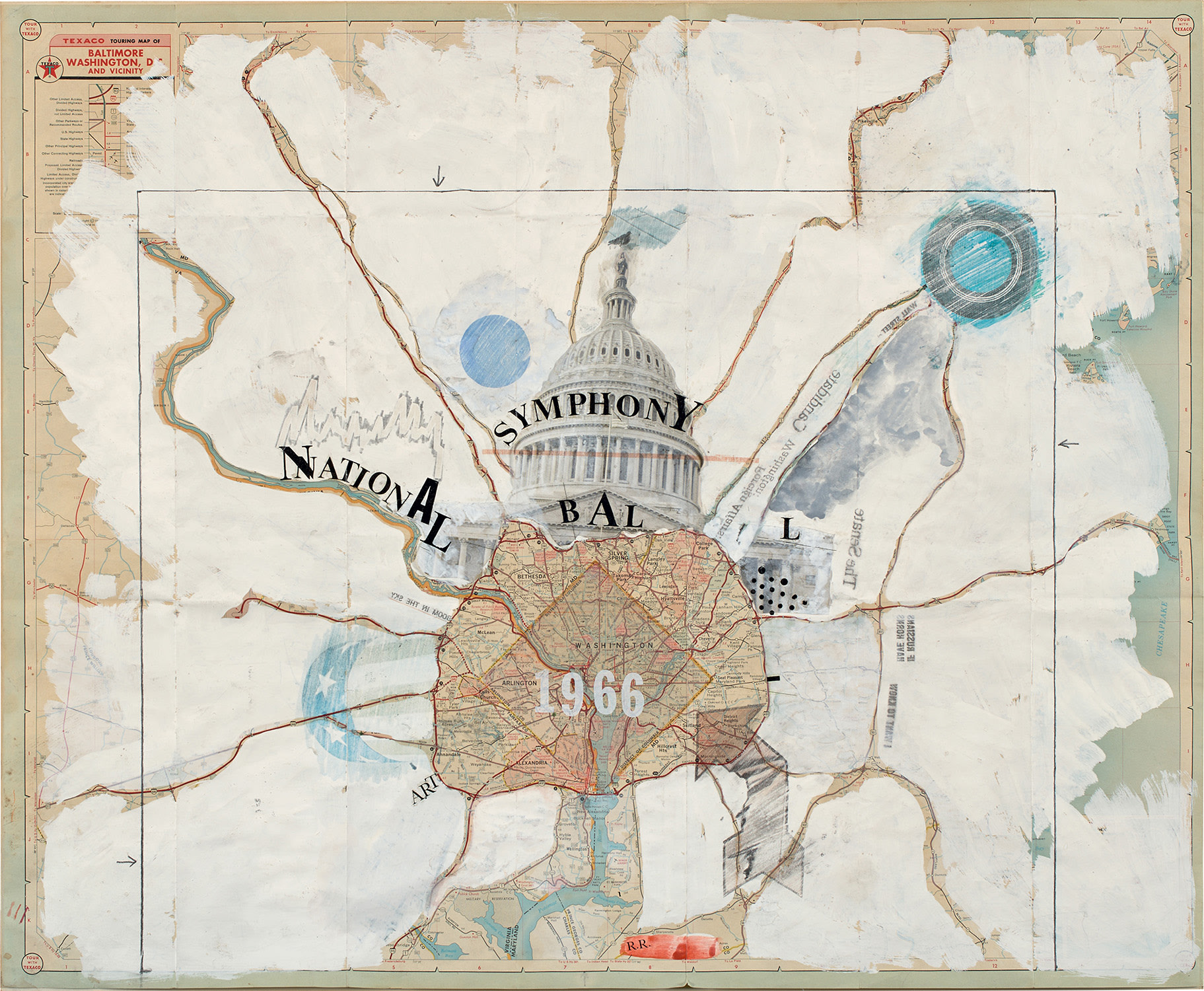
National Symphony Ball
估價
$100,000 - 150,000
拍品詳情
acrylic, gouache, solvent transfer, ink, graphite and collage on paper map
22 3/4 x 27 3/4 in. (57.8 x 70.5 cm)
Executed in 1966.
專家
完整圖錄內容
圖錄文章
Robert Rauschenberg, an undisputed leader in the American avant-garde, was highly prolific, as he worked in a variety of mediums throughout his life. The artist most notably pushed the boundaries of conventional artistic practice by integrating utilitarian items into his work in a Duchampian style. Referring to these works as Combines, Rauschenberg used ordinary objects, like newspapers and photographs, as artistic materials, seeking to work between the gap of art and life. In National Symphony Ball, Rauschenberg’s interest in everyday materials is palpable, as he presents the viewer with an intricate imagining of the American capital, Washington DC. Leaving the central portion of the city map visible, Rauschenberg creates a shaded image of the Capitol building, planetary forms, and text saying “National Symphony Ball” overlayed in bold lettering. While the artist predominantly covers the map with white paint, the red lines of the map lead towards the city center. In using an existing material, Rauschenberg’s use of utilitarian materials speaks to the greater politics and economics of American life.
During his lifetime, Rauschenberg’s use of everyday objects and intricate layering of materials spoke to the proliferation of images in American media and consumer culture. This aesthetic vernacular that he championed was viewed as an overt acceptance of American capitalism and a strong force of nationalism during the Cold War. Rauschenberg was criticized for this aspect of his work in the global sphere. After being awarded the Golden Lion at the Venice Biennale just two years prior to the creation of National Symphony Ball, global artists cited the basis of his award to be American political and economic influence, not his own artistic ability. National Symphony Ball speaks to Rauschenberg’s relationship with Western capitalism and his American identity.
During his lifetime, Rauschenberg’s use of everyday objects and intricate layering of materials spoke to the proliferation of images in American media and consumer culture. This aesthetic vernacular that he championed was viewed as an overt acceptance of American capitalism and a strong force of nationalism during the Cold War. Rauschenberg was criticized for this aspect of his work in the global sphere. After being awarded the Golden Lion at the Venice Biennale just two years prior to the creation of National Symphony Ball, global artists cited the basis of his award to be American political and economic influence, not his own artistic ability. National Symphony Ball speaks to Rauschenberg’s relationship with Western capitalism and his American identity.
來源