28
Amelia Peláez
Pescados grises
完整圖錄內容
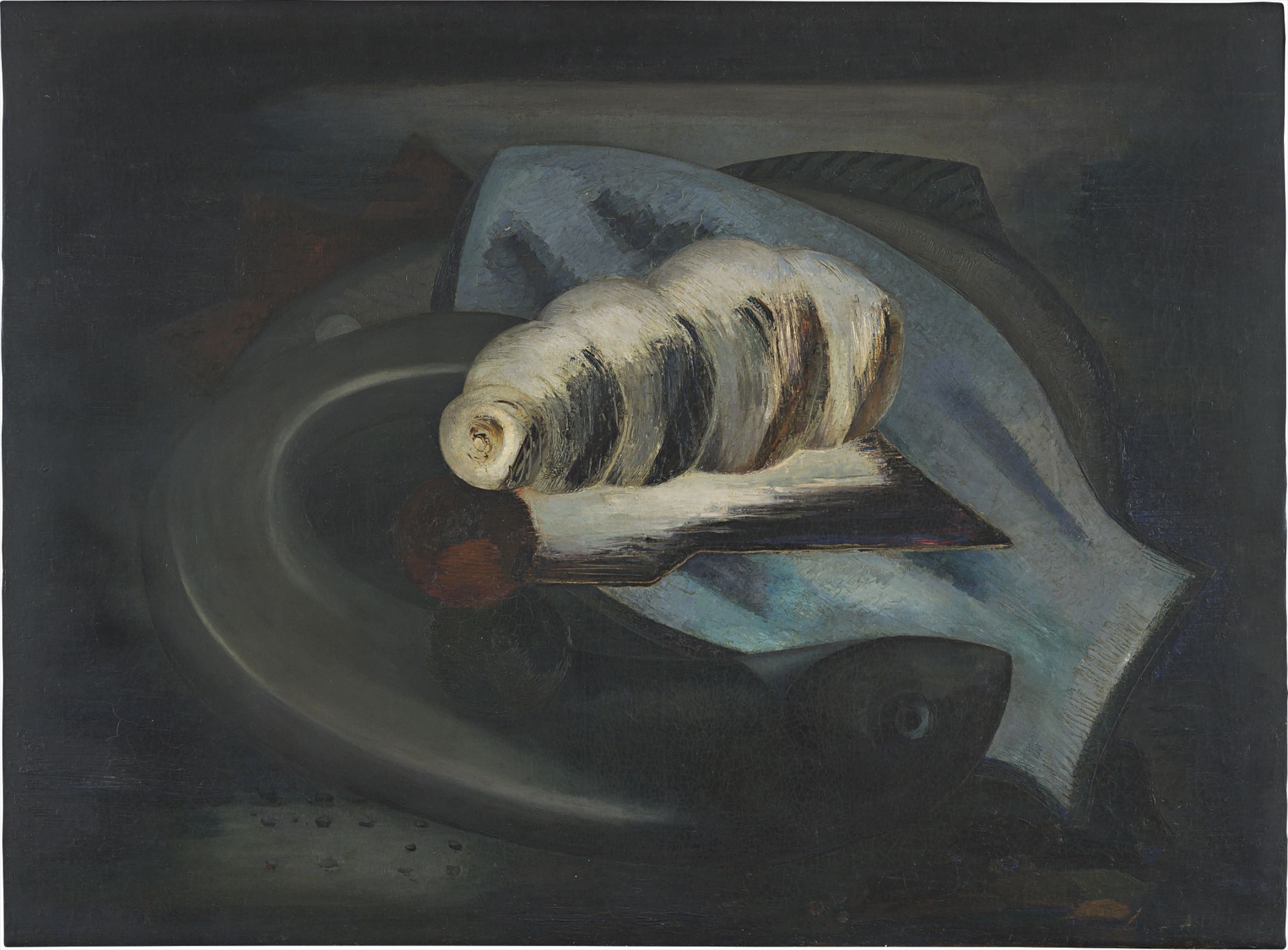
Pescados grises, is a stunning sill life composition rendered with great technical sophistication. In the center of the painting, the artist presents the viewer with a circular arrangement of fish and seashells. While Peláez’s use of dark grey and ochre tones imparts a melancholic feel to the composition, the application of white paint creates a stark contrast, adding light and warmth. The use of white tones not only serves to highlight key compositional elements, such as the large fish and shell in the foreground, but also creates a chiaroscuro effect. It can be argued that the rich color and texture of the piece, achieved by a generous application of paint and expressionistic brushstrokes was influenced, not only by the artist’s time in Paris, but also by her teacher at San Alejandro, Leopoldo Romañach. Romañach was a distinguished nineteenth century Cuban artist whose work was characterized by loose and painterly brushstrokes. The carefully constructed composition also has many cubist elements, including a flattened the picture plane, reducing the composition to a few color forms and emphasizing a central focal point and symmetry.
The still life as a subject matter is also important within Peláez’s oeuvre as it foreshadows many of her future works. Upon her return to Cuba in 1934, Peláez began to experiment with brighter colors and a more Cubist esthetic. She also began to include Cuban imagery in her still life compositions including tropical fruit and traditional stained glass windows found in Cuban homes. Although Peláez’s imagery radically shifted in her later works, she continued to use symbols that she had developed in Paris, most notably images of fish. While Peláez’s mature style differs greatly from the composition in Pescados grises, it is evident that the present lot served as a precursor to her later works and illustrates the artist’s early investigation into Cubism.
Amelia Peláez
Cuban | B. 1896 D. 1968Amelia Peláez, one of the most prominent Cuban avant-garde artists, studied at the Academia de San Alejandro in Havana. She was part of the first wave of Cuban artists living in Europe before World War II. In Paris, she witnessed the development of Cubism as well as other European art movements that would later inform her complex personal aesthetic of simplified forms and bold colors.
With the decline of the sugar boom, Peláez returned to Cuba and laid the foundation for Cuban modernism by introducing artistic innovations. Her mature works are composed of brightly hued, quasi-abstract compositions that often depict unique domestic and architectural settings. Peláez was undeniably inspired by her surroundings in Cuba, where she continued to live until her death.