37
唐納·賈德
Untitled (4 Units; 89-49 Ballantine)
完整圖錄內容
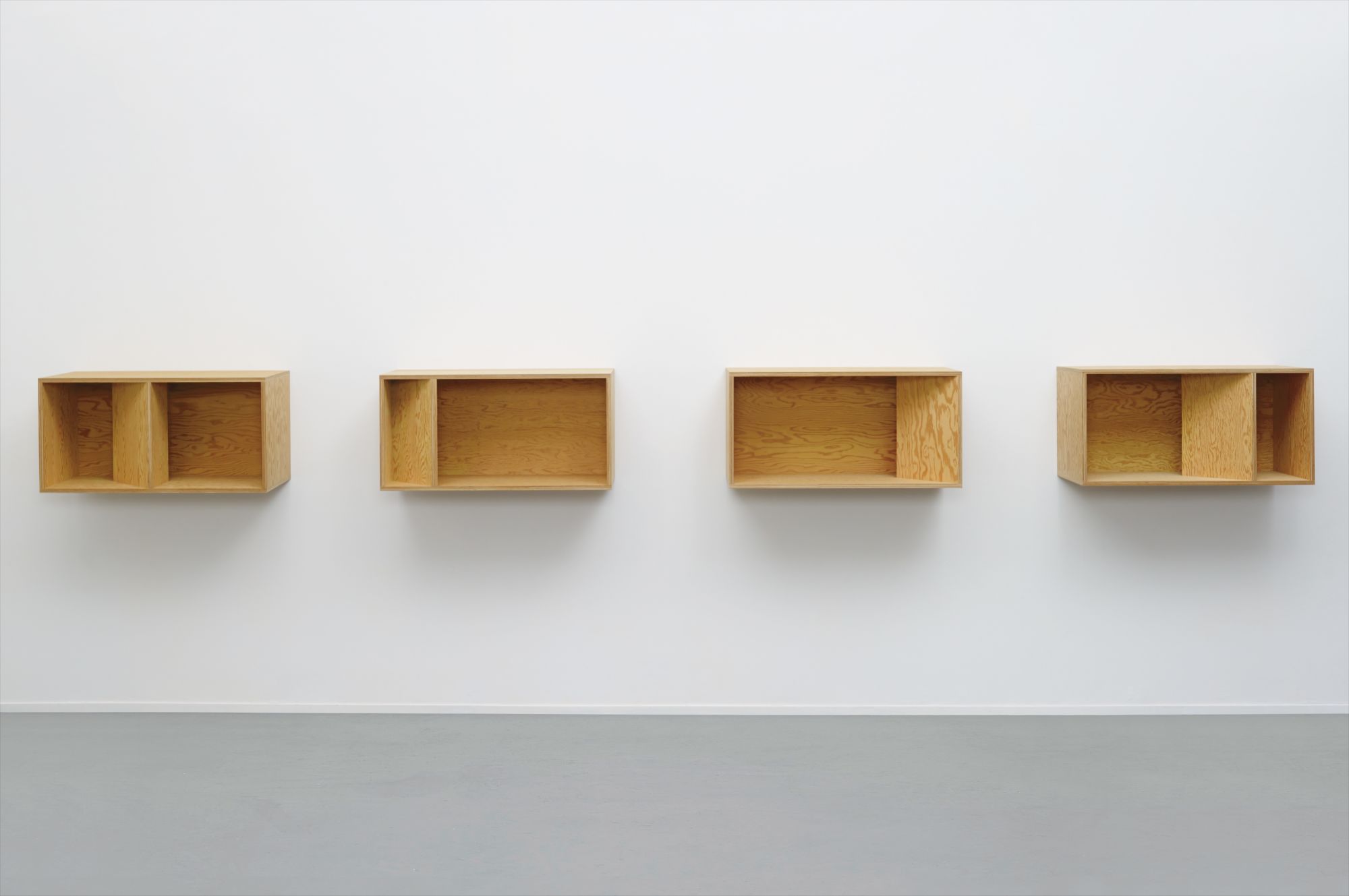
Untitled (4 Units; 89-49 Ballantine), 1989 possesses the warm and tawny hue of Douglas-fir wood, emitting a luscious glow, almost akin to Judd’s brushed copper works. The four boxes stretch out across a white wall, each unique, created with exhaustive detail and thoughtful proportion. Begging to be touched, the texture of soft and supple wood also holds darkened grains which create a swirling pattern of natural movement, emphasizing nature’s ability to create patterns at random of exquisite intricacy. Each of the four open cubes has been dissected by a triangular form, of a varying angle. The volume within each cube has been altered in a singular and formulaic way; like the pattern of the wood grain, logic can be found in a series of four that could not be determined by examining one box alone.
Though Judd did study the history of art, Ballantine believes that Judd’s study of philosophy and British empiricism at Columbia held greater significance for his artistic inspiration. Of the present lot, one unit seems empty while another may include an element dividing its interior by 1:2 or 1:4. Although the 4 units exist as a whole, each part differentiates itself from the grouping – acting at once alone and unified as part of the group. As Judd explains, “The thing as a whole, its quality as a whole, is what is interesting." (Donald Judd in Donald Judd. White and Grey. Complete Writings, New York, 1975, p. 116)
唐納·賈德
American | B. 1928 D. 1994Donald Judd came to critical acclaim in the 1960s with his simple, yet revolutionary, three-dimensional floor and wall objects made from new industrial materials, such as anodized aluminum, plywood and Plexiglas, which had no precedent in the visual arts. His oeuvre is characterized by the central constitutive elements of color, material and space. Rejecting the illusionism of painting and seeking an aesthetic freed from metaphorical associations, Judd sought to explore the relationship between art object, viewer and surrounding space with his so-called "specific objects." From the outset of his three-decade-long career, Judd delegated the fabrication to specialized technicians. Though associated with the minimalist movement, Judd did not wish to confine his practice to this categorization.
Inspired by architecture, the artist also designed and produced his own furniture, predominantly in wood, and eventually hired a diverse team of carpenters late in his career.