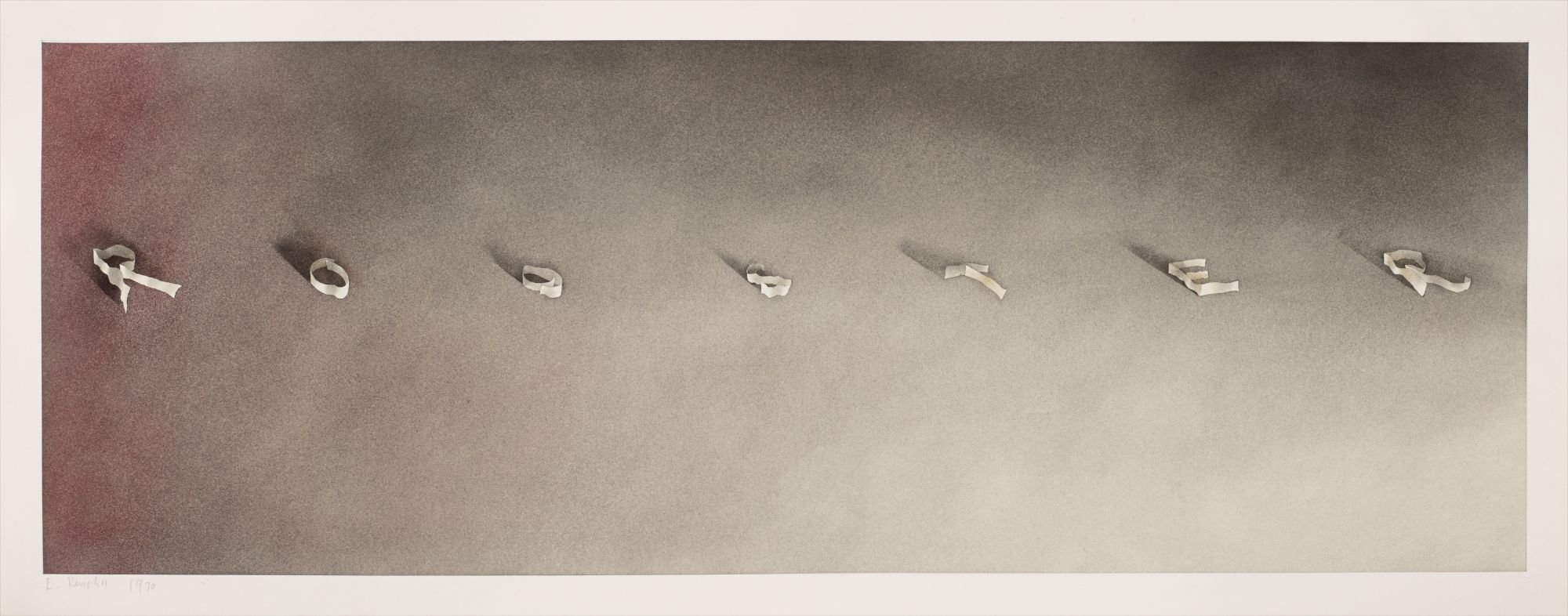
The present lot, Rooster, 1970, executed in crimson powdered pastel and gunpowder on paper, captures Ed Ruscha’s iconic and unrivaled handling of text and landscape; here ribbon-like letters swirl upon a smoky backdrop of charcoal grays and burgundy reds. Reading from left to the right the “R” rests upon a deep cardinal red border, a foreboding start to the narrative. As the word is spelled out, the red dissipates into a light grey; it travels horizontally across the composition to the paper’s far right edge, reminiscent of the early gelatin silver photographic prints which form the foundation of Ruscha’s oeuvre. Finely executed, work emphasizes the warm tone that Ruscha admired and embraced in his materials. The present lot is a pillowy trompe l’oeil that captures Ruscha’s subtle genius in both its composition and technique. Seamlessly blending text with visual illusion, it is a masterful example of the artist’s multifarious works on paper.Ruscha draws his artistic technique from the slick, flattened backdrops of Hollywood set design and the graphics of rolling movie credits. The viewer senses that the ribbon-like, silvery white letters may at any moment disappear from the screen as they stroll across the page. But each letter casts delicate and differentiated shadows onto the amorphous background of the sheet. There are also “high art” allusions at play here. The smoky gradations of light and shade that merge the planes of the composition could be found in the canonical works of Old Masters. The traditional power of these techniques comes into conjunction with the visual transience of mass media. As the artist explained in reference to these impermanent words and phrases, “When I see a word or phrase, or hear one (on the radio or in the street), I have to capture it immediately. Otherwise it will slip away from me, disappear.” (Ed Ruscha in Margit Rowell’s Cotton Puffs, Q-Tips©, Smoke and Mirrors: The Drawings of Ed Ruscha, New York, The Whitney Museum of American Art, 2004, p. 15)