35
Ed Ruscha
Ship Talk
完整圖錄內容
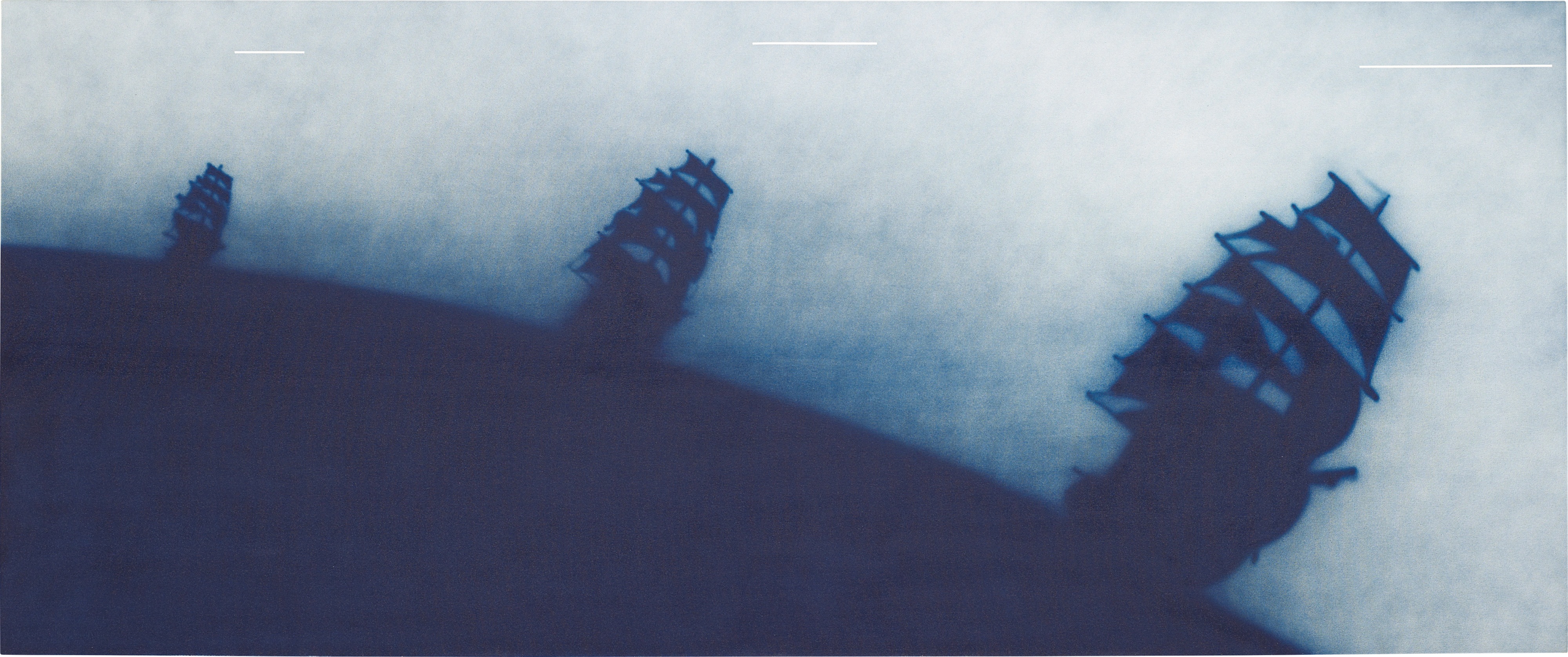
In 1983, Ruscha painted Brave Men Run In My Family. A work in oil, it overlaid the titular phrase on an optimistic maritime scene: sails billowing against a swathe of blue sky. Several years later, the ship returned in a series of altogether more brooding compositions. Instances of the artist’s silhouette paintings, pieces like Brother, Sister (1987), Parts per Trillion (1987), and the present lot saw Ruscha use an airbrush to produce hazy black-and-white designs. Ship Talk finds three vessels precariously balanced atop an improbably curved seascape. The boats are both imperilled and threatening, recalling a painterly tradition of ships desperately adrift amid storm-struck oceans.
Yet the scene depicted is not the chaos of a naval battle; its tone is less frenetic, more unnerving. It reveals a tendency in Ruscha’s work to link the nautical and the spectral – a tendency most striking in his 1986 painting Ghost Ship. The ship envisaged in both pieces is remarkably similar: a shadowy silhouette, banking to the side. It is beguilingly inaccessible, possessed of a ghostliness that is typical of Ruscha. His pieces often seem haunted: empty yet reverberating with memory. Amongst these resonances is the maritime painting of Caspar David Friedrich, particularly his pieces Segelschiff (1815) and Schiffe auf Reed (1816-17). In both, the Romantic painter uses a muted palette to imbue his ships with an eerie silence. Human forms are in retreat; here, as in Ship Talk, one senses an indefinable presence in their place.
Discussing Brother, Sister and the subject of his ship paintings, Ruscha makes a careful distinction: ‘they’re not about my experience because I ain’t a sailor. The ship is my interpretation of a picture of a ship rather than a ship. It’s like a painting of an idea about a ship.’ (Ed Ruscha in Guy Cross, ‘Pronounce His Name Rew-Shay,' Alexandra Schwartz (ed.), Leave Any Information at the Signal, Cambridge, MA: The MIT Press, 2004, p.33). This casts light on the paintings’ ghostliness; shrouded in haze, the ships generate an ambiance or a set of associations. Ruscha translates the indefinite quality of thought onto canvas. To do so, he makes careful use of the airbrush – a technique to which he was once adverse. Relating an about-turn in his practice, he recounts ‘I always detested airbrush art. And I found myself using an airbrush ... I’m finding myself going against my own rules.’ (Ed Ruscha, Ed Ruscha on His Silhouette Paintings [video], SFMOMA, July 2004).
As he turned to the airbrush, text also began to depart from Ruscha’s work. In Ship Talk, as in other of his paintings from the period, a series of strips runs across the image. The implication is that text has been blocked out; much like the cloudiness of the image itself, they act as an impediment to easy comprehension. Varying in size, each strip appears to correspond to one of the three boats. The title is perhaps elucidating; as Ship Talk implies, the boats are communicating with one another, but in a language that we are unable to understand. Here the work alludes to nautical history - to the specialised forms of correspondence that govern the high seas: flag semaphore, for instance, and the idiosyncrasy of nautical terminology. These are types of communication that are impenetrable to those untrained in their strictures. In the same way, Ship Talk assumes an air of mystification; it exists at the bounds of comprehension.
Discussing his iconic representations of gas stations, Ruscha remarks ‘I think they become more powerful without extraneous elements like people, cars, anything beyond the story.’ (Ed Ruscha in Thomas Beller, ‘Ed Ruscha,' Alexandra Schwartz (ed.), Leave Any Information at the Signal, Cambridge, MA: The MIT Press, 2004, p.285). This same economy characterises Ship Talk. The composition is uncluttered, and all the more entrancing for its concision. It is restrained, but far from cautious.
Ed Ruscha
American | 1937Quintessentially American, Ed Ruscha is an L.A.-based artist whose art, like California itself, is both geographically rooted and a metaphor for an American state of mind. Ruscha is a deft creator of photography, film, painting, drawing, prints and artist books, whose works are simultaneously unexpected and familiar, both ironic and sincere.
His most iconic works are at turns poetic and deadpan, epigrammatic text with nods to advertising copy, juxtaposed with imagery that is either cinematic and sublime or seemingly wry documentary. Whether the subject is his iconic Standard Gas Station or the Hollywood Sign, a parking lot or highway, his works are a distillation of American idealism, echoing the expansive Western landscape and optimism unique to postwar America.