40
Keith Haring
Keith and Julia
估價
$700,000–1,000,000
成交價
$970,000
signed, titled, inscribed and dated ""Keith + Julia" © K. Haring Sept. 27-86 ⊕ NYC" on the overlap
oil and acrylic on canvas
36 1/4 x 48 1/4 in. (92.1 x 122.6 cm.)
Painted in 1986.
完整圖錄內容
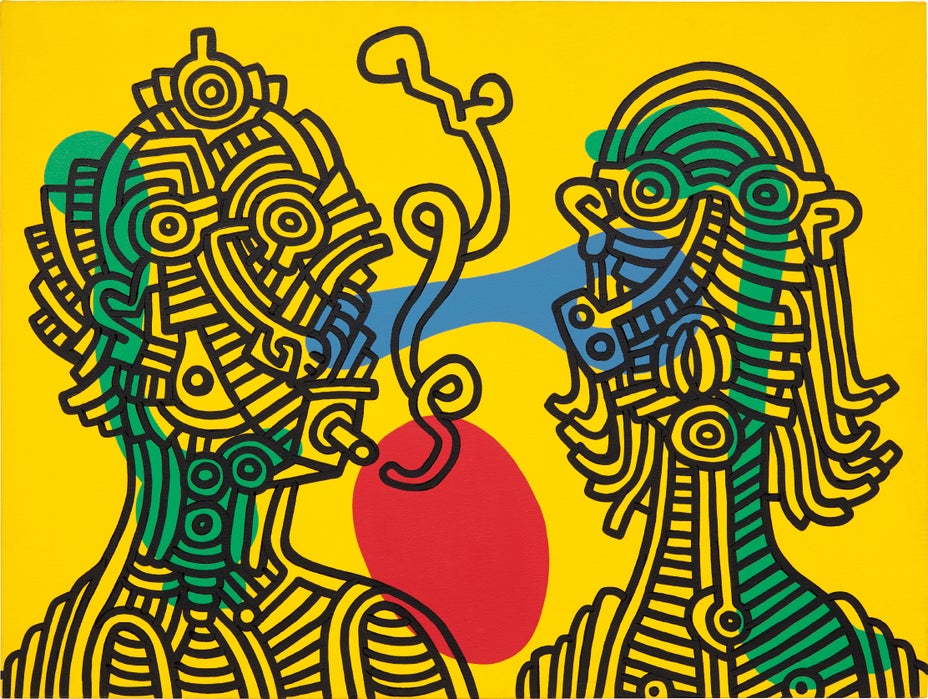
Keith and Julia is a striking and deeply intimate self-portrait of Keith Haring with Julia Gruen, the artist’s assistant, studio manager and confidante during the last six years of his life. An iconic example of Haring’s celebrated aesthetic idiom, this work presents the two figures with bold, schematic outlines against a bright yellow background across which flat organic shapes of color hover. Executed in 1986, at the peak of Haring’s tragically short but intensely dynamic life and career, Keith and Julia belongs to a small series of portrait paintings that are stylistically distinct within Haring’s oeuvre for the complex fragmentation with which the human figure is delineated. The only painting to pay tribute to Julia Gruen, Keith and Julia notably inspired a series of iconic yellow sculptures, entitled Julia, in the following year. A seminal work, Keith and Julia has since been exhibited at the 2006 Lyon Biennial and the 2007 Milano Triennale.
A vibrant and life-affirming celebration of humanity, Keith and Julia perfectly articulates the artist’s radical fusing of high and low art. It was upon moving to New York in 1978 and meeting such contemporaries as Kenny Scharf and Jean Michel Basquiat that Haring developed his distinctive artistic idiom, one that built upon his childhood interest in popular culture cartoons and drew liberally from New York’s 1980s street culture. Works such as the present one demonstrate Haring’s embrace of the graffiti-art aesthetic, but also exemplify his deep engagement with art history. As curator and art critic Demetrio Paparoni has observed, “from Picasso he [Haring] took a delight in painting that found expression in the most complete liberty of form; from Leger, the clean black line that shapes his figures, set against the background of Matisse’s flat slabs of color"(Demetrio Paparoni, The Keith Haring Show, 2005, p. 41). While the subject matter and combination of frontal and profile perspective in Keith and Julia recalls Pablo Picasso’s portraits of muses, the modulation of the busts reveals the influence of French anti-establishment artist Jean Dubuffet. In stark contrast to the majority of Haring’s faceless depictions of figures, the figures in Keith and Julia are carefully modulated - the fragmentation and delineation of facial features clearly paying homage to Dubuffet’s signature L’Hourloupe style.
Haring’s distinctive visual language and political sensibility have made him one of the most influential artists of the 20th century, one who Julia Gruen has spent her life promoting. Gruen first encountered Haring in 1984 when New York gallerist Tony Shafrazi hired her to be his assistant, and soon thereafter became one of his closest confidantes. Gruen organized many of the now legendary events around Haring’s groundbreaking practice, such as the Parties of Life series, socially-engaged art projects with local school children of New York or, notably, the opening of the infamous Pop Shop in 1986. Entrusted with establishing the artist’s legacy, Gruen was made the director of the Keith Haring Foundation in 1989, a year before Haring’s premature death from AIDS. Gruen passionately expresses the depth of their relationship when she says, “I had worked for him for six years. We had become close friends, our relationship was characterized by a deep trust and respect for one another. This resulted in his request that I remain in place, supervising and managing and perpetuating his vision… He remains a voice of his generation and ours. More admired and validated than ever, his philosophies and visual messages remain meaningful and continue to exert their powerful influence. He lived a life that demonstrated the importance of breaking boundaries and taking chances-of being loving, tolerant, and extravagantly generous. Keith dared to be passionately alive, and his life changed mine” (Julia Gruen, The Keith Haring Show, 2005, p. 35).
A vibrant and life-affirming celebration of humanity, Keith and Julia perfectly articulates the artist’s radical fusing of high and low art. It was upon moving to New York in 1978 and meeting such contemporaries as Kenny Scharf and Jean Michel Basquiat that Haring developed his distinctive artistic idiom, one that built upon his childhood interest in popular culture cartoons and drew liberally from New York’s 1980s street culture. Works such as the present one demonstrate Haring’s embrace of the graffiti-art aesthetic, but also exemplify his deep engagement with art history. As curator and art critic Demetrio Paparoni has observed, “from Picasso he [Haring] took a delight in painting that found expression in the most complete liberty of form; from Leger, the clean black line that shapes his figures, set against the background of Matisse’s flat slabs of color"(Demetrio Paparoni, The Keith Haring Show, 2005, p. 41). While the subject matter and combination of frontal and profile perspective in Keith and Julia recalls Pablo Picasso’s portraits of muses, the modulation of the busts reveals the influence of French anti-establishment artist Jean Dubuffet. In stark contrast to the majority of Haring’s faceless depictions of figures, the figures in Keith and Julia are carefully modulated - the fragmentation and delineation of facial features clearly paying homage to Dubuffet’s signature L’Hourloupe style.
Haring’s distinctive visual language and political sensibility have made him one of the most influential artists of the 20th century, one who Julia Gruen has spent her life promoting. Gruen first encountered Haring in 1984 when New York gallerist Tony Shafrazi hired her to be his assistant, and soon thereafter became one of his closest confidantes. Gruen organized many of the now legendary events around Haring’s groundbreaking practice, such as the Parties of Life series, socially-engaged art projects with local school children of New York or, notably, the opening of the infamous Pop Shop in 1986. Entrusted with establishing the artist’s legacy, Gruen was made the director of the Keith Haring Foundation in 1989, a year before Haring’s premature death from AIDS. Gruen passionately expresses the depth of their relationship when she says, “I had worked for him for six years. We had become close friends, our relationship was characterized by a deep trust and respect for one another. This resulted in his request that I remain in place, supervising and managing and perpetuating his vision… He remains a voice of his generation and ours. More admired and validated than ever, his philosophies and visual messages remain meaningful and continue to exert their powerful influence. He lived a life that demonstrated the importance of breaking boundaries and taking chances-of being loving, tolerant, and extravagantly generous. Keith dared to be passionately alive, and his life changed mine” (Julia Gruen, The Keith Haring Show, 2005, p. 35).
Keith Haring
American | B. 1958 D. 1990Haring's art and life typified youthful exuberance and fearlessness. While seemingly playful and transparent, Haring dealt with weighty subjects such as death, sex and war, enabling subtle and multiple interpretations.
Throughout his tragically brief career, Haring refined a visual language of symbols, which he called icons, the origins of which began with his trademark linear style scrawled in white chalk on the black unused advertising spaces in subway stations. Haring developed and disseminated these icons far and wide, in his vibrant and dynamic style, from public murals and paintings to t-shirts and Swatch watches. His art bridged high and low, erasing the distinctions between rarefied art, political activism and popular culture.