PROPERTY OF THE WILLIAM J. HOKIN COLLECTION
3Ο︎◆︎
Kenneth Noland
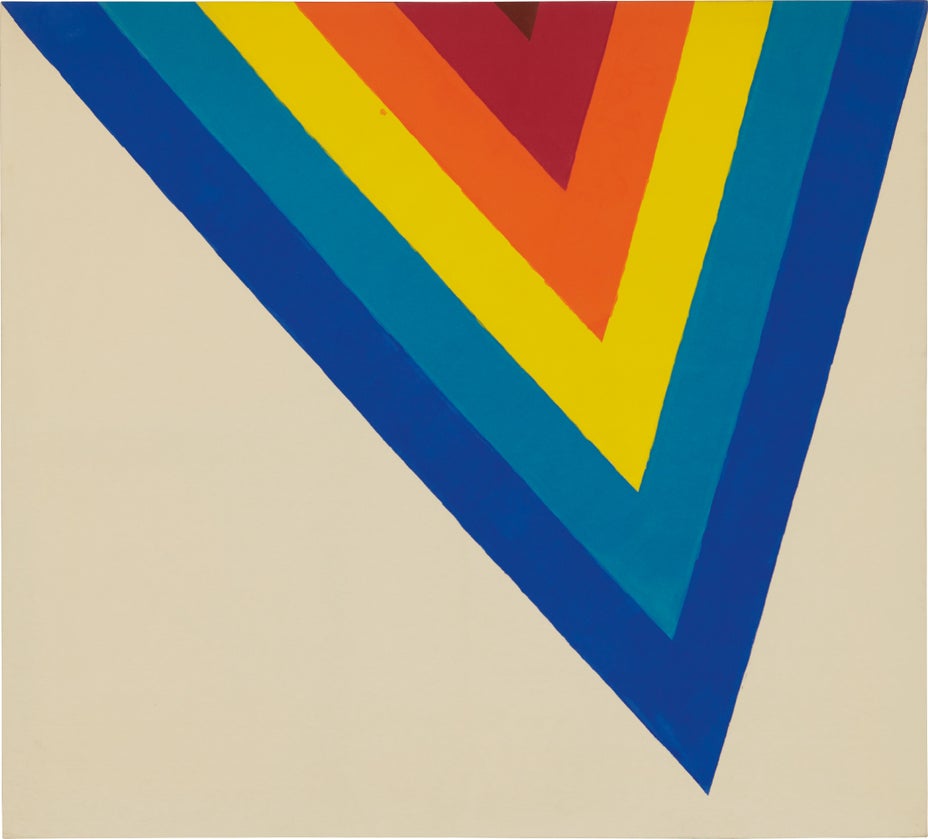
Bridge
估價
$600,000–800,000
成交價
$1,450,000
signed, titled and dated "Bridge 1964 Kenneth Noland" on the reverse
acrylic on canvas
88 3/4 x 98 1/4 in. (225.4 x 249.6 cm.)
Painted in 1964.
完整圖錄內容
Bridge from 1964 is a brilliant example from Kenneth Noland’s series of Chevron paintings. Rendered in primary colors of blue, red, yellow and orange, the present lot perfectly encapsulates Noland's pristine compositional format and banded color schemes, drawing a visual parallel to the paintings of Josef Albers with whom Noland studied at the seminal Black Mountain College in 1947. A few years later in 1953, following a trip to New York, where Noland was exposed to the visionary staining techniques of Helen Frankenthaler, Noland and fellow painter Morris Louis worked closely together for weeks. Each discovered their own practice during this collaborative period, applying diluted acrylic paint to unprimed, un-sized canvas. Louis poured his paint onto the canvas, while Noland employed more traditional techniques, using brushes and rollers to paint directly on the surface. Together, Noland and Morris would become iconic figures within Color Field painting as part of the Washington Color School.
Noland initiated his exploration into the formal principles of simple composition and color with his concentric circles, and expanded his geometric vocabulary to include stripes, diamonds and his series of the Chevron paintings. Abandoning his circles, Noland next explored V-shaped bands of colors; this would come to define the Chevrons series with their bold lines forming a decisive, geometric shape. The earliest Chevrons display a fully painted canvas with the chevron centered within the composition, creating a work of perfect symmetry, while the 1964 Chevrons, including examples such as the present lot Bridge and Trans Shift, in the permanent collection of the Guggenheim Museum, depict de-stabilized chevrons, off-center and set upon raw canvas. As art historian Diane Waldman explains, “in these asymmetrical chevrons, a dramatic thrust toward the right or left-hand side of the painting replaces the central focus movement of the symmetrical motif, and there is a shift to generally larger proportions, more optical effects of brighter, more limited numbers of colors and rectangular rather than square proportions. Noland compensated for eccentric form by altering the balance of his colors, the proportions of his hands and the shape of the support. He used few colors, widened his bands and sometimes reduced their numbers. The resulting effect is of heightened drama.” (Diane Waldman, Kenneth Noland: A Retrospective, New York, 1977, p. 30). Noland utilized a staining technique which fused raw canvas with impenetrable bands of color, the hard edges of the dramatic shape are slightly softened by the absorbent hues. Applying paint to canvas in a number of different ways Noland sought to attain varying degrees of color thickness and thinness, some colors matte, some colors sheen. Noland describes all these varieties in hue as giving “you a difference of paint quality, giving you a range of color.”(Kenneth Noland quoted in Diane Waldman, Kenneth Noland: A Retrospective, New York, 1977, p. 33). In Bridge, the stability of the triangular shape seen in the upper quadrant of the composition stands in direct opposition to the vibrating bands of color, which meet at a point that draws the eye off center, toward the bottom edge or boundary of the canvas. The composition varies between watery acrylic washes and woven raw cotton canvas, as Noland himself emphasized, "I do open painting . . . I like lightness, airiness, and the way color pulsates. The presence of the painting is all that's important." (Kenneth Noland quoted in Kennworth Moffett, Kenneth Noland, New York 1977, p. 51)
Noland initiated his exploration into the formal principles of simple composition and color with his concentric circles, and expanded his geometric vocabulary to include stripes, diamonds and his series of the Chevron paintings. Abandoning his circles, Noland next explored V-shaped bands of colors; this would come to define the Chevrons series with their bold lines forming a decisive, geometric shape. The earliest Chevrons display a fully painted canvas with the chevron centered within the composition, creating a work of perfect symmetry, while the 1964 Chevrons, including examples such as the present lot Bridge and Trans Shift, in the permanent collection of the Guggenheim Museum, depict de-stabilized chevrons, off-center and set upon raw canvas. As art historian Diane Waldman explains, “in these asymmetrical chevrons, a dramatic thrust toward the right or left-hand side of the painting replaces the central focus movement of the symmetrical motif, and there is a shift to generally larger proportions, more optical effects of brighter, more limited numbers of colors and rectangular rather than square proportions. Noland compensated for eccentric form by altering the balance of his colors, the proportions of his hands and the shape of the support. He used few colors, widened his bands and sometimes reduced their numbers. The resulting effect is of heightened drama.” (Diane Waldman, Kenneth Noland: A Retrospective, New York, 1977, p. 30). Noland utilized a staining technique which fused raw canvas with impenetrable bands of color, the hard edges of the dramatic shape are slightly softened by the absorbent hues. Applying paint to canvas in a number of different ways Noland sought to attain varying degrees of color thickness and thinness, some colors matte, some colors sheen. Noland describes all these varieties in hue as giving “you a difference of paint quality, giving you a range of color.”(Kenneth Noland quoted in Diane Waldman, Kenneth Noland: A Retrospective, New York, 1977, p. 33). In Bridge, the stability of the triangular shape seen in the upper quadrant of the composition stands in direct opposition to the vibrating bands of color, which meet at a point that draws the eye off center, toward the bottom edge or boundary of the canvas. The composition varies between watery acrylic washes and woven raw cotton canvas, as Noland himself emphasized, "I do open painting . . . I like lightness, airiness, and the way color pulsates. The presence of the painting is all that's important." (Kenneth Noland quoted in Kennworth Moffett, Kenneth Noland, New York 1977, p. 51)