11
León Ferrari
Untitled
完整圖錄內容
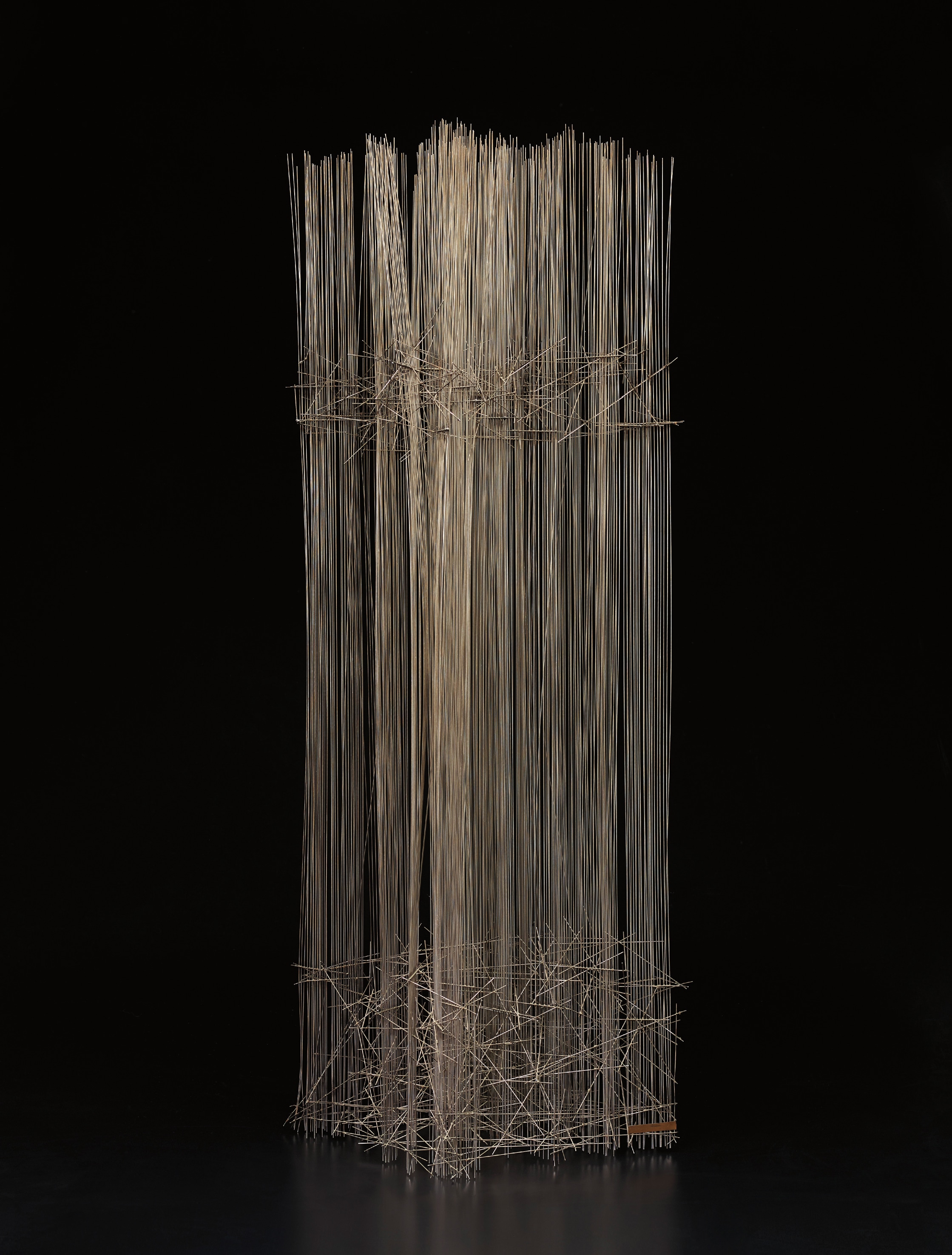
Throughout the mid-1960s and into the 1970s, Ferrari’s involvement with Romero Brest and the experimental Instituto Torcuato Di Tella fueled an intense phase within his oeuvre. This was during the advent of the Vietnam War and Ferrari was deeply affected by the controversial societal issues of inequality, power and discrimination, as became evident in his work. He was actively involved in politics and continually denounced the dictatorial government of Argentina, participating in a movement against repression and torture by advocating for human rights. Unfortunately, this led to the disappearance of his son during the military coup and his family was forced to leave the country, seeking exile in Brazil in late 1976, where he would dedicate himself solely to his art. There, he once again began exploring the possibilities inherent to wire sculptures. He changed methods, soldering the works in order to create straight lines that would contrast expansive voids. These works resemble architectural maquettes, harkening back to his days as an engineer. Light is an essential element in these works, as the straight lines allow it to penetrate the sculptures, ultimately providing a sense of the infinite. Aracy Amaral, the Curator at the Pinacoteca do Estado in São Paulo, describes these sculptures as “linear galaxies, nuclei suspended in contained spaces or models of imaginary buildings” (Aracy Amaral, León Ferrari, São Paulo, 2006, p.407). The present lot is an extraordinary example of this sophisticated and intricate body of work that attests to the visual poetry that has positioned Ferrari as a defining figure in conceptual art, both in Argentina and abroad. He was recognized with the prestigious Golden Lion for Lifetime achievement Award at the 2007 Venice Biennale.
León Ferrari
Argentinian | B. 1920 D. 2013León Ferrari was a defining figure in Argentine conceptual art. He was awarded the Golden Lion at the 2007 Venice Biennale, among other prestigious awards. During his youth, Ferrari began creating artworks while studying Engineering in Rome. Returning to Buenos Aires, he began to create art that dealt with heavy subjects such as inequality, power and discrimination, championing a sense of urgency to understand the destructive and poetic potential of these societal issues.
One particularly controversial work, La Civilización Occidental y Cristiana (Western Christian Civilization), was exhibited in 1965 and promptly censured by the Catholic Church, as the sculpture features a store-bought Jesus figure crucified to a U.S. fighter jet. However, Ferrari is probably best known for his "written drawings" that feature compositions of abstracted handwriting created in various mediums, conveying emotion and visual poetry.