Article | Think You Know How To Read The Time Unconventional Displays Phillips Geneva Fall 2026 Online Auction
Think You Know How to Read the Time? Think Again…
From scrambled numerals to wandering hours and smiling dials, these extraordinary watches challenge everything you thought you knew about reading the time.
Phillips in Association with Bacs & Russo is pleased to present The Geneva Sessions, Fall 2026, an online auction running from 4–11 September. Featuring more than 90 exceptional luxury timepieces from leading makers including A. Lange & Söhne, Audemars Piguet, F.P. Journe, and Patek Philippe, the sale includes all five watches featured in this story.
Reading a clock is one of the first forms of decoding we learn as children. We were taught that the shorter hand indicated the hours, the longer hand the minutes, and that the numbers marched obediently around a circular dial from one to twelve. Learning to tell the time was simply part of growing up.
And yet there is nothing inevitable about any of it. Every element of the analogue clock – from its rotating hands to its orderly numerals – is the product of centuries of refinement and convention, rather than natural law.
From Bells to Hands
In fact, the earliest mechanical clocks would have looked strangely unfamiliar to us. Built in the late 13th century, they had no dials at all, serving instead to ring bells at fixed hours, principally to regulate daily life and prayer.
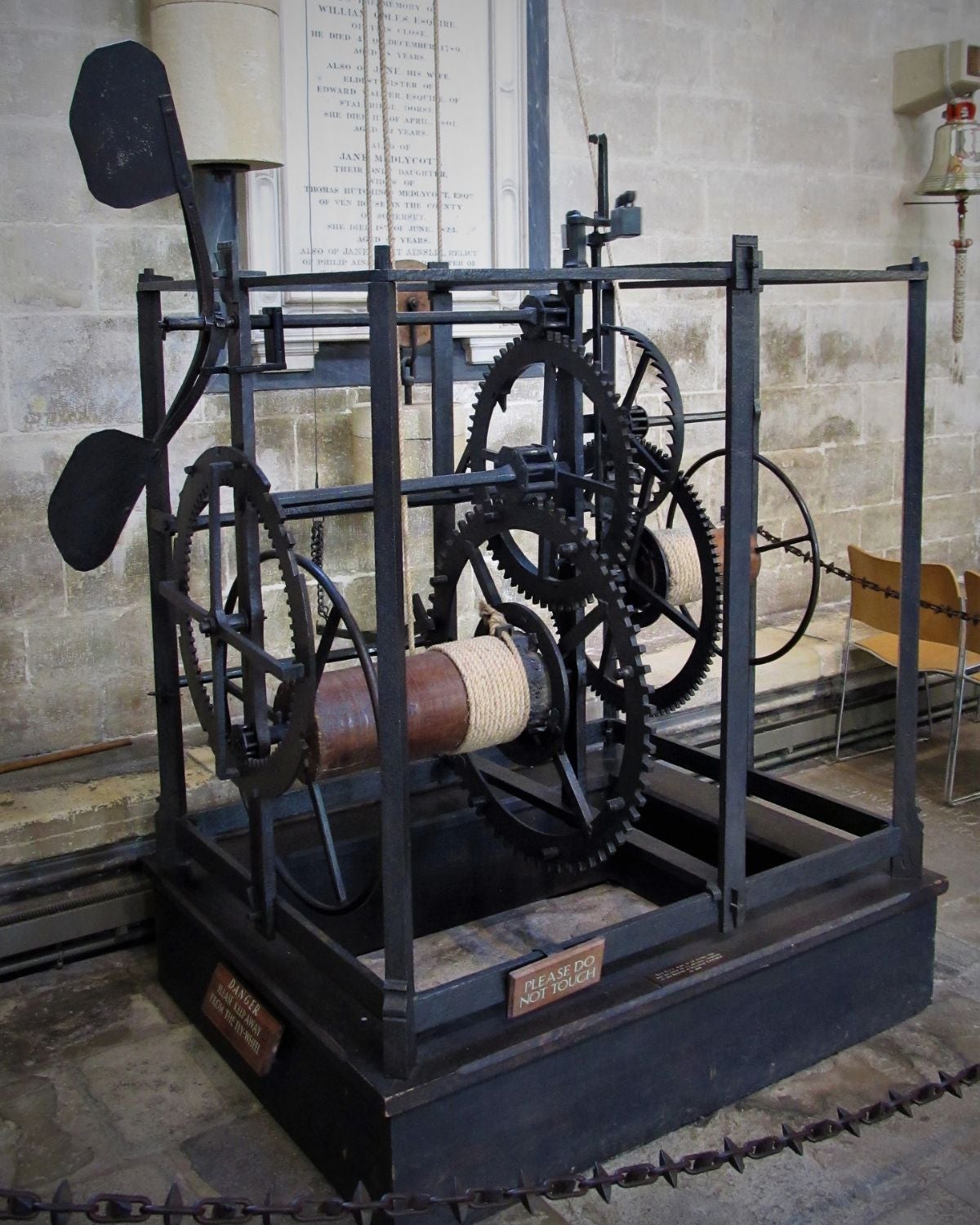
The medieval clock at Salisbury Cathedral, believed to date to around 1386. Rwendland / Wikimedia Commons / CC BY-SA 3.0
When clock faces did appear around the 14th century, they usually carried just a single hour hand, as greater precision was neither expected nor possible. Minute hands only became commonplace in the late 17th century, once improvements in accuracy made them meaningful, while second hands arrived later still.
The familiar arrangement we now take for granted was not conceived in a single stroke, rather it evolved over time as watch- and clockmakers refined how time could best be communicated.
Learning to Unlearn
Even today, parents and teachers continue the deceptively complex ritual of teaching children to tell the time from an analogue clock.
It is one of those curious traditions that has survived remarkably intact, despite the fact that most of us now encounter the time digitally – on our phones, computers, car dashboards, and countless other screens.
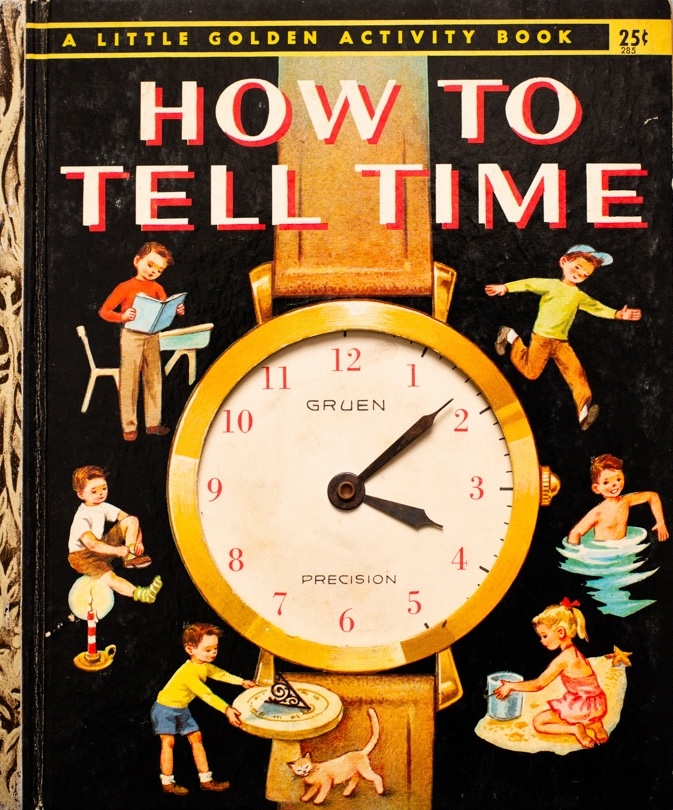
How to Tell Time (1957) by Jane Werner Watson, illustrated by Eleanor Dart. LittleGoldenBook.com
But there remains something instinctively satisfying about understanding a pair of hands sweeping across a dial, particularly for anyone drawn to mechanical watches.
Of course, not every watchmaker accepts that this is the only way time should be displayed. Some dispense with centrally mounted hands altogether. Others rearrange the hours, abandon the conventional dial, or ask the wearer to read time from an altogether different perspective.
Encounter one of these watches for the first time and you experience a rare sensation: you have to unlearn something you have known since childhood before you can read the time again.
The Numerals Don't Have to Be in Order
Some watchmakers take one of the most basic rules of analogue timekeeping and scramble it, as Franck Muller did with the Crazy Hours. Introduced in 2003, its hour numerals appear around the dial in a seemingly random sequence, yet the watch remains perfectly legible.
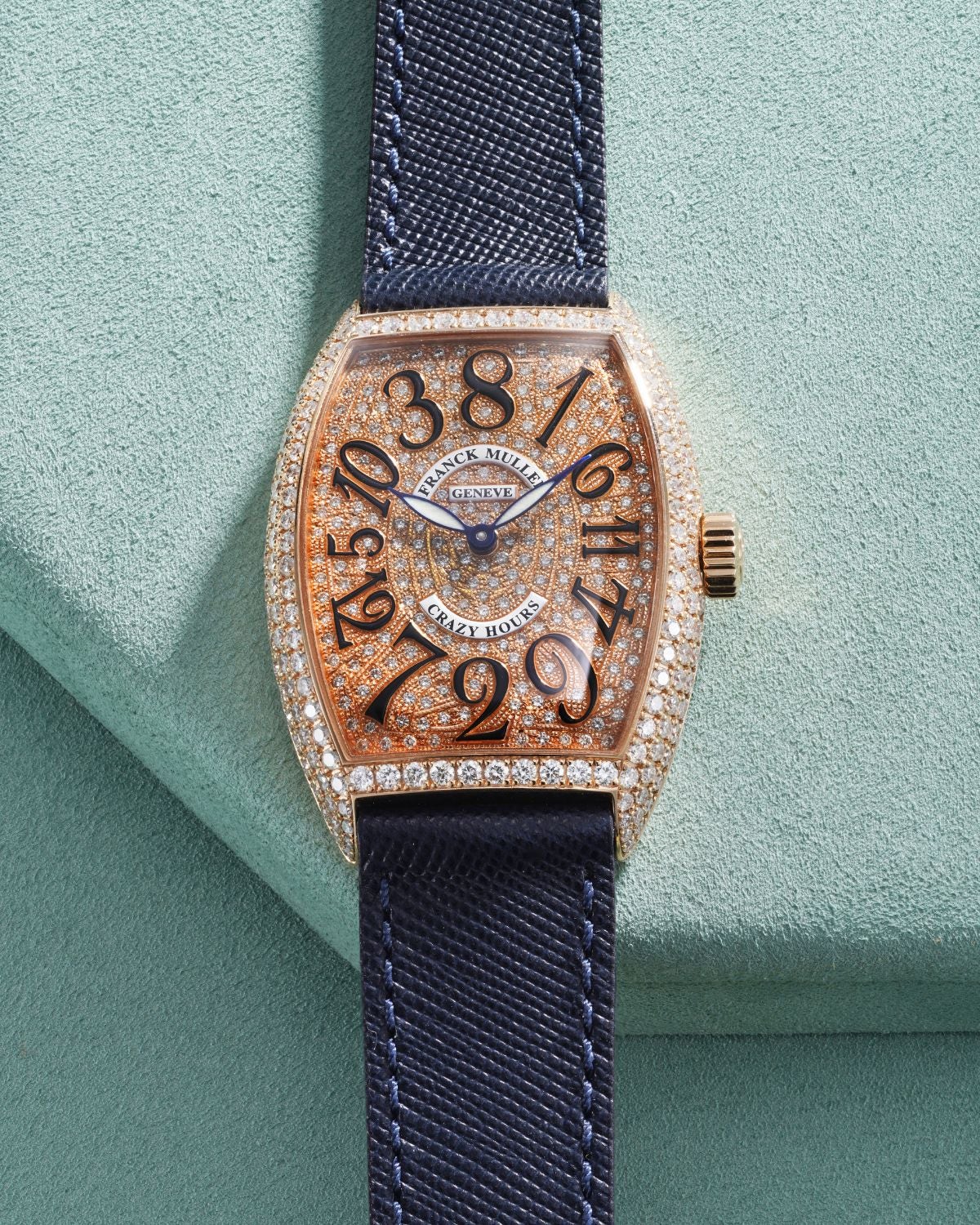
Lot 68: A Franck Muller Crazy Hours Ref. 7851 CH D CD in 18k pink gold with pavé-set diamonds, included in the Phillips Geneva Sessions, Fall 2026, Online Auction. Estimate: CHF 8,000–16,000
At the end of each hour, the hour hand jumps directly to the next correct numeral, while the minute hand continues its conventional circuit of the dial. The display therefore looks chaotic without ever losing its underlying order.
The visual joke is made possible by a specially re-engineered hour mechanism. Instead of advancing the hour hand by a fixed increment every 60 minutes, it is programmed to jump directly to the next correct numeral, wherever it appears on the dial.
The Hands Don't Have to Travel in Circles
Invented by Abraham-Louis Breguet in 1794, the retrograde display overturned one of the fundamental conventions of analogue timekeeping. Instead of completing a full revolution of the dial, a retrograde hand travels across an arc before instantly returning to its starting point.
Franck Muller, again, has embraced the complication too. The Swiss watchmaker’s BiRetro Chronograph pairs a conventional central time display with a central chronograph seconds hand, while applying retrograde indications to the running seconds on the left and the 30-minute chronograph counter on the right.

Lot 7: A circa 2000 Franck Muller BiRetro Chronograph Ref. 7000 CC B in stainless steel, included in the Phillips Geneva Sessions, Fall 2026, Online Auction. Estimate: CHF 2,000–4,000
Rather than completing a full circle, each hand sweeps across its scale before snapping back in a fraction of a second.
The dramatic motion is made possible by a mechanism that gradually stores energy as the hand advances before releasing it instantaneously at the end of its travel, turning two familiar indications into one of the watch's visual signatures.
The Hours Can Wander
The idea of the wandering hour is far older than its avant-garde appearance suggests. Developed by the Campani brothers in the 17th century for Pope Alexander VII's night clocks, the display allowed the current hour to travel across an arc before giving way to the next.
After appearing sporadically in clocks and pocket watches, the concept was revived for the wrist by Audemars Piguet's Star Wheel in 1991, before inspiring a new generation of independent watchmakers.
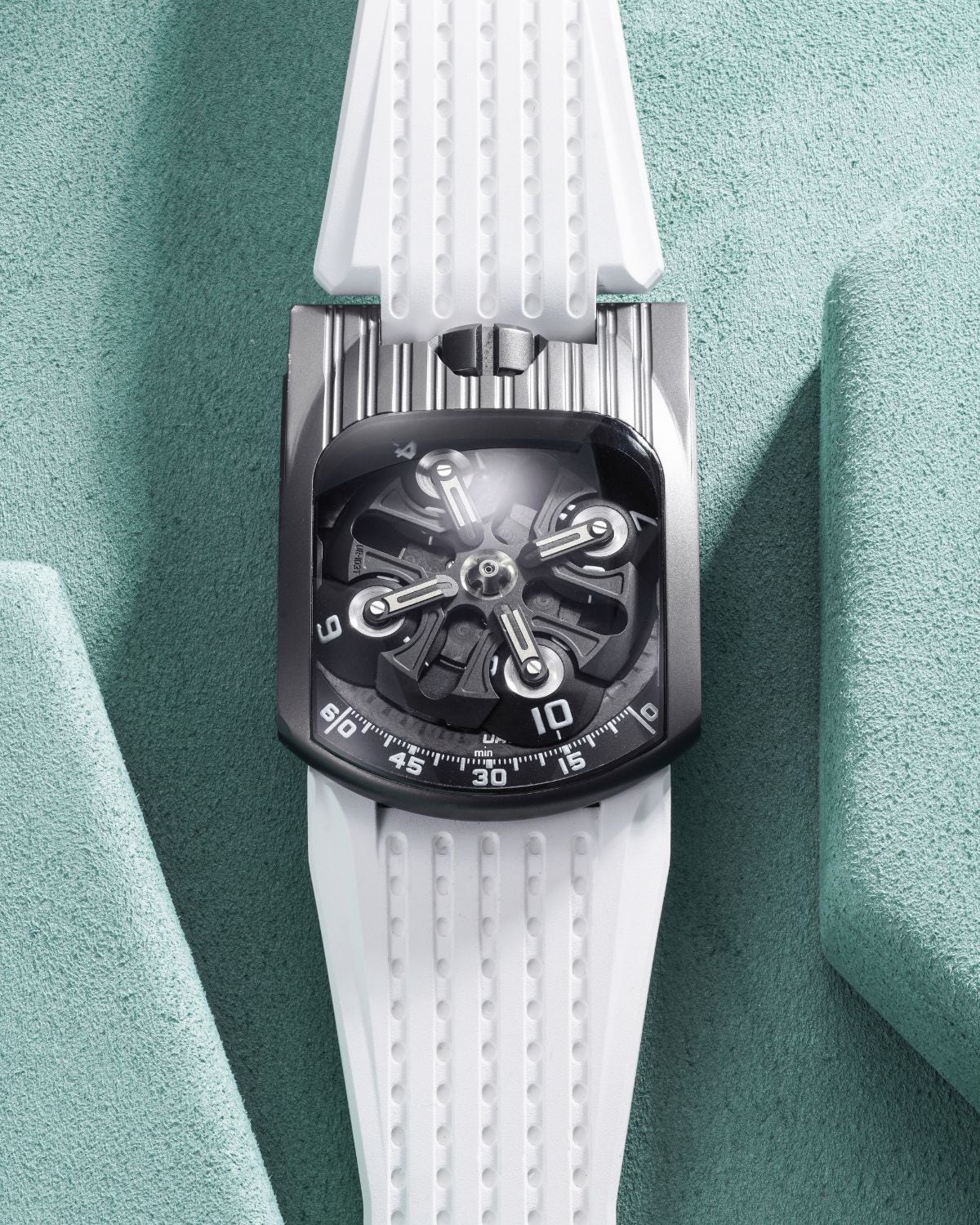
Lot 88: A circa 2009 Urwerk UR-103T in AlTiN-treated steel, one of a 60-piece limited edition, included in the Phillips Geneva Sessions, Fall 2026, Online Auction. Estimate: CHF 20,000–40,000
Among them, none has become more closely associated with the wandering hour than Urwerk. Founded in 1997 by master watchmaker Felix Baumgartner and designer Martin Frei, the Swiss independent brand reimagined the centuries-old display for the 21st century.
Many Urwerk creations reinterpret the wandering-hour concept; the example offered here is the UR-103T. Housed in a steel case coated with ultra-hard AlTiN (aluminum titanium nitride), the UR-103T displays the hours on four rotating satellite carriers, each bearing an hour numeral. As each satellite traverses the 60-minute arc, the next rotates into position, creating a display more reminiscent of orbital mechanics than a conventional wristwatch.
Time Doesn't Have to Be Read from Above
A handful of makers have challenged the convention that time must be read from directly above on a wristwatch. Already, mid-century driver's watches, such as those by Jaeger-LeCoultre and Cartier, reoriented the display so the time could be read without turning the wrist.
In 1976, the Amida Digitrend took the idea further, using a prism to project rotating discs mounted horizontally within the case into a vertical display. Four decades later, MB&F paid homage to the Digitrend with the HM5, reinterpreting the concept through its own futuristic lens.

Lot 19: A 2025 M.A.D.Editions M.A.D.1S “Grow Your Dreams, Water” in stainless steel, part of a 400-piece limited edition created with artist Yinka Ilori, included in the Phillips Geneva Sessions, Fall 2026, Online Auction. Estimate: CHF 2,000–4,000
That philosophy reached a wider audience with M.A.D.Editions, MB&F's more accessible line, originally conceived for the company's Friends, Artists and suppliers before becoming one of independent watchmaking's most sought-after releases. The M.A.D.1S refined the formula with a slimmer profile and an all-new Swiss movement.
This Yinka Ilori collaboration brings a riot of color to the concept through custom-designed numerals, mismatched straps and the artist's "Grow Your Dreams" philosophy.
And if you're wondering what occupies the space where the dial would normally be, it's a skeletonized titanium winding rotor whose blades are milled into a tree motif as a symbol of hope and growth.
A Watch Can Wear a Face
Horology has long drawn inspiration from the human form. Medieval jacquemarts struck bells as animated figures, novelty clocks were fashioned as human heads, devils and clowns, and Japanese karakuri clocks brought expressive characters to life through automata. But, in almost every case, the face and the time remained separate.
That changed in 2017 when Konstantin Chaykin unveiled the Joker. Created as an eleventh-hour replacement after the Russian independent realized the complicated watch he had planned to unveil at Baselworld would not be completed in time, the Joker used a proprietary module mounted on a conventional automatic movement to ingeniously transform the time display into something quite unexpected: an expressive face.
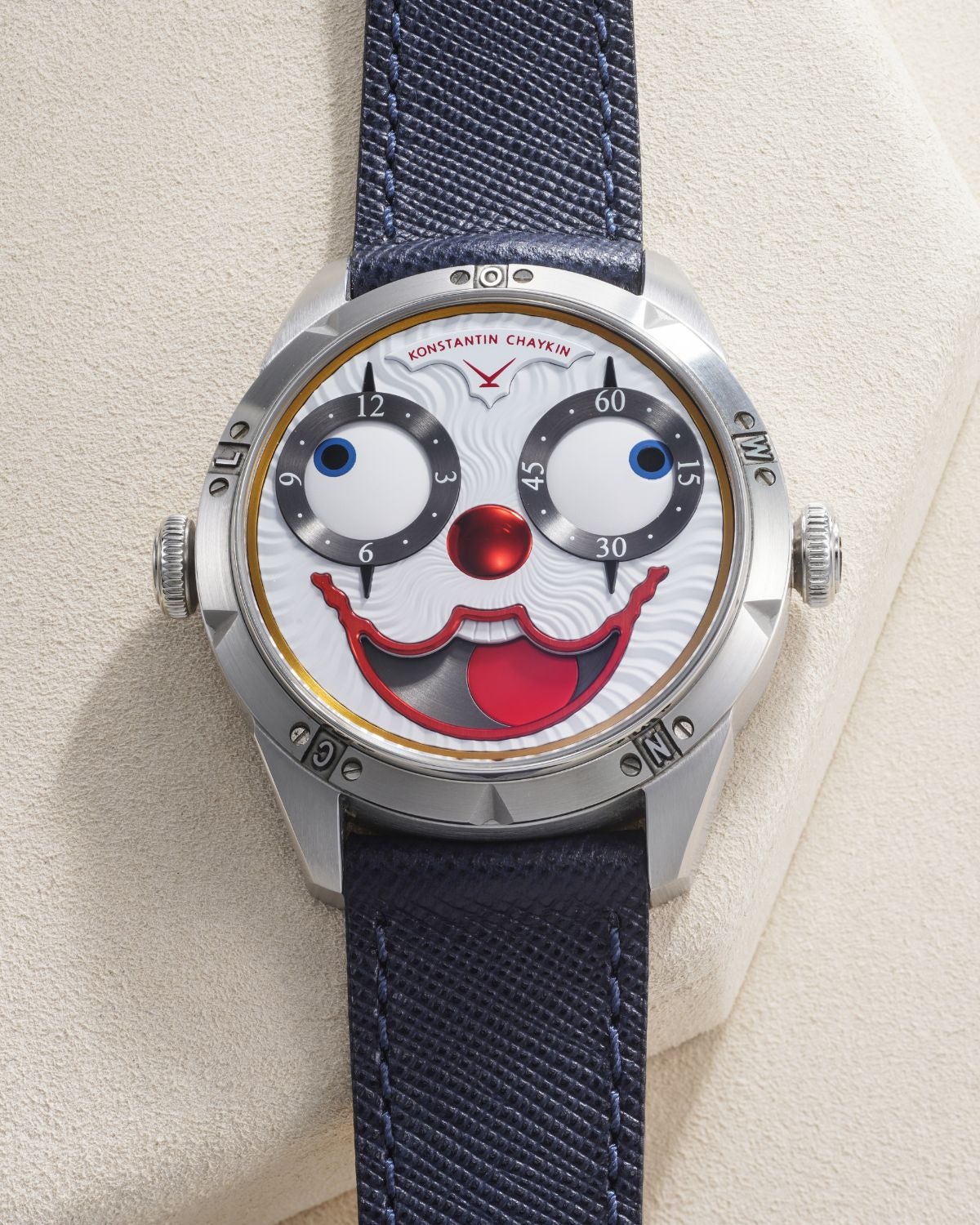
Lot 76: A 2020 Konstantin Chaykin Clown II Audacity in stainless steel, numbered 35 of a limited edition of 88 pieces, included in the Phillips Geneva Sessions, Fall 2026, Online Auction. Estimate: CHF 15,000–30,000
The hour and minute indications became wandering eyes, while the moonphase formed a smiling mouth whose expression changed as the hours, minutes and lunar cycle progressed.
The Joker's success gave birth to Chaykin's ever-expanding Wristmons collection, whose characters now include Dracula, Minotaur, Santa Claus, Harley Quinn and the Minions.
The example offered here is the Clown II Audacity, whose brightly colored dial and mischievous expression show that, in the right hands, reading the time can be every bit as playful as it is practical.
You can learn more, place a bid, and view the entire Geneva Sessions, Fall 2026, catalog here.