Property of an Eclectic Asian Collector
7
IWC
Ref. 3510
Porsche Design Compass Watch
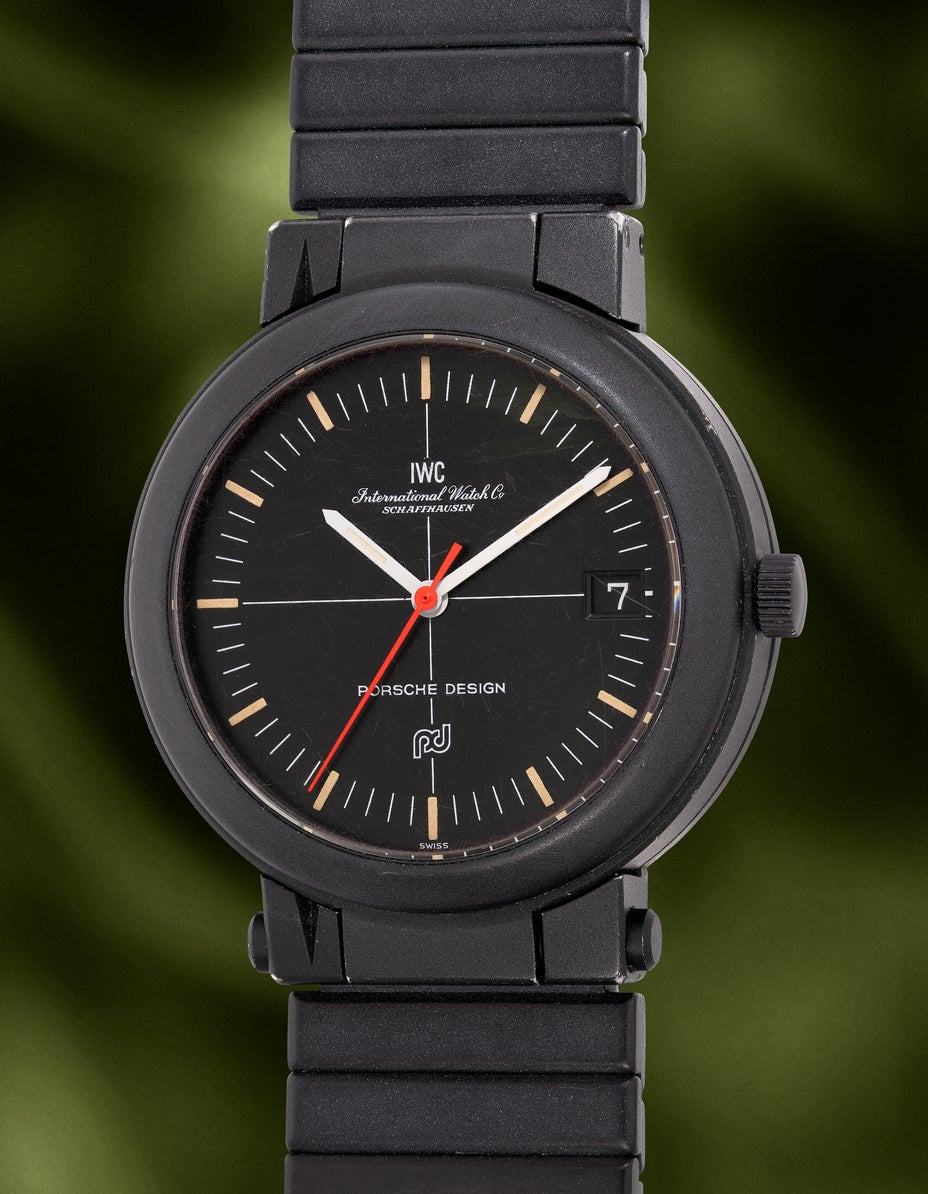
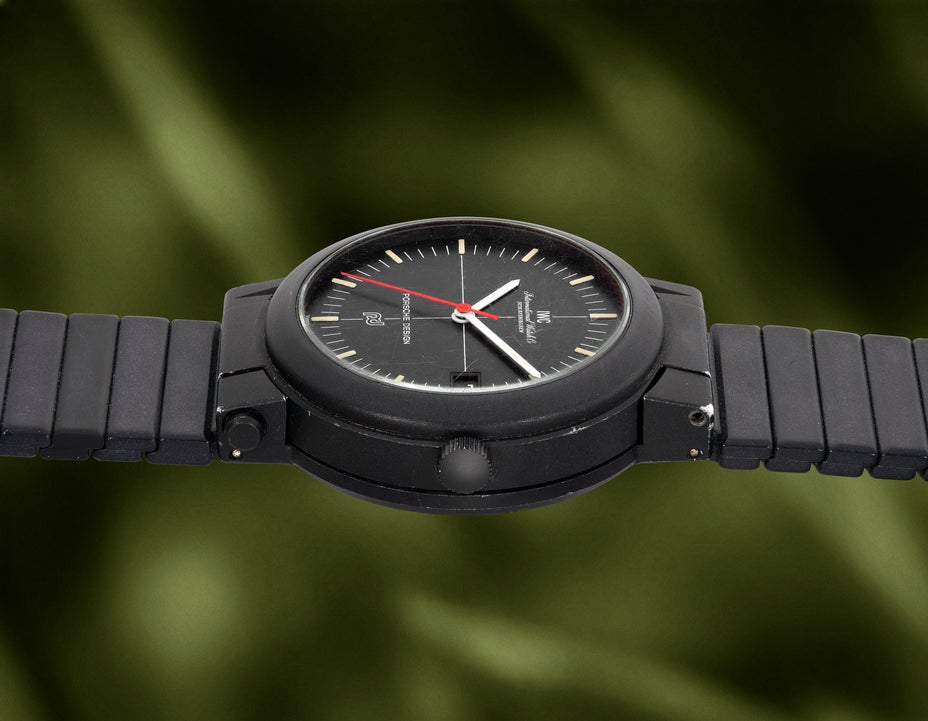
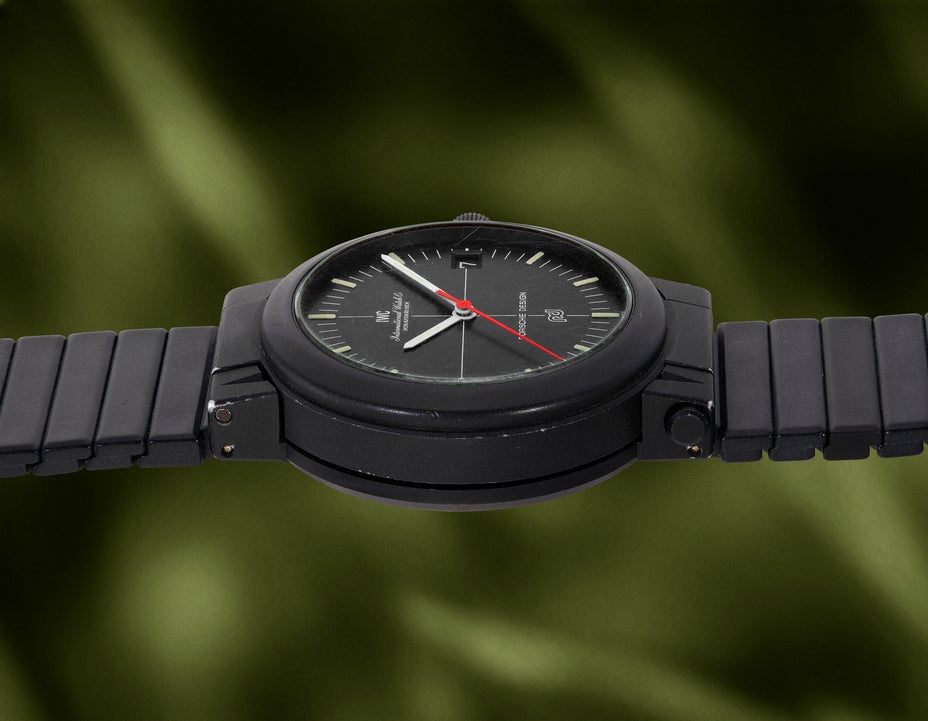
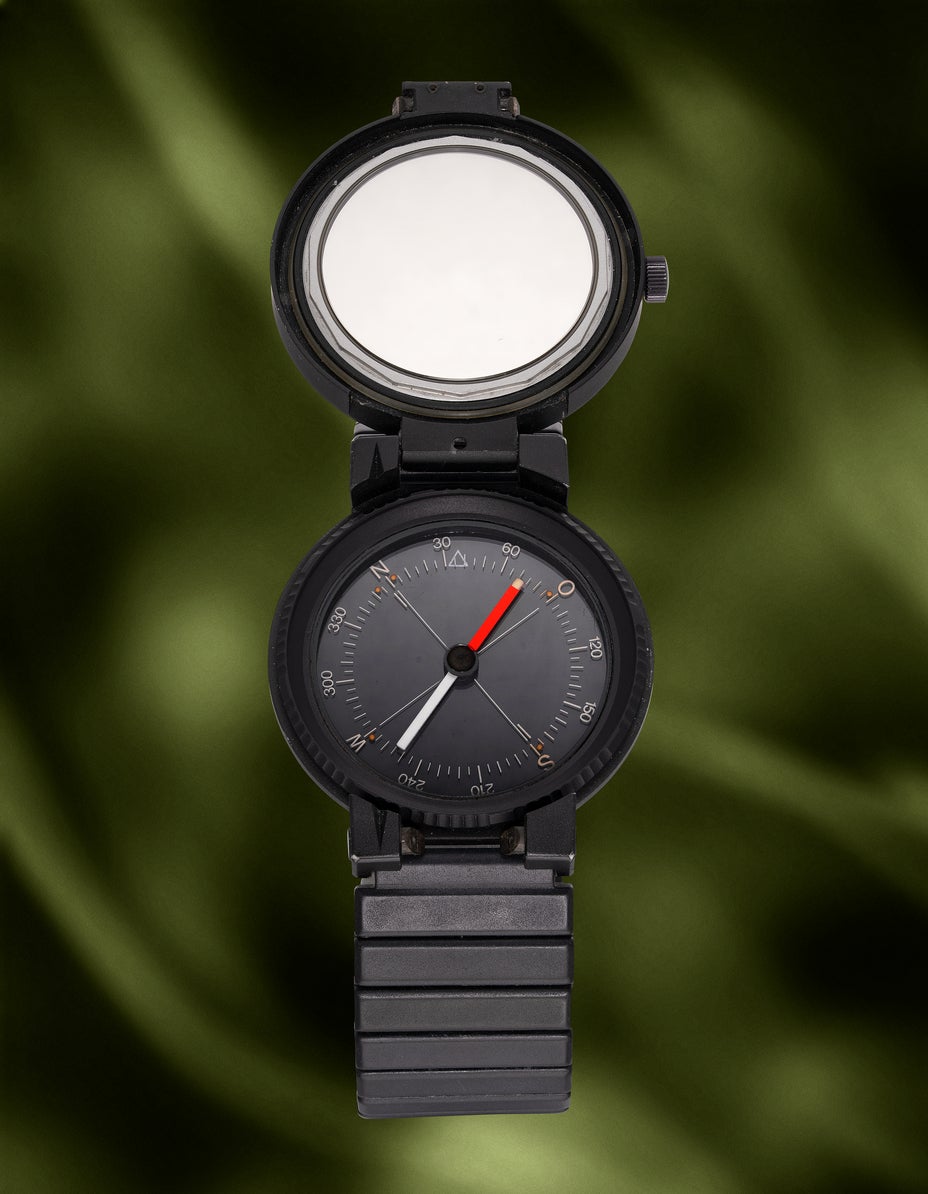
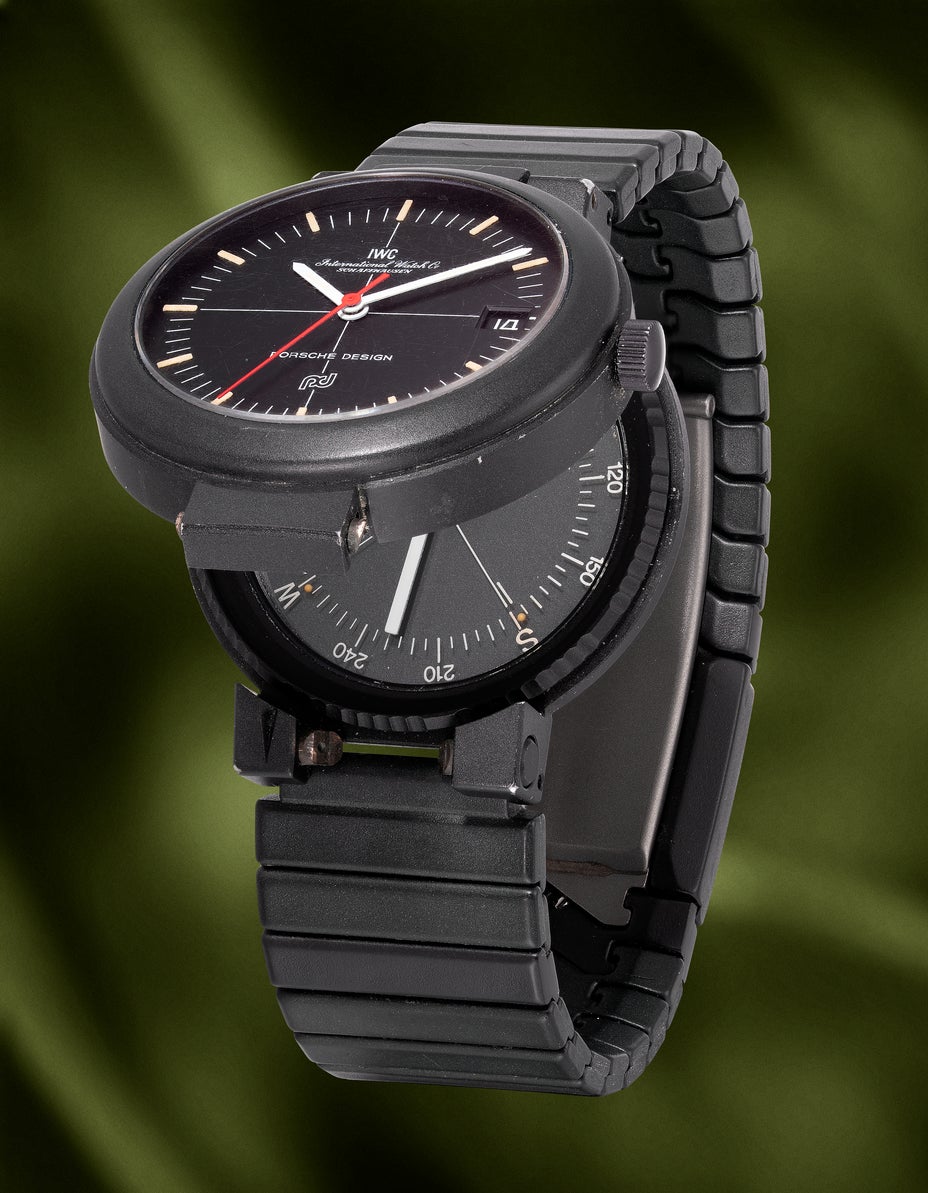
An unusual and well-preserved black PVD-coated aluminium wristwatch with centre seconds, date, hinged case concealing a compass and an emergency beacon mirror and bracelet
Estimate
HK$40,000–80,000•︎
€4,400–8,800
$5,100–10,300
Sold For
HK$44,450
Manufacturer
IWC
Year
1979, Switzerland
Movement No
2892
Reference No
3510
Case No
2’248’674
Model Name
Porsche Design Compass Watch
Material
PVD-coated aluminium
Calibre
Automatic, cal. 375, 21 jewels
Bracelet/Strap
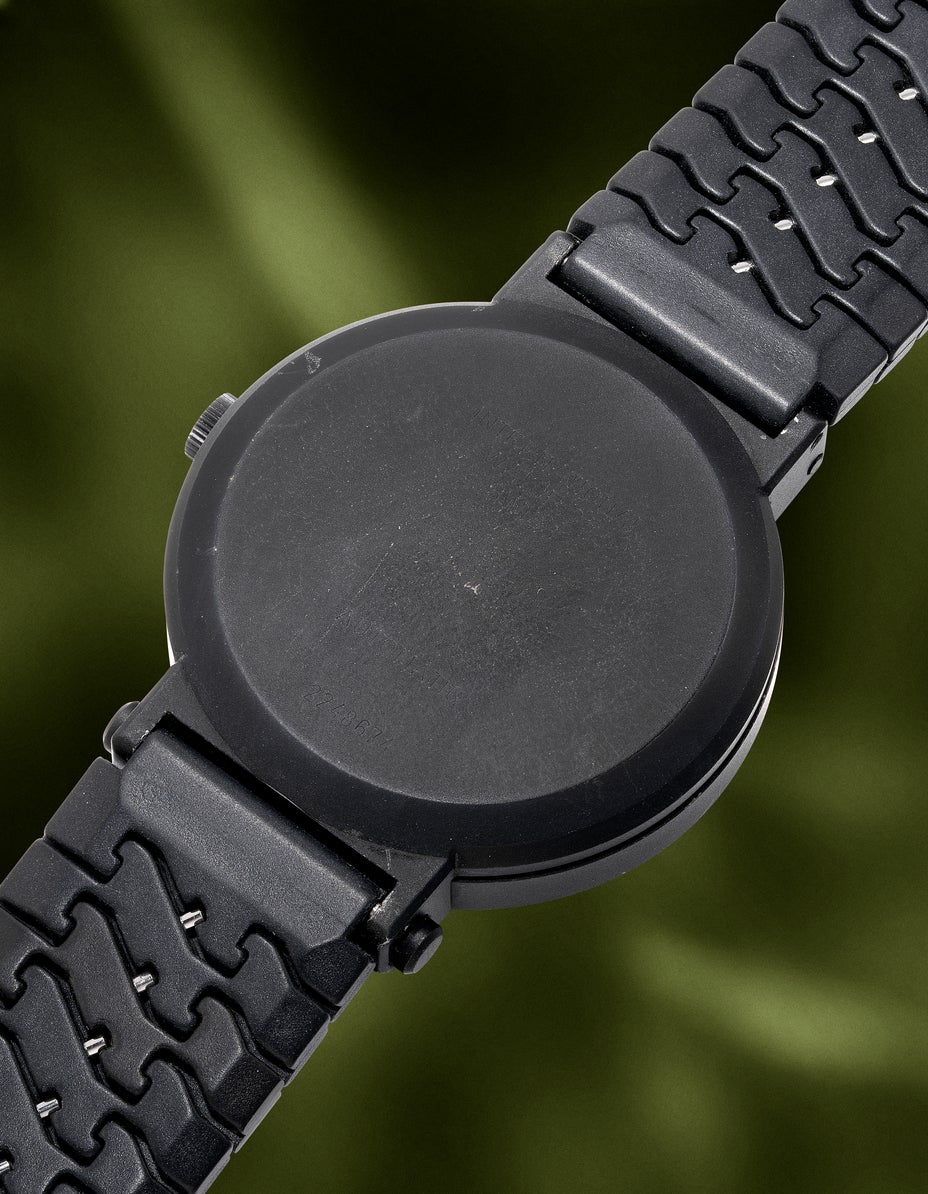
PVD-coated aluminium IWC bracelet, max length 170mm
Clasp/Buckle
Titanium IWC deployant clasp
Dimensions
39mm diameter
Signed
Case, dial, movement, bracelet and clasp signed; dial further signed Porsche Design
Accessories
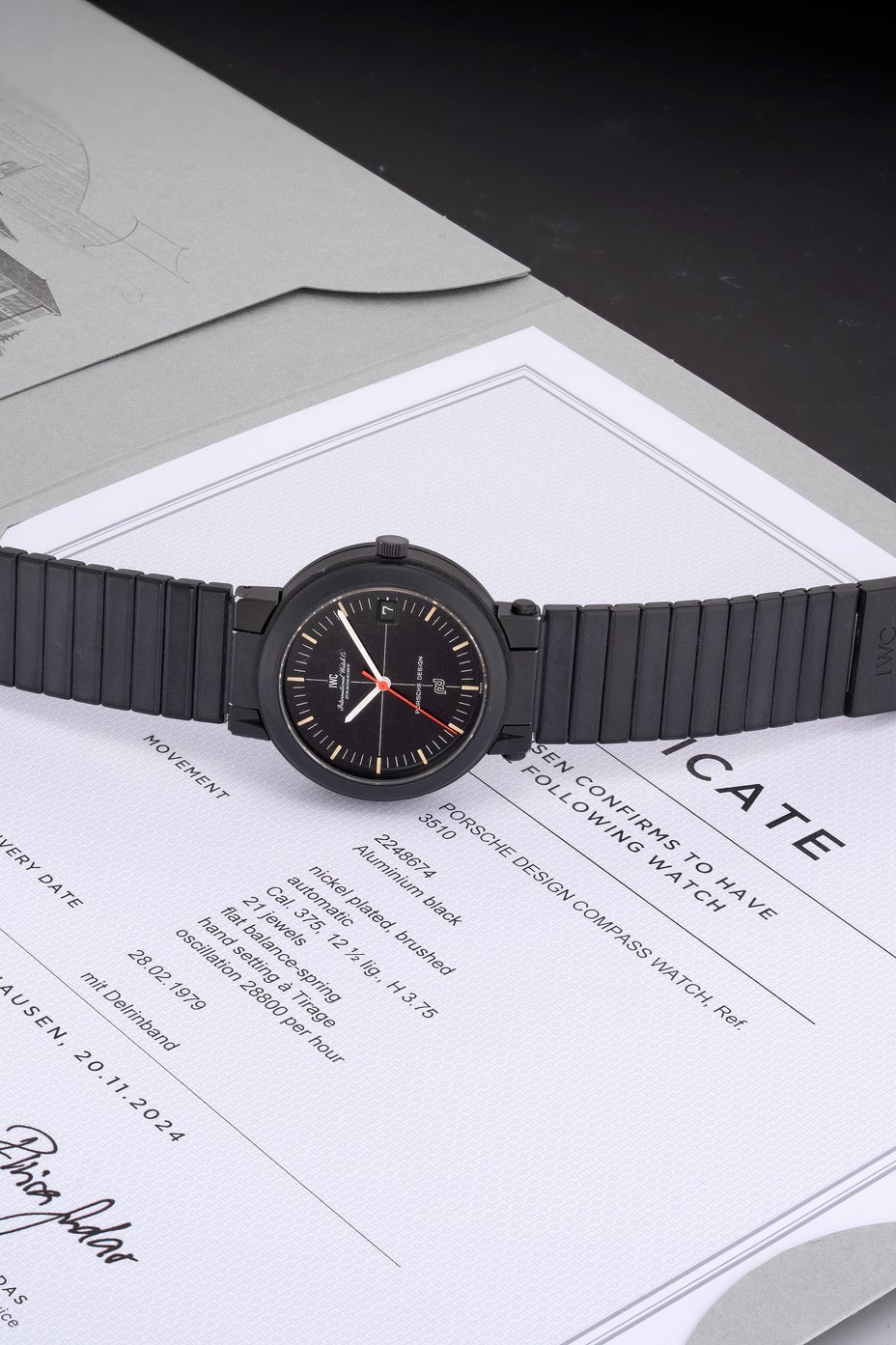
Delivered with IWC certificate of authenticity confirming production of the present timepiece on 28 February 1979.
Full-Cataloguing
• The IWC Porsche Design Compass Watch, reference 3510, released in 1978, represents a pioneering fusion of industrial design and horological innovation. As the first and most iconic model from the IWC and Porsche Design collaboration, it was conceived by Ferdinand Alexander Porsche, designer of the Porsche 911 and founder of Porsche Design. His vision combined rugged utility with minimalist aesthetics, resulting in a timepiece that featured a concealed compass beneath a hinged watch case. This was an essential tool for adventurers in the era before GPS. The reference was offered in both matte black and NATO olive green finishes. Although the black version is considerably more common, the exact production ratio and total quantity remain unknown.
• The development of the Compass Watch presented significant technical challenges, particularly in managing the interaction between metal components and the delicate mechanics of both the watch and the compass. A compass relies on a magnetised needle floating freely, yet placing it near a mechanical movement risks magnetising critical parts such as the hairspring and balance spring, which would compromise accuracy or render the watch inoperable. To address this, IWC replaced traditional ball bearings with nine ruby balls in the rotor to minimise magnetic interference. This innovation laid the foundation for the later Ocean BUND, an anti-magnetic diver’s watch developed for the Bundeswehr, the German Federal Armed Forces. According to IWC’s Museum Curator David Seyffer, the experience gained from this project enabled the company to advance further with the Ocean BUND. The movement developed for mine divers was eventually used in the Ocean 2000.
• Reference 3510 was marketed not only as a timepiece but also as a survival instrument for pilots, sailors, and outdoor enthusiasts. The compass was paired with a mirror intended for emergency signalling, reinforcing its role as a tool watch. This feature could be used by a lost explorer to attract the attention of a passing aircraft.
• The case was made from anodised aluminium, chosen for its exceptional lightness and durability. It was available in NATO olive green or matte black, as seen in the present example. The radical design of the case posed manufacturing difficulties, but during the quartz crisis, case makers were willing to take on challenging work. A manufacturer in the Jura Mountains succeeded in producing anodised aluminium cases and bracelets for the first generation of watches, meeting Porsche’s specifications for an ultra-lightweight design.
• To maximise legibility, Porsche focused on creating strong contrast on the dial. The final design featured a matte black background with large white hands, white minute hashes, oversized luminous hour markers, and a colour-matched date window at three o’clock. A set of quadrisecting lines reminiscent of hunting crosshairs completed the dial, reinforcing the compass theme. Two dial variations were produced for this reference:
• Type 1: “IWC” in sans-serif, “International Watch Co.” in cursive script, and “Schaffhausen” in capitalised serif italics at twelve o’clock. “Porsche Design” appears in capitalised sans-serif at six o’clock, with the “PD” logo below.
• Type 2: The layout remains the same, but “IWC” is rendered in a serif font, and “Schaffhausen” matches the line above in elegant cursive.
• The present 1979 example features an early type 1 dial and first-generation bracelet. This bracelet includes a side release button for the deployant clasp, allowing the watch to be laid flat over a map to measure distance using its 5mm links. However, collectors and accounts from IWC and Porsche Design note that this innovative bracelet was fragile and prone to accidental release. Whether due to wear from frequent use or the softness of the aluminium case, it became a known point of failure and could be uncomfortable to wear. Later versions featured a redesigned bracelet made from Delrin plastic with standard titanium clasps, offering improved durability and a more conventional deployant mechanism.
• Although it was later succeeded by the titanium reference 3511, the original 3510 remains a landmark in watchmaking. It captures a unique moment when analogue tools were essential companions in exploration, and when form and function were seamlessly integrated into a bold and forward-thinking design.
• The development of the Compass Watch presented significant technical challenges, particularly in managing the interaction between metal components and the delicate mechanics of both the watch and the compass. A compass relies on a magnetised needle floating freely, yet placing it near a mechanical movement risks magnetising critical parts such as the hairspring and balance spring, which would compromise accuracy or render the watch inoperable. To address this, IWC replaced traditional ball bearings with nine ruby balls in the rotor to minimise magnetic interference. This innovation laid the foundation for the later Ocean BUND, an anti-magnetic diver’s watch developed for the Bundeswehr, the German Federal Armed Forces. According to IWC’s Museum Curator David Seyffer, the experience gained from this project enabled the company to advance further with the Ocean BUND. The movement developed for mine divers was eventually used in the Ocean 2000.
• Reference 3510 was marketed not only as a timepiece but also as a survival instrument for pilots, sailors, and outdoor enthusiasts. The compass was paired with a mirror intended for emergency signalling, reinforcing its role as a tool watch. This feature could be used by a lost explorer to attract the attention of a passing aircraft.
• The case was made from anodised aluminium, chosen for its exceptional lightness and durability. It was available in NATO olive green or matte black, as seen in the present example. The radical design of the case posed manufacturing difficulties, but during the quartz crisis, case makers were willing to take on challenging work. A manufacturer in the Jura Mountains succeeded in producing anodised aluminium cases and bracelets for the first generation of watches, meeting Porsche’s specifications for an ultra-lightweight design.
• To maximise legibility, Porsche focused on creating strong contrast on the dial. The final design featured a matte black background with large white hands, white minute hashes, oversized luminous hour markers, and a colour-matched date window at three o’clock. A set of quadrisecting lines reminiscent of hunting crosshairs completed the dial, reinforcing the compass theme. Two dial variations were produced for this reference:
• Type 1: “IWC” in sans-serif, “International Watch Co.” in cursive script, and “Schaffhausen” in capitalised serif italics at twelve o’clock. “Porsche Design” appears in capitalised sans-serif at six o’clock, with the “PD” logo below.
• Type 2: The layout remains the same, but “IWC” is rendered in a serif font, and “Schaffhausen” matches the line above in elegant cursive.
• The present 1979 example features an early type 1 dial and first-generation bracelet. This bracelet includes a side release button for the deployant clasp, allowing the watch to be laid flat over a map to measure distance using its 5mm links. However, collectors and accounts from IWC and Porsche Design note that this innovative bracelet was fragile and prone to accidental release. Whether due to wear from frequent use or the softness of the aluminium case, it became a known point of failure and could be uncomfortable to wear. Later versions featured a redesigned bracelet made from Delrin plastic with standard titanium clasps, offering improved durability and a more conventional deployant mechanism.
• Although it was later succeeded by the titanium reference 3511, the original 3510 remains a landmark in watchmaking. It captures a unique moment when analogue tools were essential companions in exploration, and when form and function were seamlessly integrated into a bold and forward-thinking design.
IWC
Swiss | 1868With a clear focus on technology and development, the Swiss watch manufacturer IWC Schaffhausen has been producing timepieces of lasting value since 1868. The company has gained an international reputation based on a passion for innovative solutions and technical ingenuity. One of the world's leading brands in the luxury watch segment, IWC crafts masterpieces of haute horlogerie at their finest, combining high precision with masculine design. Vintage wristwatches such as the oversized Portugieser, Aquatimer, Ingenieur and the B-UHR pilots watch are especially desirable for collectors.