

13
Jaeger-LeCoultre
Ref. 3027
“Lucky 13”
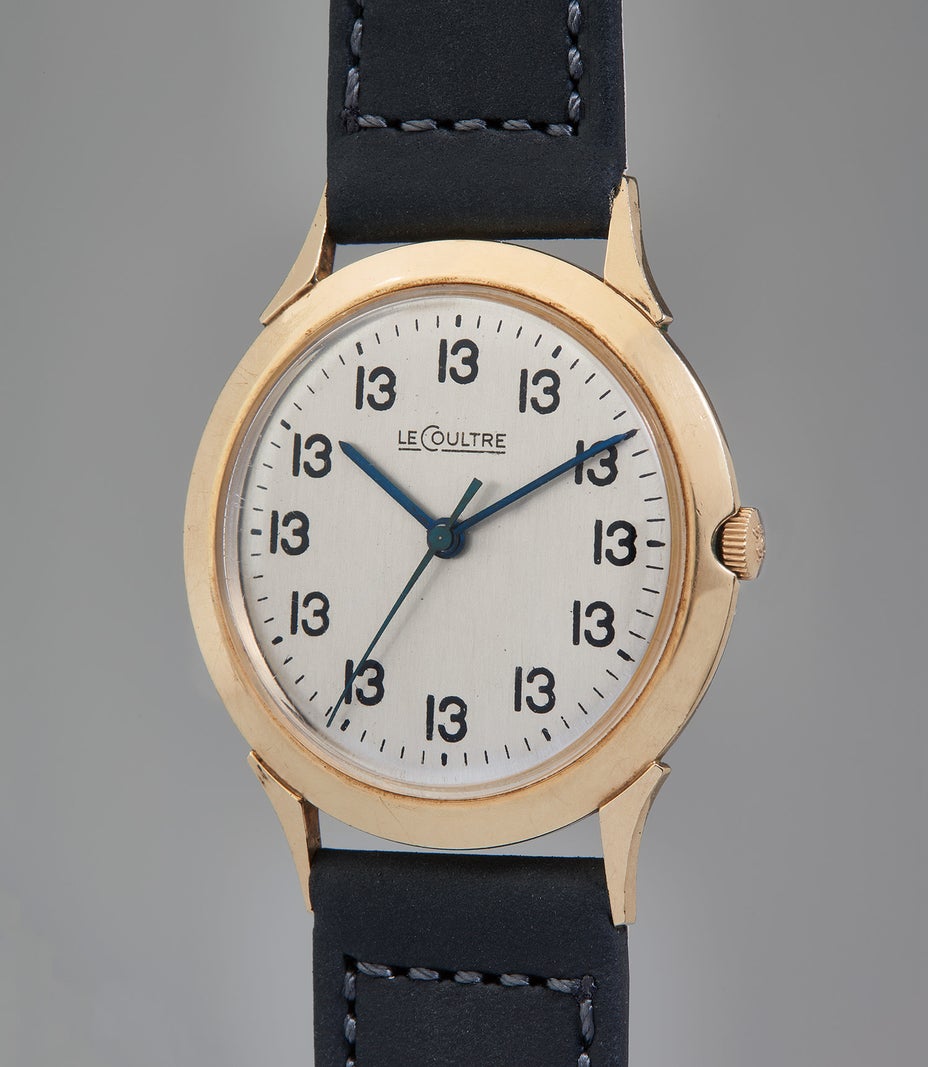
A unique, historically important, and unusual gold-filled time-only wristwatch with center seconds and “Lucky 13” dial
- Estimate
- $20,000 - 40,000
$62,500
Lot Details
- Manufacturer
- Jaeger-LeCoultre
- Year
- 1962
- Reference No
- 3027
- Movement No
- 1’328’079
- Case No
- 898’783
- Model Name
- “Lucky 13”
- Material
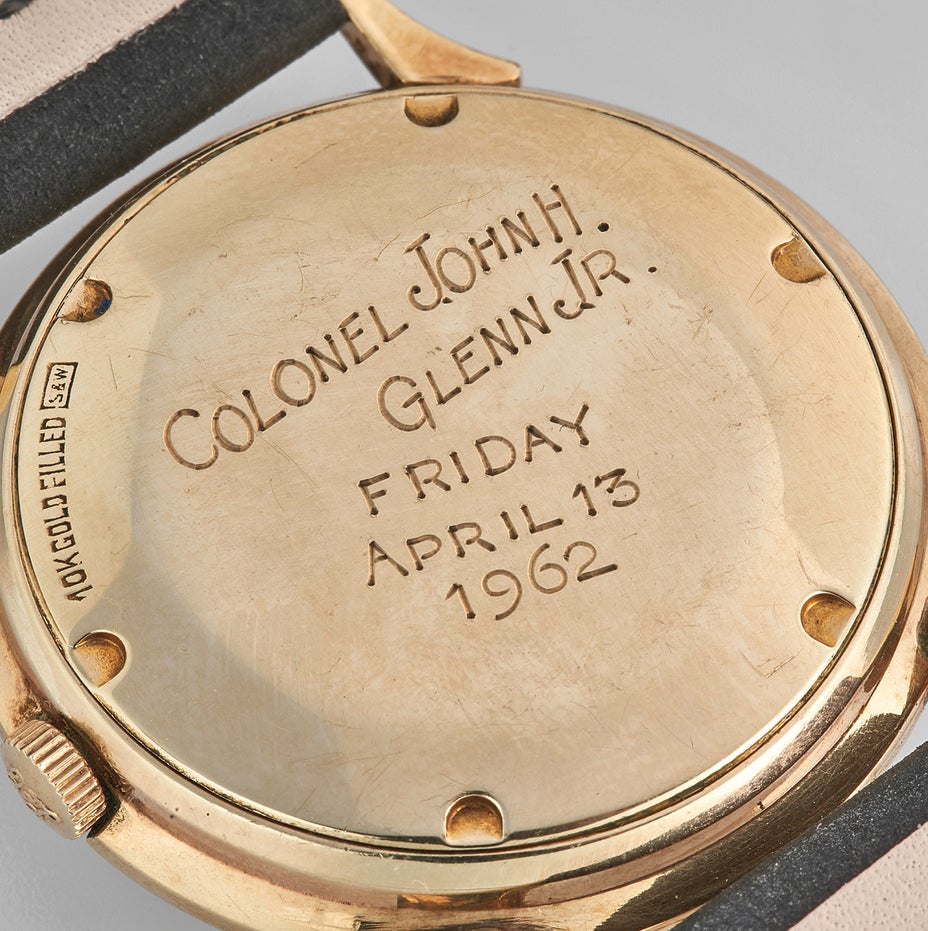
- 10K Gold-filled
- Calibre
- Manual, cal. K831/CW, 17 jewels
- Bracelet/Strap
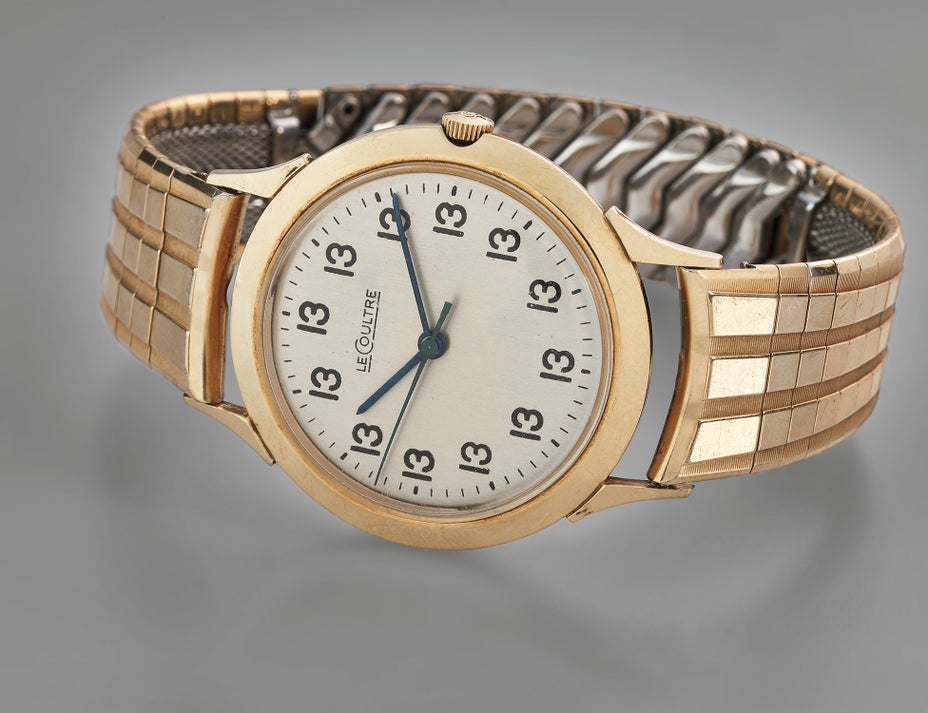
- Associated gold tone Speidel extendable bracelet
- Dimensions
- 33mm Diameter
- Signed
- Case, dial, and movement signed; movement additionally stamped “VXN”
- Accessories
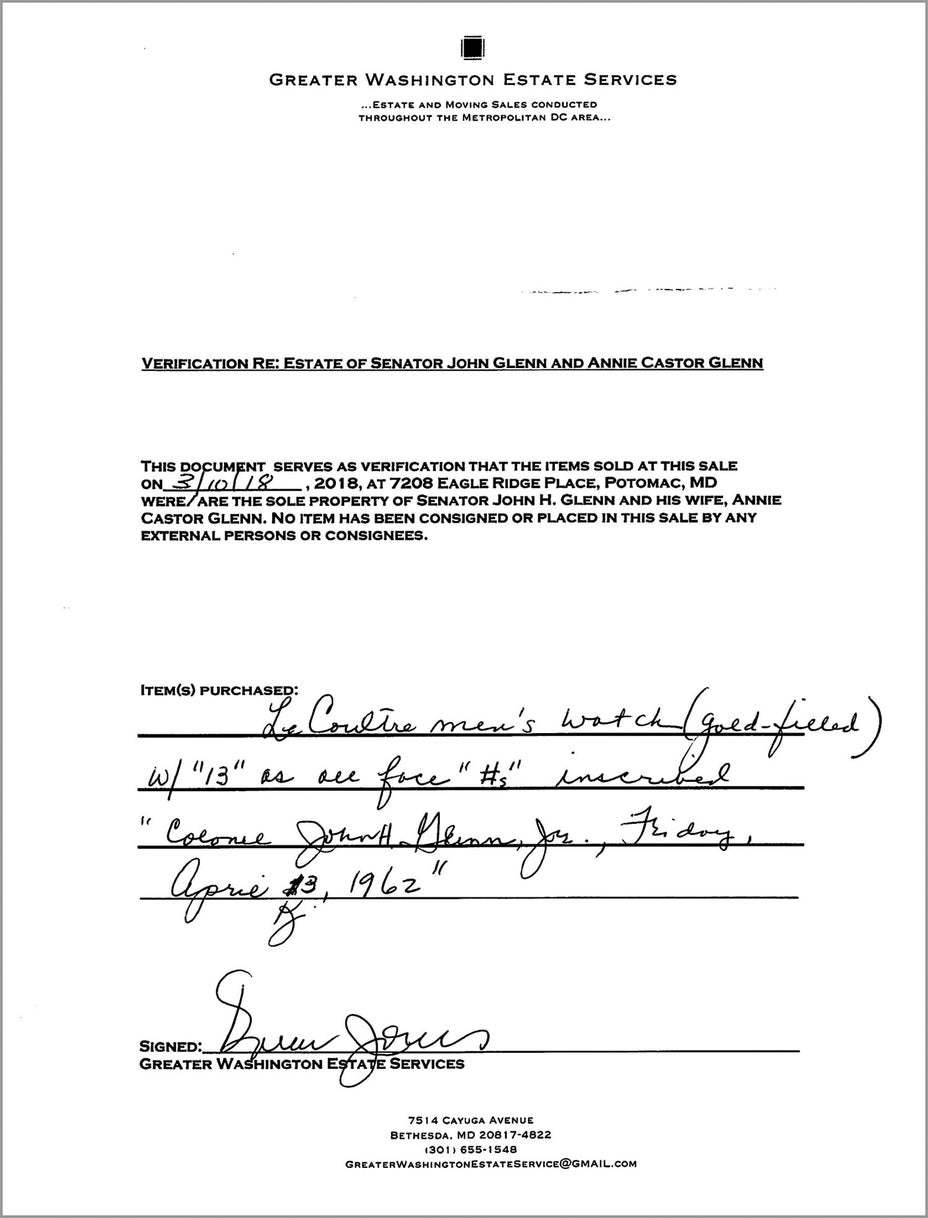
- Accompanied by estate document.
Specialist
Full-Cataloguing
Catalogue Essay
The fear of the number 13, triskaidekaphobia, or fear of Friday the 13th, called Paraskevidekatriaphobia, is a pervasive one in the collective social conscious, even if its difficult to determine exactly why or from where this fear stems. On Friday, December 13th 1941, “169 audacious and irreverent gentlemen” set out to reject this fear by embracing the number 13 utterly. A description of the event in LIFE magazine states, “Each table seated 13. Upon each rested an open umbrella, a bottle of bourbon and 13 copies of a poem called The Harlot. The speaker’s table was strewn with horseshoes, old keys, mirrors, and cardboard black cats. Before it reposed an open coffin with 13 candles.” Clearly, the founders of the Anti-Superstition Society of Chicago set out to expose triskaidekaphobia as a ridiculous idea by in effect, acting ridiculously. They set out to meet on every Friday the 13th, and their members numbered many prominent citizens of the city of Chicago.
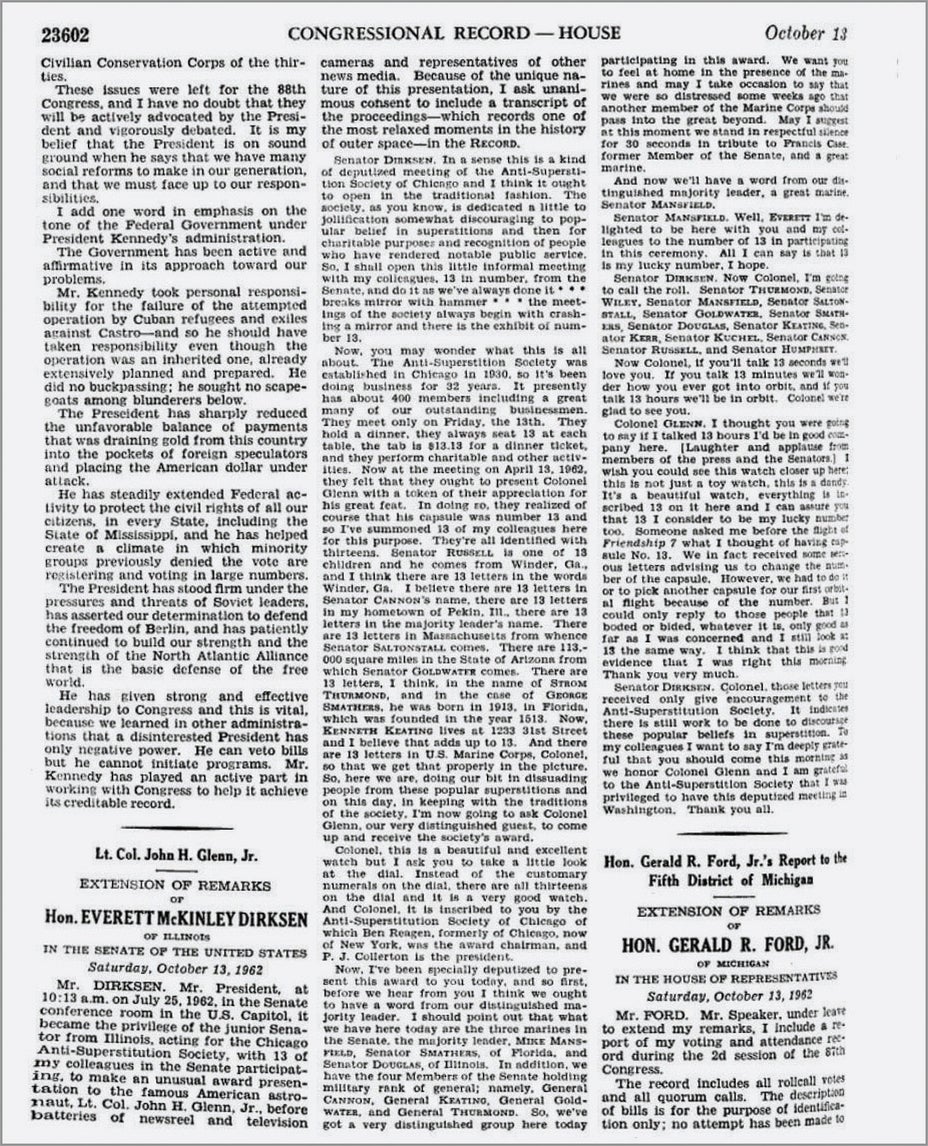
In 1962, Friday the 13th fell on April 13th, almost two months after the first American orbited Earth. On this day, thirteen U.S. Senators gathered at the Anti-Superstition Society in Chicago to present the first American to orbit Earth with a special watch commemorating his spacecraft capsule number 13, callsign Friendship 7, as a further ode to the rejection of the number 13 as unlucky. Senator Everett Dirksen, of Illinois, in presenting the watch said, “Colonel, this is a beautiful and excellent watch but I ask you to take a little look at the dial. Instead of the customary numerals on the dial, there are all thirteens on the dial and it is a very good watch. And Colonel, it is inscribed to you by the Anti-Superstition Society of Chicago.” This meeting of the Anti-Superstition Society of Chicago was entered in the House Congressional Record on October 13th, 1962. Collectors rejoice when a watch comes with documentation and a backstory – but rarely does it ever come with a Congressional record of its delivery. The astronaut’s acceptance speech, also in the record, goes on to thank the group for their gif of such a lovely watch, and express how he has embraced the number 13 as lucky for him personally.
Though the dial is vaguely similar to the LeCoultre 24-hour dial watch that was given to all astronauts who participated in Project Mercury, its 10K gold-filled case was manufactured by LeCoultre in the United States, and fitted with a custom-made silvered, non-luminous dial. Only the movement came from Switzerland; otherwise, it was produced and assembled in the United States by the American arm of Jaeger-LeCoultre. The case bears the reference 3027, which is found on other 10K gold-filled LeCoultre watches with similar angled lugs. It is offered here in hardly-worn, original condition, totally unpolished and unrestored.
A portion of the proceeds of the sale of this watch will be donated to The John Glenn College of Public Affairs at The Ohio State University.
In 1962, Friday the 13th fell on April 13th, almost two months after the first American orbited Earth. On this day, thirteen U.S. Senators gathered at the Anti-Superstition Society in Chicago to present the first American to orbit Earth with a special watch commemorating his spacecraft capsule number 13, callsign Friendship 7, as a further ode to the rejection of the number 13 as unlucky. Senator Everett Dirksen, of Illinois, in presenting the watch said, “Colonel, this is a beautiful and excellent watch but I ask you to take a little look at the dial. Instead of the customary numerals on the dial, there are all thirteens on the dial and it is a very good watch. And Colonel, it is inscribed to you by the Anti-Superstition Society of Chicago.” This meeting of the Anti-Superstition Society of Chicago was entered in the House Congressional Record on October 13th, 1962. Collectors rejoice when a watch comes with documentation and a backstory – but rarely does it ever come with a Congressional record of its delivery. The astronaut’s acceptance speech, also in the record, goes on to thank the group for their gif of such a lovely watch, and express how he has embraced the number 13 as lucky for him personally.
Though the dial is vaguely similar to the LeCoultre 24-hour dial watch that was given to all astronauts who participated in Project Mercury, its 10K gold-filled case was manufactured by LeCoultre in the United States, and fitted with a custom-made silvered, non-luminous dial. Only the movement came from Switzerland; otherwise, it was produced and assembled in the United States by the American arm of Jaeger-LeCoultre. The case bears the reference 3027, which is found on other 10K gold-filled LeCoultre watches with similar angled lugs. It is offered here in hardly-worn, original condition, totally unpolished and unrestored.
A portion of the proceeds of the sale of this watch will be donated to The John Glenn College of Public Affairs at The Ohio State University.
Provenance
Jaeger-LeCoultre
Swiss | 1833Not all companies in the watchmaking field have been able to stand the test of time quite like Jaeger LeCoultre, also known as the "watchmaker's watchmaker." Founded in 1833 by Antoine LeCoultre and originally named LeCoutre, the firm provided watchmaking's top brands, such as Patek Philippe, Vacheron Constantin and Audemars Piguet, the high-grade, unfinished mechanical movements with which they completed their watches.
In the early 1900s, Cartier's watch supplier Edmond Jaeger sought out LeCoultre's help in creating the world's thinnest watches. The collaboration resulted in the creation of Cartier's earliest Tank and Santos watches, all housed with LeCoultre movements. The duo decided to merge in 1937, and the firm officially became the Jaeger-LeCoultre brand by which collectors know and adore it today. Some of the firm's most significant and important timepieces include the Reverso, the Memovox, the Atmos clock and, among modern watches, their Master Complications.
Browse MakerIn the early 1900s, Cartier's watch supplier Edmond Jaeger sought out LeCoultre's help in creating the world's thinnest watches. The collaboration resulted in the creation of Cartier's earliest Tank and Santos watches, all housed with LeCoultre movements. The duo decided to merge in 1937, and the firm officially became the Jaeger-LeCoultre brand by which collectors know and adore it today. Some of the firm's most significant and important timepieces include the Reverso, the Memovox, the Atmos clock and, among modern watches, their Master Complications.