816
Patek Philippe
Ref. 1459
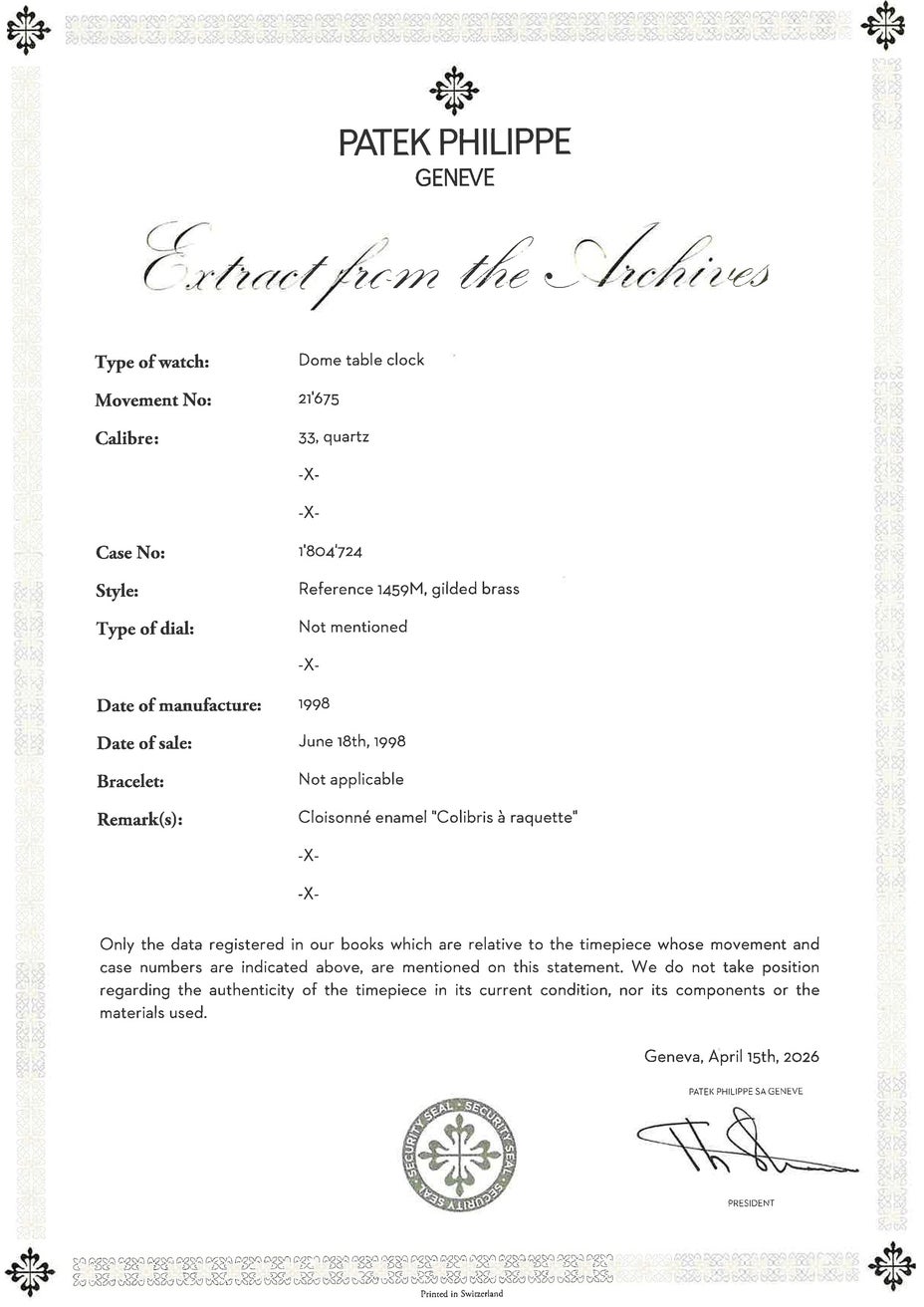
Colibris à raquette by Anita Porchet
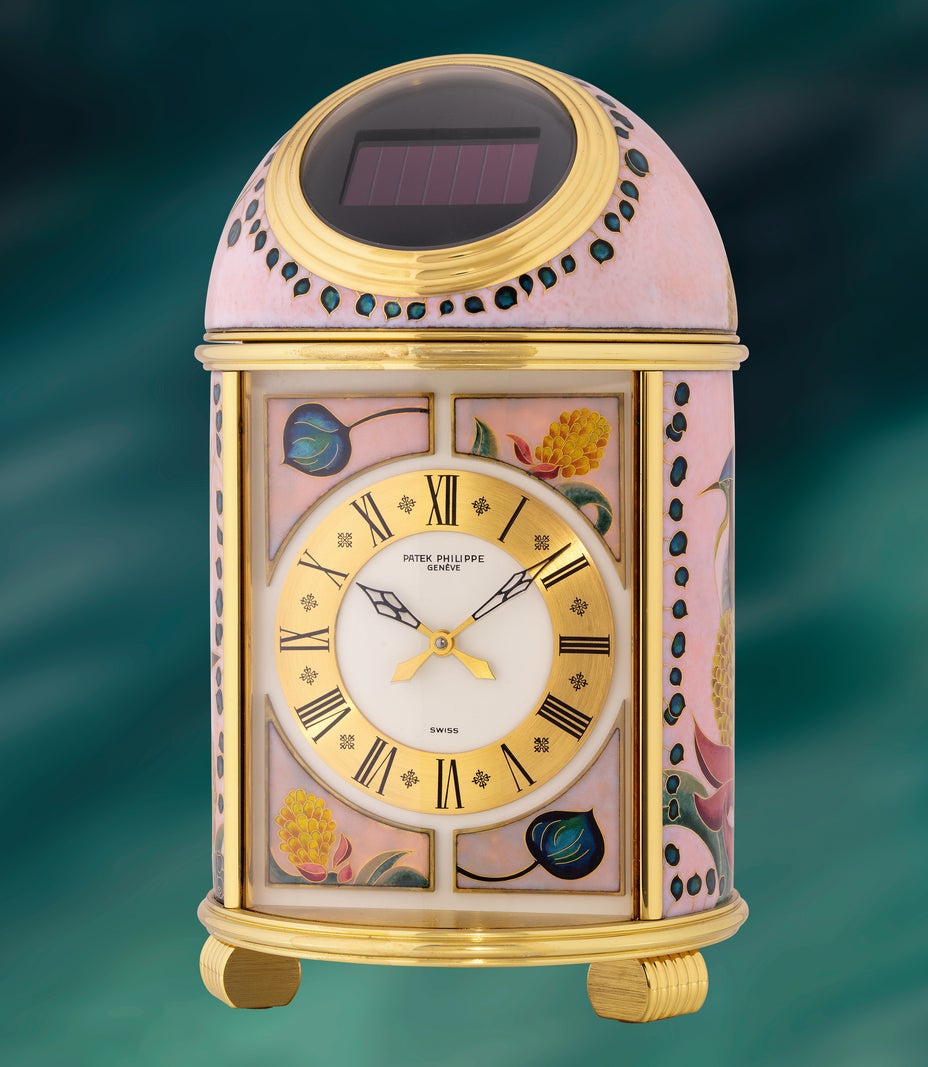
An exquisite, unique and highly attractive gilt brass solar dome clock with Colibris à raquette enamel scene by Anita Porchet
Full-Cataloguing
- Solar powered movement
The Patek Philippe Solar Dome Clock, part of the esteemed Pendulette Dôme series, exemplifies the Swiss manufacture’s pioneering integration of advanced horological technology with exceptional artisan craftsmanship. The solar dome clocks collectively represent an innovative chapter in Patek Philippe’s history, blending photoelectric innovation with sculptural design and handcrafted enamel work.
These table clocks first emerged in the mid-1950s, following the establishment of Patek Philippe’s Electronics Division in 1948. The division, led by Georges Delessert, explored photoelectric, electronic, and even nuclear timekeeping methods to future-proof the company amid evolving industry challenges. By 1954, Patek Philippe had developed its inaugural photoelectric desk clock, powered by light rather than traditional winding. Series production of the dome models commenced soon after, with early examples retailed through prestigious outlets such as Tiffany & Co.. Production of solar variants continued into the 1970s before a gradual transition to battery-powered quartz movements, with solar technology fully discontinued by the year 2007.
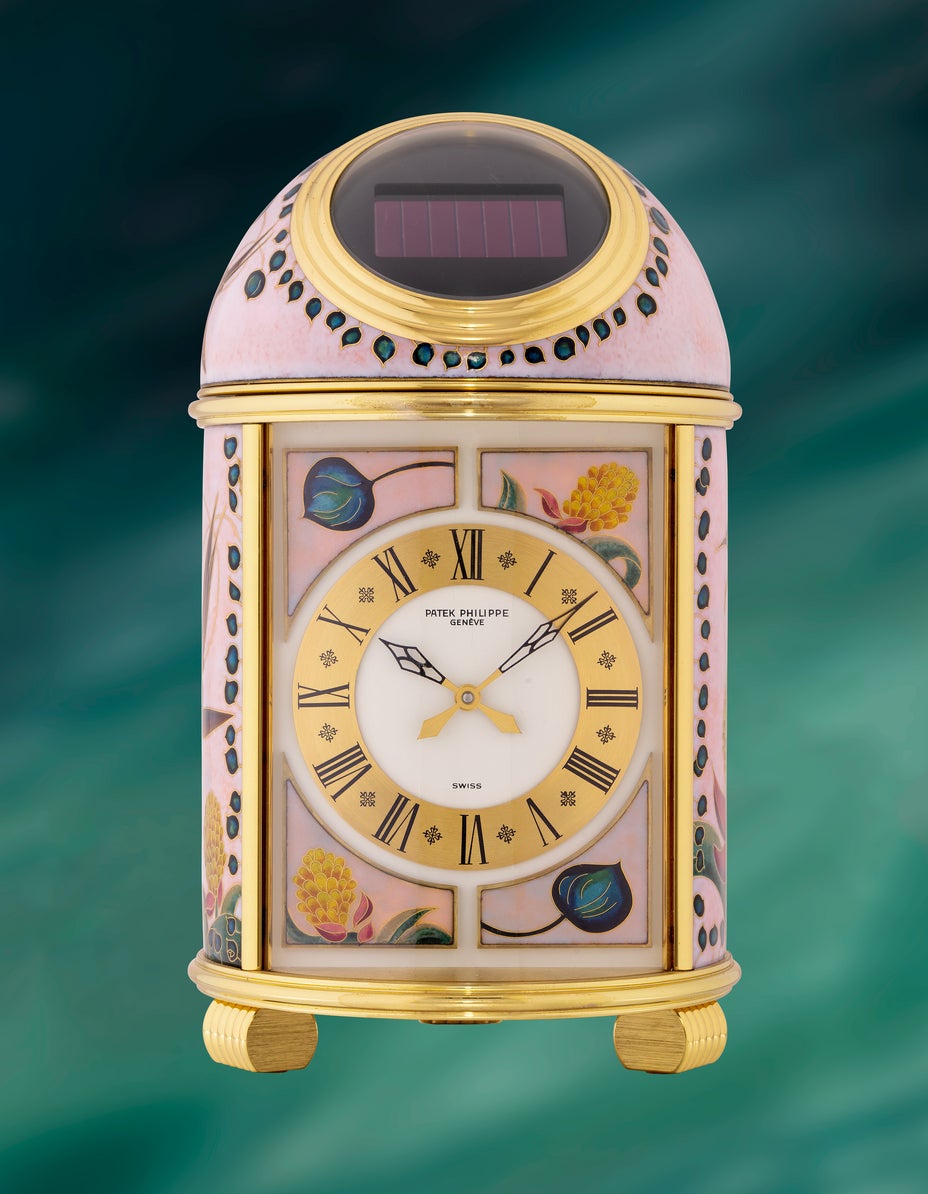
The core of the solar dome clocks is indeed a sophisticated photoelectric system. A small, rotatable solar panel atop the dome captures ambient light and converts it into electrical energy. This energy charges a storage device that automatically winds the mechanical movement housed within. The dome’s rotatable design allowed users to optimize orientation toward the light source during the day. The dome form—evocative of European cathedrals and observatory architecture—served as a perfect canvas for artistic expression. Cases were commonly executed in gilt brass, with cylindrical bodies supported by fluted bun feet like the present example - it features cloisonné enamel decoration applied to the dome and on all sides. Cloisonné enamel involves soldering delicate gold wires to outline intricate scenes or motifs, then filling compartments with colored enamel powder and firing the piece multiple times at high temperatures—an extremely labor-intensive process that could take a master enameller up to a year to complete per clock, with a high risk of defects throughout every step of the enamelling process.
Themes ranged from classical landscapes and floral patterns to commemorative scenes. The present example is from master enameller Anita Porchet, widely regarded as one of the foremost master enamellers of her generation, she maintains a profound connection to Patek Philippe’s tradition through her longstanding collaboration with the manufacture. Porchet’s oeuvre represents a direct artistic continuation of the exceptional artisans that define these iconic timepieces.
Porchet began her association with Patek Philippe in the early 1990s, supported by then-President Philippe Stern, and has since produced numerous enamel decorations for dome clocks featured in the brand’s annual Rare Handcrafts exhibitions. Patek Philippe granted her and her ateliers considerable creative freedom in conceiving these works, allowing the artist’s vision to manifest across the entire cylindrical case. She employs a mastery of complex techniques, including grand feu cloisonné enamel, paillonné enamel, and miniature painting on enamel. These methods mirror those used by earlier Patek Philippe enamellers on the original solar dome clocks, such as Luce Chappaz, Michel Deville, and Michèl Mauris, who adorned the photoelectric models since the 1950s.
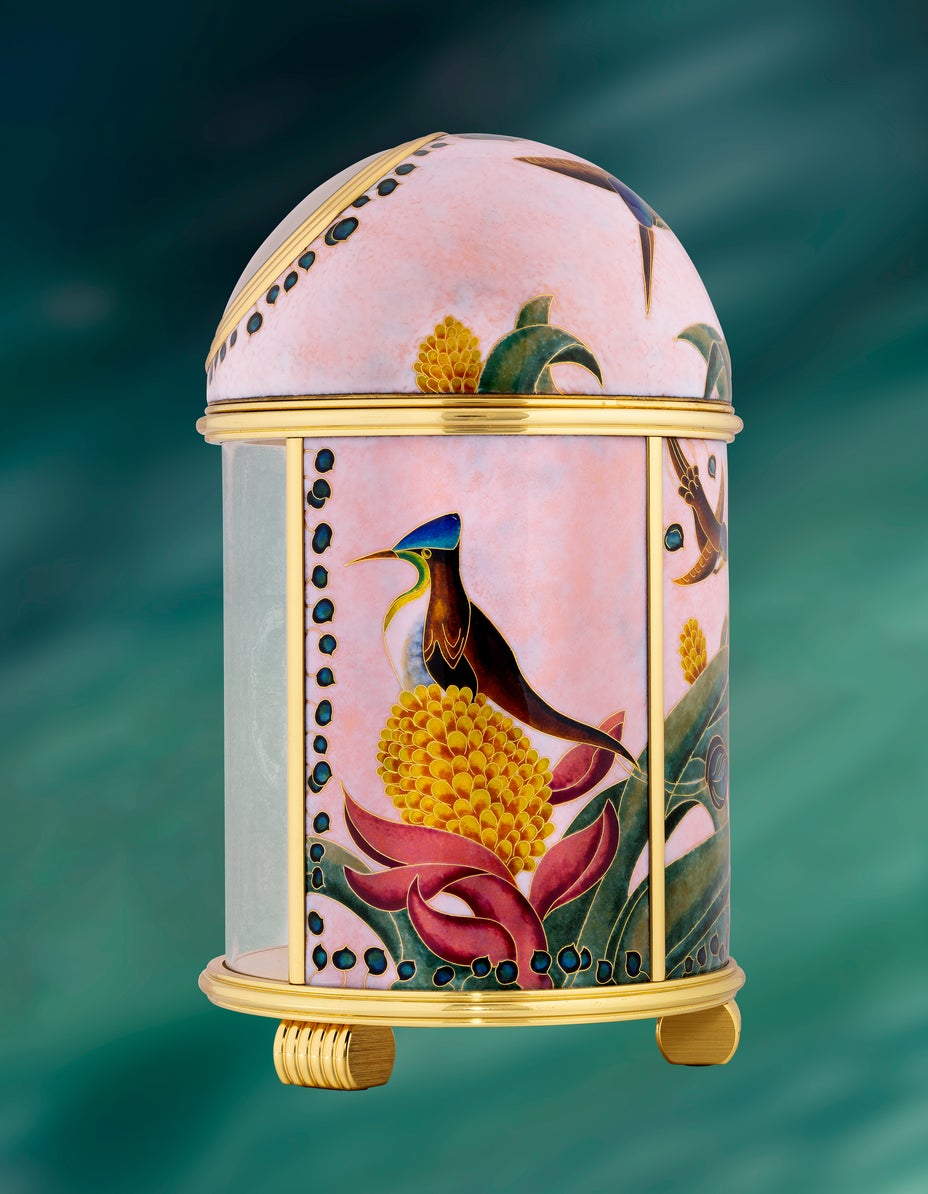
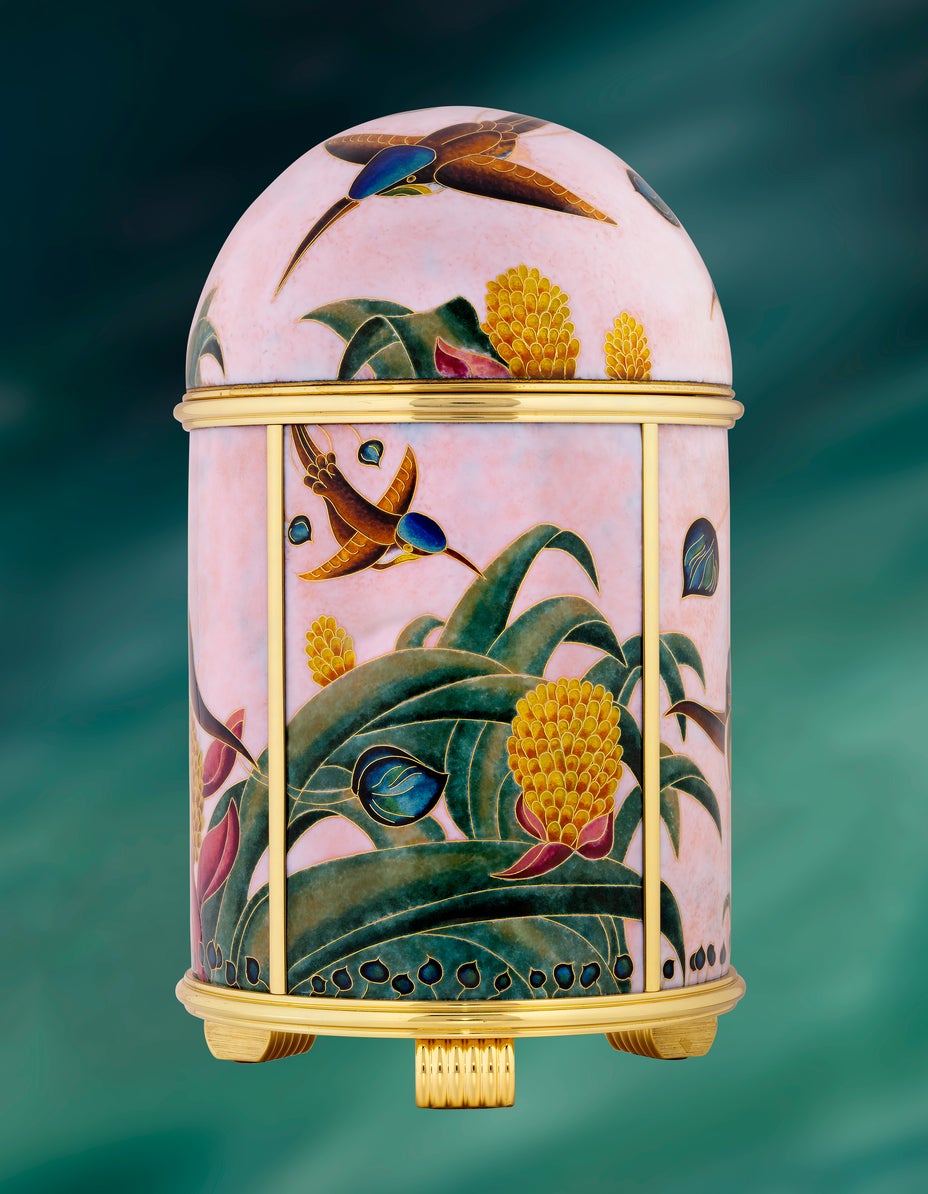
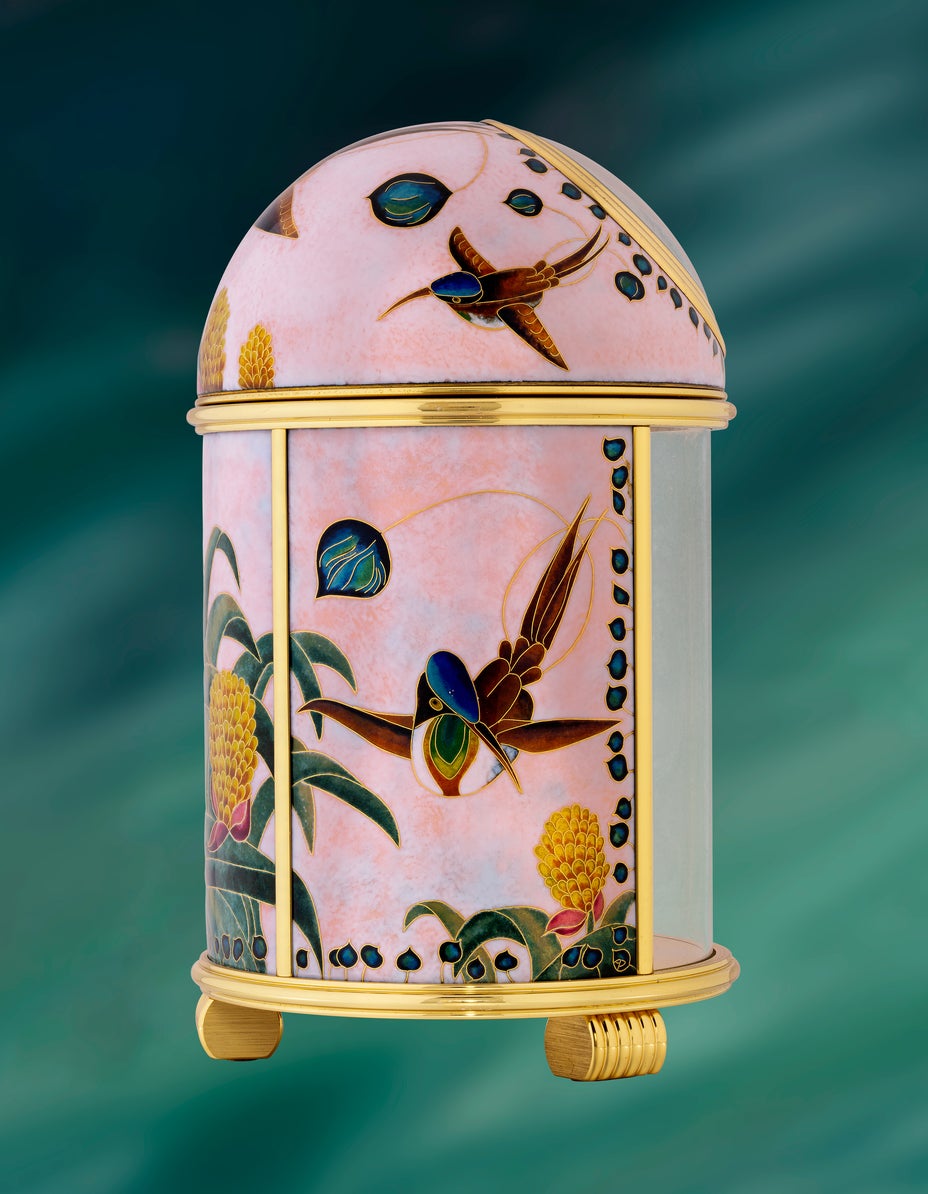
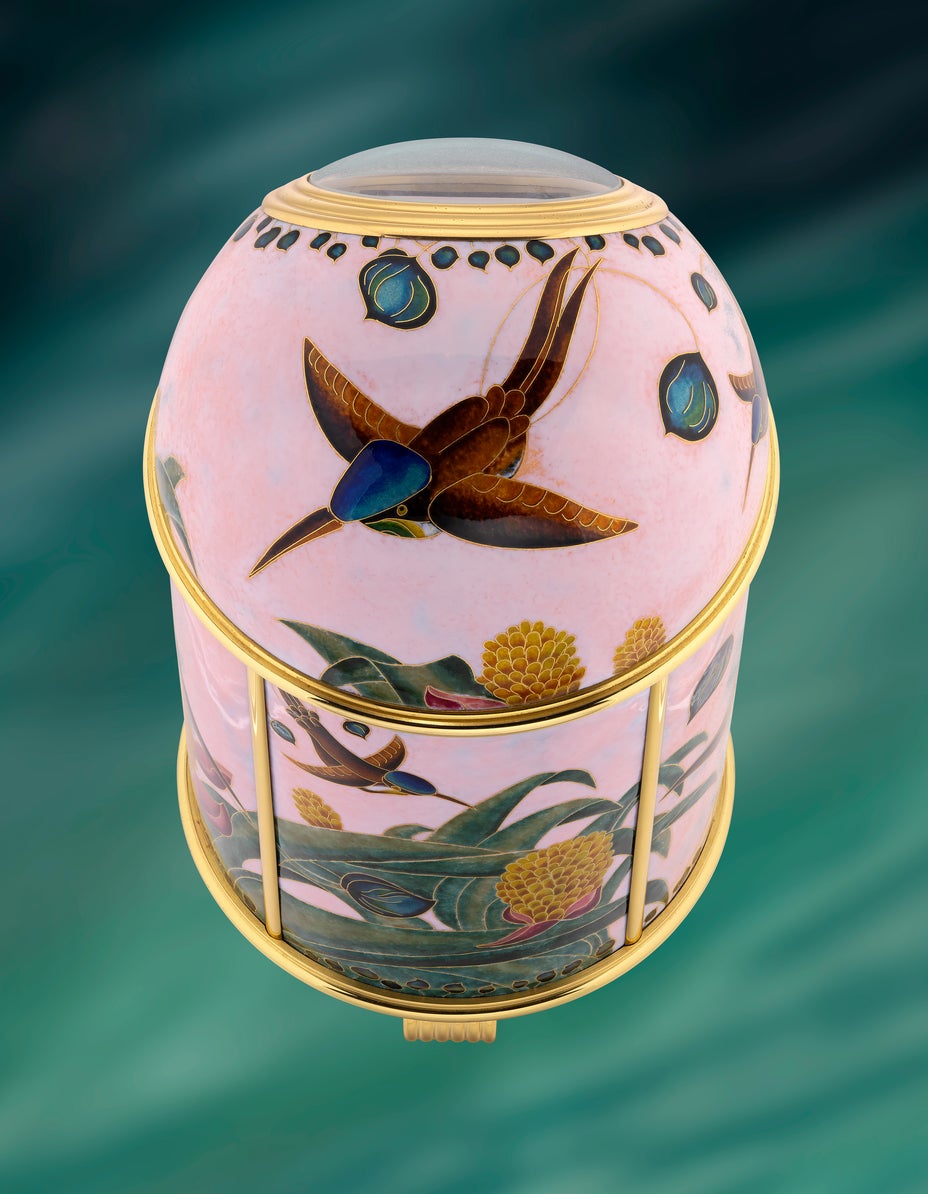
Notable examples of Porchet’s dome clocks include many themes, such as the “Neige de Printemps”, her pieces frequently bear the discreet signature “A. Porchet” (indicating personal execution) or “AP” (denoting atelier collaboration), underscoring the exceptional rarity and value of these objects. The present example features a meticulously executed cloisonné enamel decoration depicting a lively tropical scene. Multiple racket-tailed hummingbirds—characterized by their iridescent blue heads, elongated curved beaks, and brown bodies—are portrayed in dynamic poses: one in mid-flight on the dome, others perched or hovering among the flora on the cylindrical body. These avian subjects interact with exotic vegetation, including prominent golden-yellow, cone-shaped inflorescences, accompanied by deep green leaves, buds, and subtle red accents at the floral bases. The entire composition is set against a soft pink enamel ground, framed by polished gilt vertical bands that, maybe inadvertently, evoke the structure of a birdcage. This artistic motif exemplifies the exceptional métiers d’art tradition associated with Patek Philippe’s Pendulette Dôme series, as realized by a master enameller Anita Porchet herself in contemporary Rare Handcrafts creations.
Today, Patek Philippe solar dome clocks remain highly sought after by connoisseurs for their technical foresight and artistic rarity. They bridge mid-20th-century innovation with centuries-old craft traditions. Their enduring appeal lies in the harmonious balance of self-sustaining solar mechanics and bespoke handwork—qualities that continue to distinguish Patek Philippe as a guardian of both precision and beauty in horology.
Patek Philippe
Swiss | 1839Since its founding in 1839, this famous Geneva-based firm has been surprising its clientele with superbly crafted timepieces fitted with watchmaking's most prestigious complications. Traditional and conservative designs are found across Patek Philippe's watches made throughout their history — the utmost in understated elegance.
Well-known for the Graves Supercomplication — a highly complicated pocket watch that was the world’s most complicated watch for 50 years — this family-owned brand has earned a reputation of excellence around the world. Patek's complicated vintage watches hold the highest number of world records for results achieved at auction compared with any other brand. For collectors, key models include the reference 1518, the world's first serially produced perpetual calendar chronograph, and its successor, the reference 2499. Other famous models include perpetual calendars such as the ref. 1526, ref. 3448 and 3450, chronographs such as the reference 130, 530 and 1463, as well as reference 1436 and 1563 split seconds chronographs. Patek is also well-known for their classically styled, time-only "Calatrava" dress watches, and the "Nautilus," an iconic luxury sports watch first introduced in 1976 as the reference 3700 that is still in production today.